PulseAugur / Brief
EN
LIVE 10:03:05

Brief

last 24h
[9/9] 222 sources

Multi-source AI news clustered, deduplicated, and scored 0–100 across authority, cluster strength, headline signal, and time decay.

  1. UltraProbe Is Live — The World's First Free AI Security Scanner That Finds Your LLM Vulnerabilities in 5 Seconds

    UltraProbe, a new free AI security scanner, has been released by Ultra Lab to address the growing threat of prompt injection attacks on LLM applications. The tool offers two scanning modes: one that analyzes a system prompt for vulnerabilities in under five seconds, and another that scans a website's URL to detect risks associated with integrated AI chatbots. UltraProbe aims to provide accessible and comprehensive security testing for developers, covering major attack vectors identified by OWASP. AI

    IMPACT Provides a free, accessible tool for developers to test and mitigate prompt injection vulnerabilities in LLM applications, addressing a critical security gap.

  2. Claude Sonnet 4.6 vs GPT-4.1 vs Gemini 2.5 Flash: which wins JSON extraction?

    A recent benchmark evaluated six large language models on their ability to extract structured data, specifically JSON, from customer support emails. The analysis found that Anthropic's Claude Haiku 4.5 offered the best value, achieving high accuracy at a significantly lower cost compared to more powerful models. While Gemini 2.5 Flash was fast and inexpensive, it struggled with accuracy, particularly in hallucinating data. The study suggests using Haiku for most extraction tasks, Sonnet for more complex reasoning, and avoiding more expensive frontier models for simple data extraction. AI

    Claude Sonnet 4.6 vs GPT-4.1 vs Gemini 2.5 Flash: which wins JSON extraction?

    IMPACT Identifies the most cost-effective LLM for structured data extraction, guiding developers on model selection for production features.

  3. Code Researcher: Deep Research Agent for Large Systems Code and Commit History

    A new deep research agent called Code Researcher has been developed to tackle complex systems code by analyzing large codebases and their commit histories. This agent significantly outperforms existing methods on benchmarks like kBenchSyz, achieving a 48% crash-resolution rate with GPT-4o and even higher rates with Gemini 2.5-Flash. The research highlights the critical role of gathering extensive global context and employing multi-faceted reasoning for effective code modification in large systems. AI

    IMPACT New agent significantly improves code repair rates, potentially accelerating software development and maintenance.

  4. Towards Selection of Large Multimodal Models as Engines for Burned-in Protected Health Information Detection in Medical Images

    Researchers evaluated large multimodal models (LMMs) like GPT-4o and Gemini 2.5 Flash for detecting protected health information (PHI) in medical images. While LMMs showed improved text recognition (lower Word Error Rate) compared to traditional OCR methods, this did not always translate to higher overall PHI detection accuracy. The study found that LMMs were most effective on complex imprint patterns and offered recommendations for selecting and deploying these models in healthcare settings. AI

    IMPACT LMMs show potential for improving PHI detection in medical images, particularly for complex cases, guiding future healthcare AI deployments.

  5. Beyond Acoustic Emotion Recognition: Multimodal Pathos Analysis in Political Speech Using LLM-Based and Acoustic Emotion Models

    Researchers have developed a multimodal approach to analyze pathos in political speeches, outperforming traditional acoustic emotion recognition models. The study utilized Gemini 2.5 Flash and an LLM supervisor ensemble, finding Gemini's valence scores strongly correlated with the TRUST-Pathos scores. This LLM-based method proved more effective than acoustic models alone in capturing semantically defined political emotion, though acoustic features still offered insights into arousal levels. AI

    IMPACT LLM-based multimodal analysis offers a more nuanced understanding of political speech emotion than acoustic methods alone.

  6. Retrieval-Augmented Long-Context Translation for Cultural Image Captioning: Gators submission for AmericasNLP 2026 shared task

    Researchers from the University of Florida Gators have won the AmericasNLP 2026 shared task for cultural image captioning of Indigenous languages. Their two-stage system uses Qwen2.5-VL for an intermediate Spanish caption and then Gemini 2.5 Flash with retrieval-augmented prompting for the final translation. The submission demonstrated significant performance gains, exceeding 150% improvement for certain languages, and was the overall winner of the competition. AI

    Retrieval-Augmented Long-Context Translation for Cultural Image Captioning: Gators submission for AmericasNLP 2026 shared task

    IMPACT Demonstrates advanced multimodal AI capabilities for low-resource languages, potentially improving cultural preservation and accessibility.

  7. Gemini 3.5 Flash Looks Good For How Fast It Is

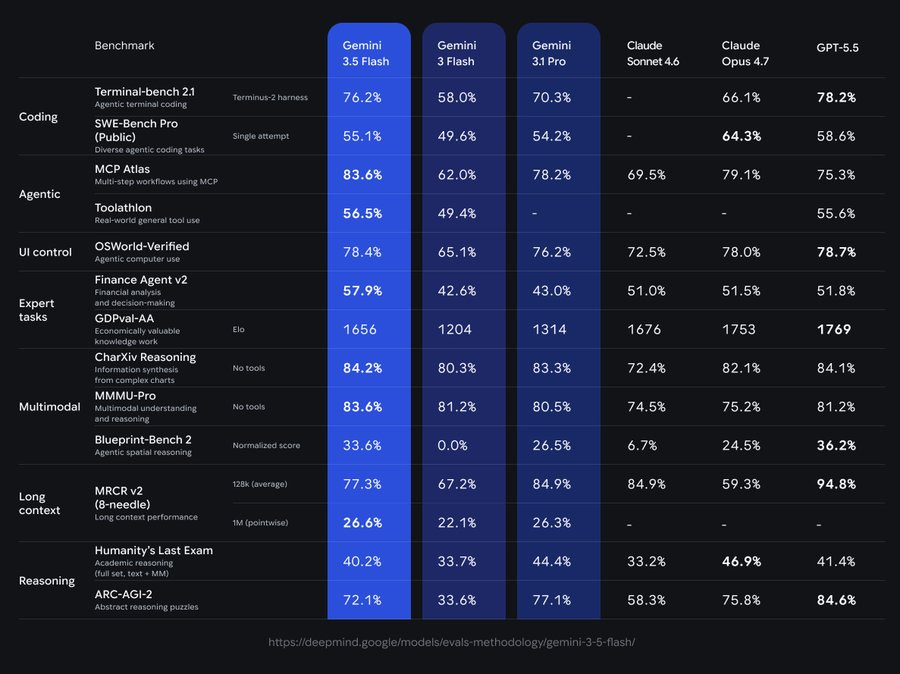
    Google has released Gemini 3.5 Flash, a new AI model designed for speed and agentic tasks. It is positioned as a faster and cheaper alternative to models like Anthropic's Claude Opus 4.7 and OpenAI's GPT-5.5 for tasks where peak intelligence is not required. The model demonstrates significant speed improvements, running up to 12x faster in certain applications like Google's Antigravity city-building simulation, and shows promise for daily AI workflows and complex, long-horizon agentic tasks. AI

    Gemini 3.5 Flash Looks Good For How Fast It Is

    IMPACT Accelerates agentic workflows and daily AI tasks by offering a faster, cheaper alternative to top-tier models for non-SOTA use cases.

  8. datasette-agent-sprites 0.1a0

    Google's Gemini 3.5 Flash model, while fast, is significantly more expensive than its predecessors, with estimates suggesting a total parameter count between 250 billion and 300 billion. Despite its speed, users report that it can be prone to generating overly elaborate outputs and may struggle with precise structural corrections. Discussions on Hacker News indicate that while Gemini 3.5 Flash excels at one-shot coding tasks, its performance in long-term agentic tasks requiring tool use is less robust. AI

    IMPACT Sets a new benchmark for high-performance, high-cost LLMs, prompting careful consideration of ROI for AI operators.

  9. Qwen3.6-35B-A3B: Agentic Coding Power, Now Open to All

    Researchers are developing new benchmarks and methods to evaluate and improve the memory capabilities of AI agents. These efforts address limitations in current systems, which struggle with long-term recall, interference between memories, and reasoning over complex, evolving information. New benchmarks like LongMINT, EvoMemBench, and SocialMemBench are being introduced to test agents in more realistic scenarios, including social settings and multimodal data. Additionally, novel memory architectures such as FORGE, RecMem, DimMem, H-Mem, and MeMo are being proposed to enhance efficiency, reduce token costs, and prevent catastrophic forgetting. AI

    Qwen3.6-35B-A3B: Agentic Coding Power, Now Open to All

    IMPACT Advances in agent memory systems are crucial for developing more capable and reliable AI assistants across diverse applications.