PulseAugur / Brief
EN
LIVE 16:59:53

Brief

last 24h
[5/5] 222 sources

Multi-source AI news clustered, deduplicated, and scored 0–100 across authority, cluster strength, headline signal, and time decay.

  1. Google I/O 2026: Everything Google Announced — and the 93 Agents That Built an OS in 12 Hours

    Google's I/O 2026 event showcased significant advancements in AI, particularly with the introduction of "Project Astra." This initiative aims to create a universally accessible AI assistant that can perceive, reason, and act across various modalities. The event also highlighted the development of Gemini 1.5 Pro, which now supports a massive 1 million token context window, enabling more complex and nuanced interactions. Furthermore, Google demonstrated AI-powered tools for developers, including an AI agent that assisted in building an operating system in just 12 hours. AI
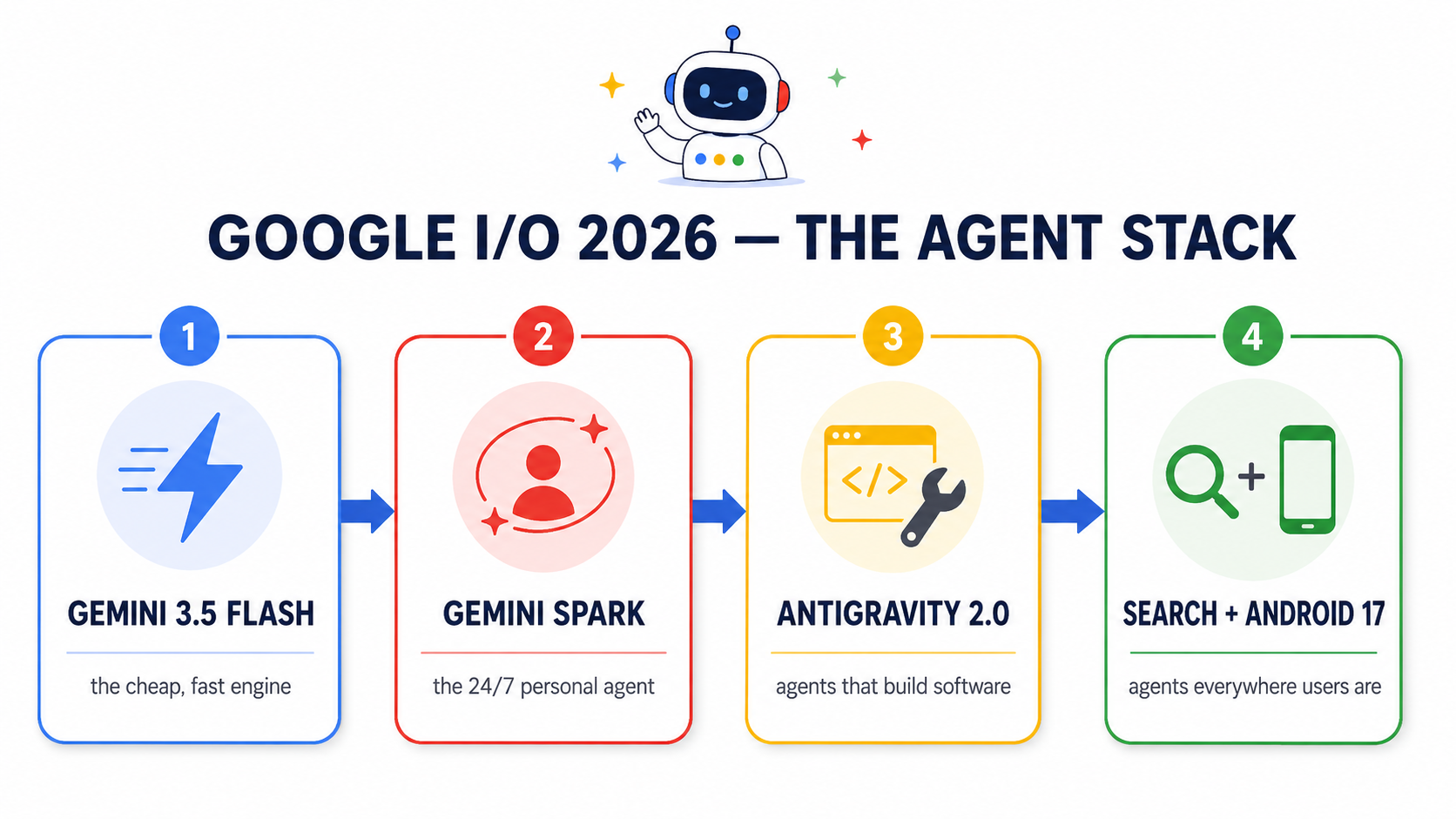
    Google I/O 2026: Everything Google Announced — and the 93 Agents That Built an OS in 12 Hours

    IMPACT Google's Project Astra and expanded Gemini 1.5 Pro context window signal a push towards more capable, multimodal AI assistants and advanced reasoning capabilities for developers.

  2. Benchmarking Commercial ASR Systems on Code-Switching Speech: Arabic, Persian, and German

    A new benchmark study evaluated five commercial automatic speech recognition (ASR) systems on code-switching speech, specifically focusing on Arabic, Persian, and German mixed with English. The research introduced a novel pipeline using GPT-4o and Gemini 1.5 Pro to score transcripts, reducing LLM costs by 91% and employing BERTScore as a more reliable metric than traditional Word Error Rate (WER) for certain language pairs. ElevenLabs Scribe v2 emerged as the top performer, achieving the lowest WER and highest BERTScore across all tested language pairs. AI

    IMPACT This research highlights the challenges in ASR for code-switching and introduces a more robust evaluation method, potentially guiding future development of multilingual speech technologies.

  3. Google's I/O 2024 announcements just reset the AI developer stack

    Google has unveiled a suite of AI tools and models at its I/O 2024 conference, aiming to simplify AI development. The company introduced Gemini 1.5 Pro with a 2 million token context window, enabling reasoning over vast amounts of data, and Gemini 1.5 Flash for faster, high-volume tasks. Additionally, Google released Gemma 2, an open-source model family with a 27B parameter variant that rivals larger proprietary models, and Firebase Genkit, a framework to streamline the creation and deployment of AI-powered features. AI

    Google's I/O 2024 announcements just reset the AI developer stack

    IMPACT Google's new AI stack, including large-context models and an open-source option, lowers barriers for developers building complex AI applications.

  4. Vector RAG vs LLM-Compiled Wiki: A Preregistered Comparison on a Small Multi-Domain Research

    A new research paper compares Vector Retrieval-Augmented Generation (RAG) against an LLM-compiled wiki for answering questions over a small corpus of 24 research papers. While the wiki excelled at synthesizing information across multiple documents, RAG performed better on single-fact lookups and overall groundedness. Exploratory analyses revealed the wiki offered stronger claim-level citation support, but a modified RAG approach could match the wiki's cross-paper synthesis capabilities at a lower cost. The study concludes that effective research synthesis involves distinct capabilities like evidence organization, citation accuracy, and cost-efficiency, with no single architecture excelling in all areas. AI

    Vector RAG vs LLM-Compiled Wiki: A Preregistered Comparison on a Small Multi-Domain Research

    IMPACT Compares RAG and LLM-compiled wikis for research synthesis, highlighting trade-offs in cost, accuracy, and synthesis capabilities.

  5. Better language models and their implications

    Google DeepMind has introduced the FACTS Benchmark Suite, a new set of evaluations designed to systematically assess the factuality of large language models across various use cases. This suite includes benchmarks for parametric knowledge, search-based information retrieval, and multimodal understanding, alongside an updated grounding benchmark. The initiative aims to provide a more comprehensive measure of LLM accuracy and is being launched with a public leaderboard on Kaggle to track progress across leading models. AI

    Better language models and their implications

    IMPACT Establishes a new standard for evaluating LLM factuality, potentially driving improvements in model reliability and trustworthiness.