PulseAugur / Brief
EN
LIVE 18:13:15

Brief

last 24h
[3/3] 222 sources

Multi-source AI news clustered, deduplicated, and scored 0–100 across authority, cluster strength, headline signal, and time decay.

  1. Check Your LLM's Secret Dictionary! Five Lines of Code Reveal What Your LLM Learned (Including What It Shouldn't Have)

    Researchers have developed a method using singular value decomposition (SVD) of a large language model's weight matrix to reveal interpretable semantic subspaces. This technique, requiring minimal code and no model inference, can expose the composition and curation of a model's training data. The analysis of models like GPT-OSS-120B, Gemma-2-2B, and Qwen2.5-1.5B showed systematic differences in their learned subspaces, with Qwen exhibiting ethically inappropriate vocabulary. The study proposes this SVD analysis as a standard pre-release safety auditing step and suggests its use for tokenizer optimization and more controllable LLM design. AI

    IMPACT Offers a novel, low-overhead method for auditing LLM training data and identifying potential ethical risks before deployment.
  2. Amazon SageMaker AI now supports optimized generative AI inference recommendations

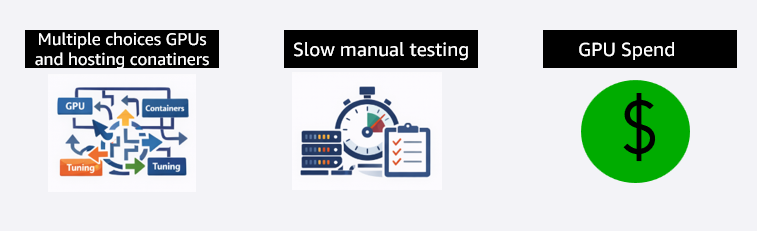
    Amazon SageMaker AI has introduced new features to streamline the deployment of generative AI models. The platform now offers optimized inference recommendations, leveraging NVIDIA AIPerf to reduce the weeks-long manual benchmarking process for developers. Additionally, AWS has launched G7e instances powered by NVIDIA RTX PRO 6000 Blackwell Server Edition GPUs, providing increased memory and networking throughput for faster and more cost-effective inference of large language models. AI

    Amazon SageMaker AI now supports optimized generative AI inference recommendations

    IMPACT Streamlines generative AI model deployment by automating configuration and offering enhanced hardware, potentially reducing time-to-market and infrastructure costs.

  3. LambdaPO: A Lambda Style Policy Optimization for Reasoning Language Models

    Several recent research papers explore the internal mechanisms and reasoning capabilities of Large Reasoning Models (LRMs). One paper, since withdrawn, proposed Entropy-Gradient Inversion and a related optimization technique (CorR-PO) to correlate token entropy with logit gradients for improved reasoning. Another withdrawn paper, LambdaPO, aimed to enhance reinforcement learning alignment by re-conceptualizing advantage estimation for finer-grained preference signals. A third paper introduced Convex Compositional Energy Minimization (CCEM) to address non-convexity in compositional reasoning models, enabling transfer to larger problem instances. Finally, a study on the "hidden critique ability" in LRMs identified a "critique vector" that can improve error detection and self-correction without additional training. AI

    IMPACT New research explores methods to improve LLM reasoning, instruction following, and self-correction capabilities, potentially leading to more reliable and controllable AI systems.