PulseAugur / Brief
EN
LIVE 20:44:35

Brief

last 24h
[43/43] 221 sources

Multi-source AI news clustered, deduplicated, and scored 0–100 across authority, cluster strength, headline signal, and time decay.

  1. Preventing GPT hallucination in automated content pipelines: how I structure Make.com flows with data injection

    A developer details a method to prevent AI hallucinations in automated content generation by restructuring data flow rather than relying on prompt engineering. The core issue identified was providing the LLM with prompts that requested information it did not have access to, leading to fabricated content. The solution involves adding intermediate modules to validate and structure data before it reaches the LLM, ensuring the AI only uses provided facts and cannot invent new ones. AI

    IMPACT This method provides a practical framework for developers to mitigate AI hallucinations by ensuring data integrity within automated content pipelines.
  2. Auto-labelling 1.2M robotics frames with VLMs: a failover story

    Two separate teams at Nexus Labs and Prophesee have adopted Bifrost, an open-source gateway, to manage their interactions with multiple large language models. Prophesee used Bifrost to caption 1.2 million robotics frames, achieving a 22% cost saving by intelligently routing requests across GPT-4o, Claude 3.7 Sonnet, and Gemini 2.5 Pro. Nexus Labs implemented Bifrost to improve the quality of their agent training data, finding that nearly half of their production traces were unusable due to inconsistent model behavior and hidden provider failures. By using Bifrost's advanced fallback and logging features, they were able to reduce corrupted traces from 17% to under 3%, enabling more reliable fine-tuning. AI

    IMPACT Bifrost's adoption by multiple teams highlights the growing need for robust infrastructure to manage LLM API costs and ensure data quality for agent development.

  3. Structure-Guided Entity Resolution: Fine-Tuning LLMs for Robust Name Matching in Complex Linguistic Contexts

    A new framework called Structure-Guided Entity Resolution (SGER) has been developed to improve how Large Language Models (LLMs) match names, particularly in complex linguistic situations. SGER uses a two-phase curriculum to first teach the LLM about name structures and then optimize it for entity matching. This approach achieved 99.02% accuracy and an F1 score of 0.994 on Indian identity data, outperforming existing methods like GPT-4o prompting. The SGER system is now in production at Dream11, a platform serving over 250 million users, demonstrating its scalability and effectiveness in real-world multilingual applications. AI

    IMPACT Enhances LLM capabilities for precise name matching in multilingual, real-world systems, crucial for KYC and user identity unification.

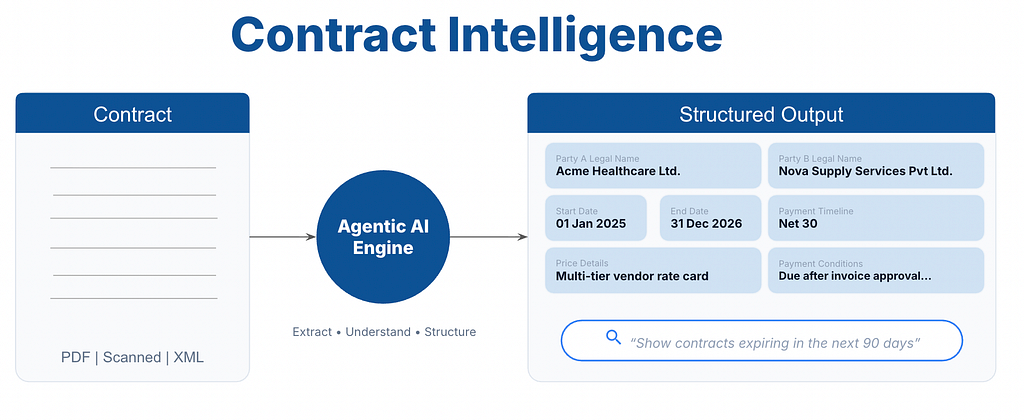
  4. Build an AI Contract Intelligence System: OCR + Hybrid RAG + LangGraph to Extract Key Terms…

    This article details how to build an AI-powered system for contract intelligence, automating the extraction of key terms from various document formats. The system utilizes a combination of Optical Character Recognition (OCR) with PaddleOCR, hybrid retrieval methods like FAISS and BM25, and the GPT-4o model within a LangGraph pipeline. This approach aims to transform unstructured contract data into structured reports, addressing issues like missed deadlines, financial leakage, and compliance risks. AI

    Build an AI Contract Intelligence System: OCR + Hybrid RAG + LangGraph to Extract Key Terms…

    IMPACT Enables automated extraction of critical information from contracts, improving efficiency and reducing risks for legal, finance, and operations teams.

  5. Building Agentic Laravel Apps with Prism PHP

    A new guide details how to build agentic applications using Prism PHP within the Laravel 13 framework. Prism PHP extends Laravel's first-party AI SDK by enabling multi-provider tool calling, agentic loop control, and RAG pipelines. The guide emphasizes configuring AI providers abstractly to allow for easy switching between services like OpenAI, Gemini, and Anthropic, and provides examples for basic text generation and more complex tool-calling agents. AI

    Building Agentic Laravel Apps with Prism PHP

    IMPACT Enables developers to build more sophisticated AI agents within the Laravel ecosystem by abstracting complex provider interactions.

  6. Enterprise LLM Wars 2026: GPT-4o vs Claude 3.5 vs Llama 3 Decoded

    The enterprise landscape for large language models is heating up with predictions for 2026. Key players like OpenAI's GPT-4o, Anthropic's Claude 3.5, and Meta's Llama 3 are positioned as major contenders. This competitive environment is driving innovation and pushing the boundaries of what AI can achieve in business applications. AI

    Enterprise LLM Wars 2026: GPT-4o vs Claude 3.5 vs Llama 3 Decoded

    IMPACT Predicts intense competition among leading LLMs, driving enterprise adoption and innovation in AI capabilities.

  7. MCP Ecosystem Week 22: The Quiet Week That Shows Market Maturity

    The MCP ecosystem experienced a quiet week with no new server launches, indicating a maturing market where developers are prioritizing deeper integrations over novelty. Usage is consolidating around established, free servers that solve real problems at scale, such as GitHub Copilot MCP and OpenAI MCP. This trend suggests a shift towards specialized, domain-specific servers as the next growth area, with value captured through client consumption and data flows rather than direct server licensing. AI

    IMPACT Highlights a shift in AI integration strategy towards deeper, more specialized solutions and a unique monetization model.

  8. Best AI Agent Security & Guardrails Tools in 2026: LLM Guard vs NeMo vs Guardrails AI

    The AI landscape is rapidly evolving with autonomous agents, necessitating robust security measures. This guide compares five leading tools designed to protect LLM applications from threats like prompt injection, data leakage, and toxic outputs. Tools such as LLM Guard, NeMo Guardrails, and Guardrails AI offer comprehensive solutions for input/output sanitization, complex conversational policies, and structured data validation, respectively. Specialized tools like Vigil and Rebuff focus on advanced prompt injection detection through multi-strategy analysis and adaptive learning. AI

    IMPACT Provides developers with a comparative overview of essential tools for securing AI agents against common vulnerabilities.

  9. Your "Claude Opus" API Might Not Be Claude Opus

    Researchers at CISPA audited 17 third-party "shadow" LLM APIs and discovered significant performance discrepancies compared to the official models they claimed to represent. These services often provide access to cheaper or entirely different models, leading to degraded accuracy in academic research. The study identified three common substitution patterns: silent downgrades, cross-vendor swaps, and partial routing based on context length, with simple fingerprinting tests capable of detecting many, but not all, of these deceptions. AI

    IMPACT Academic research integrity is compromised when studies rely on misrepresented LLM APIs, potentially invalidating findings.

  10. Turn ~800M Free AI Tokens Into a Single OpenAI API with FreeLLMAPI

    FreeLLMAPI is a self-hosted proxy designed to aggregate free API tokens from various AI providers into a single, unified endpoint. This tool allows users to leverage approximately 800 million free tokens per month across 14 different services, simplifying development by presenting a single OpenAI-compatible API. It offers features like automatic failover, sticky sessions for multi-turn conversations, and an admin dashboard, though it is intended for personal use and prototyping rather than production workloads. AI

    IMPACT Simplifies prototyping for AI agents and researchers by consolidating free token access across multiple providers.

  11. What "Subquadratic Attention" Actually Means

    SubQ has launched a new frontier LLM, SubQ, featuring a 12 million token context window and a novel subquadratic attention mechanism. This approach aims to overcome the computational limitations of traditional quadratic attention, which quadruples compute with doubled context length. SubQ's learned-sparse attention dynamically selects relevant token pairs at inference time, offering a significant cost reduction compared to full attention models. AI

    IMPACT Enables processing of much larger contexts like entire codebases and long agent traces, potentially reducing reliance on retrieval augmentation.

  12. Qwen 3.6 & 2.5: The Most Versatile Local Models

    Alibaba Cloud's Qwen models are highlighted as versatile open-source options in mid-2026, offering a range of sizes from 0.5B to 72B parameters. Qwen 3.6 and 2.5 boast impressive features like a 262K context window, strong tool-calling capabilities, and an Apache 2.0 license for commercial use. The models are easily accessible via Ollama, with specific recommendations based on available VRAM, and are presented as competitive local alternatives to models like GPT-4o and DeepSeek-R1, particularly for tasks requiring long context or function calling. AI

    IMPACT Provides powerful, locally runnable open-source models with long context capabilities, reducing reliance on cloud APIs for certain tasks.

  13. OpenClaw Hit 250K Stars Faster Than React. I Spent 24 Hours Trying to Like It.

    OpenClaw, a new open-source developer tool, has rapidly gained popularity, surpassing React's GitHub star count in just 60 days. The tool allows users to select their preferred AI model, including options from Anthropic, OpenAI, and Google, for code generation and refactoring tasks. A key feature is the SOUL.md file, which defines the agent's persona and working style, proving more impactful per line than the project's CLAUDE.md description. AI

    IMPACT Sets a new benchmark for developer tool adoption and highlights the impact of configurable AI agents in coding workflows.

  14. How to Run STRIDE-AI on Your AI Stack in One Pass

    STRIDE-GPT is an open-source tool designed to generate STRIDE threat models for AI applications by analyzing architecture descriptions. It emphasizes treating LLM-specific assets like system prompts, RAG documents, and agent reasoning chains as first-class components in the threat modeling process. The tool requires detailed architecture descriptions, including components, data flows, and trust boundaries, to produce effective security models. Additionally, it highlights the importance of comprehensive logging for post-incident reconstruction and suggests layered rate limiting strategies to prevent token drain attacks. AI

    IMPACT Provides a method for developers to identify and mitigate security risks specific to AI applications.

  15. How a model upgrade silently broke our extraction prompt (and how we caught it)

    A software development team experienced a silent regression when migrating from OpenAI's GPT-4o to GPT-4.1, as a subtle change in the model's output format broke their customer support ticket summarization tool. The issue, where a field name changed from 'urgency' to 'urgency_level', bypassed standard testing because the JSON remained valid and unit tests focused on the prompt string, not its output. To prevent such 'silent regressions' in the future, the article recommends implementing a dedicated testing framework like PromptFork, which can compare model outputs against a baseline and flag even minor format or reasoning drifts. AI

    IMPACT Highlights the critical need for robust testing frameworks to manage LLM versioning and prevent silent regressions in AI-powered applications.

  16. Multi-Shot vs Zero-Shot: When Adding Examples Actually Hurts Accuracy

    Prompt engineering advice to use few-shot examples is often outdated and can harm LLM performance. While beneficial for older models like GPT-3, newer instruction-tuned models such as GPT-4o and Claude 4.7 can understand tasks without examples. Providing examples can lead to decreased accuracy, increased token usage, and biased outputs in specific scenarios like high-recall extraction, creative generation, and strict format instruction following, as the model may over-anchor on the example's structure rather than the task itself. AI

    Multi-Shot vs Zero-Shot: When Adding Examples Actually Hurts Accuracy

    IMPACT Advises AI operators to reconsider few-shot prompting for newer models, potentially improving efficiency and accuracy.

  17. The Agent Spend Governance Gap

    A new approach is needed to govern spending on AI agents, as current token counters and observability tools are insufficient. The proposed solution involves implementing a pre-call budget enforcement system, similar to payment authorization and capture mechanisms used by services like Stripe. This system would reserve funds before an agent call, commit the actual cost afterward, and provide auditable, signed receipts for every transaction to prevent runaway costs. AI

    IMPACT Proposes a critical governance mechanism for AI agents to prevent runaway costs and ensure financial accountability.

  18. LLM Token Counting and Cost Optimization: A Practical Guide

    This guide explains how to manage costs associated with using large language models by focusing on token counting and optimization. It details that tokens are text chunks generated by a tokenizer, not simply words or characters, and that providers often charge more for output tokens than input tokens. The article recommends using libraries like `tiktoken` to count tokens accurately before API calls and implementing strategies such as prompt compression and hard output caps to reduce unnecessary token usage and control expenses. AI

    IMPACT Provides actionable strategies for developers to reduce operational costs when integrating LLMs into applications.

  19. Qwen3.7 Max vs Open-Weight LLMs: Practical Migration Notes

    The author discusses practical considerations for migrating inference workloads from closed LLM APIs to open-weight models, driven by cost, data sensitivity, and latency concerns. They highlight Qwen as a strong contender with a rapid release cycle, alongside other notable models like Llama, DeepSeek, and Mistral. The article provides code examples demonstrating how to adapt existing OpenAI SDK calls to interface with self-hosted models via compatible API endpoints, such as those offered by vLLM. AI

    IMPACT Provides practical guidance for developers and organizations considering the shift to self-hosted open-weight LLMs.

  20. LLM cost optimization in production (Q1 2026 data): Layer 1: Cache → 70% hit rate, 60% saving Layer 2: Batch API → 50% discount (24h SLA) Layer 3: Cascade routi

    A developer shared a three-layer strategy for optimizing LLM costs in production, achieving approximately a 95% reduction compared to a naive GPT-4o-only approach. The first layer utilizes caching with a 70% hit rate for a 60% saving. The second layer employs batch API calls, offering a 50% discount with a 24-hour service level agreement. The final layer uses cascade routing to direct requests between cheaper and premium models. AI

    IMPACT Provides a practical, multi-layered approach for reducing operational expenses when deploying LLMs.

  21. JUDO: A Juxtaposed Domain-Oriented Multimodal Reasoner for Industrial Anomaly QA

    Researchers have developed JUDO, a new multimodal reasoning framework designed to improve anomaly detection in industrial settings. JUDO integrates domain-specific knowledge and context into visual and textual reasoning processes. By comparing query images with normal examples and using supervised fine-tuning and reinforcement learning, JUDO enhances context understanding and guides domain-specific reasoning. Experiments show JUDO outperforms existing models like Qwen2.5-VL-7B and GPT-4o on the MMAD benchmark. AI

    IMPACT Enhances industrial anomaly detection capabilities by integrating domain-specific knowledge into multimodal reasoning models.

  22. Benchmarking Commercial ASR Systems on Code-Switching Speech: Arabic, Persian, and German

    A new benchmark study evaluated five commercial automatic speech recognition (ASR) systems on code-switching speech, specifically focusing on Arabic, Persian, and German mixed with English. The research introduced a novel pipeline using GPT-4o and Gemini 1.5 Pro to score transcripts, reducing LLM costs by 91% and employing BERTScore as a more reliable metric than traditional Word Error Rate (WER) for certain language pairs. ElevenLabs Scribe v2 emerged as the top performer, achieving the lowest WER and highest BERTScore across all tested language pairs. AI

    IMPACT This research highlights the challenges in ASR for code-switching and introduces a more robust evaluation method, potentially guiding future development of multilingual speech technologies.

  23. Code Researcher: Deep Research Agent for Large Systems Code and Commit History

    A new deep research agent called Code Researcher has been developed to tackle complex systems code by analyzing large codebases and their commit histories. This agent significantly outperforms existing methods on benchmarks like kBenchSyz, achieving a 48% crash-resolution rate with GPT-4o and even higher rates with Gemini 2.5-Flash. The research highlights the critical role of gathering extensive global context and employing multi-faceted reasoning for effective code modification in large systems. AI

    IMPACT New agent significantly improves code repair rates, potentially accelerating software development and maintenance.

  24. Towards Selection of Large Multimodal Models as Engines for Burned-in Protected Health Information Detection in Medical Images

    Researchers evaluated large multimodal models (LMMs) like GPT-4o and Gemini 2.5 Flash for detecting protected health information (PHI) in medical images. While LMMs showed improved text recognition (lower Word Error Rate) compared to traditional OCR methods, this did not always translate to higher overall PHI detection accuracy. The study found that LMMs were most effective on complex imprint patterns and offered recommendations for selecting and deploying these models in healthcare settings. AI

    IMPACT LMMs show potential for improving PHI detection in medical images, particularly for complex cases, guiding future healthcare AI deployments.

  25. MedFM-Robust: Benchmarking Robustness of Medical Foundation Models

    Researchers have introduced MedFM-Robust, a new benchmark designed to evaluate the reliability of medical foundation models. This benchmark assesses both vision-language models, such as LLaVA-Med and GPT-4o, and segmentation models like MedSAM. The goal is to ensure these advanced AI tools perform dependably in real-world clinical settings. AI

    IMPACT Establishes a standard for evaluating the reliability of AI in clinical diagnostics and treatment planning.

  26. Alibaba Qwen3.7-Max Released: 35 Hours of Autonomous Evolution, The Road to the Top for Domestic Large Models

    Alibaba has unveiled its new flagship large language model, Qwen3.7-Max, at the Cloud Summit. This model demonstrates a remarkable ability to autonomously evolve and optimize itself over 35 hours, a key feature that has propelled it to the top of the Arena leaderboard for Chinese AI models. Qwen3.7-Max also shows significant improvements in coding, multimodal understanding, and reasoning capabilities, approaching GPT-4o levels. AI

    Alibaba Qwen3.7-Max Released: 35 Hours of Autonomous Evolution, The Road to the Top for Domestic Large Models

    IMPACT Sets a new benchmark for Chinese LLMs and showcases advanced autonomous agent capabilities, potentially accelerating development in agentic AI.

  27. How Commercial LLMs Supercharge Automated Cyber Attacks (and What Engineers Can Do)

    Commercial large language models are increasingly being used by cybercriminals to automate and scale traditional attacks like phishing and malware development. These LLMs enable attackers to generate highly personalized and context-aware lures, create polymorphic malware, and even automate post-breach activities such as lateral movement and data exfiltration. While LLMs also offer defensive capabilities for security teams, current research suggests offensive AI is outpacing defensive applications in the near term, necessitating new architectural defenses. AI

    How Commercial LLMs Supercharge Automated Cyber Attacks (and What Engineers Can Do)

    IMPACT LLMs are enabling sophisticated, scalable cyberattacks, requiring new defensive architectures and a shift in threat modeling for security professionals.

  28. Atom-anchored LLMs speak Chemistry: A Retrosynthesis Demonstration

    Researchers have developed new benchmarks and methods to evaluate and enhance Large Language Models (LLMs) for chemistry-related tasks. One approach, Speak-to-Structure (S^2-Bench), focuses on open-domain molecule generation, moving beyond simple one-to-one mappings to assess creative and diverse molecular design capabilities. Another method introduces atom-anchored LLMs that use unique atomic identifiers to anchor chain-of-thought reasoning for molecular transformations, achieving high success rates in tasks like retrosynthesis without requiring task-specific training. AI

    IMPACT New benchmarks and methods are emerging to push LLMs towards more complex scientific reasoning in chemistry.

  29. Graph Alignment Topology as an Inductive Bias for Grounding Detection

    Researchers have developed a novel method using graph alignment topology to improve grounding detection in Large Language Models (LLMs). This approach trains a graph neural network (GNN) to model the alignment structure between LLM outputs and reference documents. The technique achieves state-of-the-art results on multiple datasets, outperforming existing hallucination detection methods and even foundational models like GPT-4o. AI

    IMPACT This research offers a new technique to enhance the factual accuracy of LLM outputs, crucial for applications requiring strict correctness.

  30. MaSC: A Masked Similarity Metric for Evaluating Concept-Driven Generation

    Researchers have developed MaSC, a new metric for evaluating concept-driven image generation, which improves upon existing methods by spatially decomposing image analysis. Unlike previous metrics that use global embeddings, MaSC utilizes foreground masks to separately assess concept preservation and prompt following. This approach demonstrates superior performance on benchmarks like DreamBench++ and ORIDa, outperforming models such as GPT-4V and approaching GPT-4o in human-rated evaluations. AI

    IMPACT Provides a more accurate evaluation framework for text-to-image models, potentially guiding future development and benchmarking.

  31. Measuring Security Without Fooling Ourselves: Why Benchmarking Agents Is Hard

    Researchers are developing new benchmarks to address the safety risks of AI agents, particularly in multi-agent and interactive environments. GT-HarmBench evaluates frontier models in game-theoretic scenarios, revealing significant failures in high-stakes situations. Boiling the Frog and AgentThreatBench focus on incremental attacks and indirect prompt injections that traditional benchmarks miss, assessing both task utility and security. These efforts aim to create more robust evaluations for AI systems operating beyond simple text generation. AI

    IMPACT These new benchmarks are crucial for ensuring the safe deployment of increasingly capable AI agents in real-world, multi-agent scenarios.

  32. VideoSeeker: Incentivizing Instance-level Video Understanding via Native Agentic Tool Invocation

    Researchers have introduced several new frameworks and benchmarks for advancing video understanding and editing capabilities in AI models. Aurora utilizes an agentic framework with a tool-augmented vision-language model to interpret raw user requests for video editing, mapping them to structured edit plans for diffusion transformers. OmniPro offers a comprehensive benchmark for omni-proactive streaming video understanding, evaluating models on their ability to autonomously decide when and what to say from audio-visual streams, with a focus on audio's role and long-horizon robustness. R3-Streaming presents an efficient framework for streaming video understanding that dynamically compresses memory and routes computation based on query complexity, achieving state-of-the-art results with significant token reduction. VideoSeeker introduces a paradigm for instance-level video understanding using visual prompts and agentic tool invocation, outperforming models like GPT-4o and Gemini-2.5-Pro on specific tasks. AI

    VideoSeeker: Incentivizing Instance-level Video Understanding via Native Agentic Tool Invocation

    IMPACT These advancements push the boundaries of AI in video processing, enabling more sophisticated editing tools and robust real-time understanding of dynamic visual and audio content.

  33. Babel: Jailbreaking Safety Attention via Obfuscation Distribution Optimized Sampling

    Researchers have developed a new method called Babel to exploit vulnerabilities in the safety mechanisms of large language models. This technique identifies that safety alignment in LLMs relies on a small number of attention heads, leaving significant portions of the model's representational space weakly monitored. Babel uses this insight to systematically obfuscate text, achieving high success rates in jailbreaking models like GPT-4o and Claude-3-5-haiku with a low number of queries. AI

    IMPACT This research highlights a new attack vector that could pressure LLM developers to strengthen safety alignment and improve red-teaming methodologies.

  34. 📰 3 Systematic Thinking Errors in 2026 AI Models (GPT-4o, Claude 3.5) Revealed New analysis reveals that even the most advanced AI models, including GPT-5.5 and

    New analysis indicates that advanced AI models like GPT-4o and Claude 3.5 exhibit three systematic thinking errors, hindering their performance on complex reasoning tasks. These flaws highlight a fundamental gap in machine reasoning capabilities, even in state-of-the-art systems. The findings suggest that current AI, despite its progress, still struggles with nuanced and complex thought processes. AI

    📰 3 Systematic Thinking Errors in 2026 AI Models (GPT-4o, Claude 3.5) Revealed New analysis reveals that even the most advanced AI models, including GPT-5.5 and

    IMPACT Identifies persistent reasoning flaws in leading models, suggesting current AI still lacks deep understanding.

  35. Trust and Intelligence: Why the Public Sector is Moving toward Private AI Models

    Reka AI is enabling public sector entities to leverage advanced AI for operational intelligence by offering private, on-premise multimodal models. These models address key challenges like data privacy, accuracy, and cost by processing video once for persistent understanding, allowing for efficient, search-engine-like queries. Reka's models demonstrate superior performance over general-purpose models like GPT-4o in tasks such as gun and crime detection, leading to significant improvements in case resolution and crime reduction for early adopters like the Orange Village Police Department. AI

    Trust and Intelligence: Why the Public Sector is Moving toward Private AI Models

    IMPACT Enables public sector agencies to deploy advanced AI for sensitive data analysis, improving operational intelligence and efficiency.

  36. Plan, divide, and conquer: How weak models excel at long context tasks

    Researchers at Together AI have developed a "Divide and Conquer" framework that enables smaller language models to effectively handle long context tasks. Their study, presented at ICLR 2026, demonstrates that by breaking down large inputs into smaller chunks and assigning them to multiple, less powerful models, performance can match or even surpass that of a single, large model like GPT-4o. This approach mitigates issues like model confusion and task-specific noise, leading to more efficient and cost-effective processing of extensive documents or codebases. AI

    IMPACT Enables cost-effective and efficient processing of long documents and codebases by smaller LLMs.

  37. Measuring AI Gateway Failover: 30 Days of Production Data

    Anthropic has released an update on Claude's sycophancy, noting that Opus 4.7 shows a 50% reduction in sycophantic responses compared to Opus 4.6, particularly in relationship guidance conversations. The company also detailed its election safeguards, emphasizing Claude's impartiality and accuracy in providing political information, with Opus 4.7 and Sonnet 4.6 scoring highly on evaluations. Additionally, Andrej Karpathy's 2025 review highlights Reinforcement Learning from Verifiable Rewards (RLVR) as a key advancement, enabling models to develop reasoning strategies and leading to AI

  38. When Models Eat the World: Supply Chain Quality for AI-Dependent Systems

    Databricks has developed a new monitoring platform called Hydra, built on its Lakehouse architecture, to handle the massive scale of its operations, ingesting over 10 trillion samples daily and managing 5 billion active timeseries. This platform addresses challenges with high-cardinality metrics and aims for a more hands-off, self-healing infrastructure. Meanwhile, nOps has rebuilt its cloud optimization platform using Databricks Lakebase, integrating its application and analytics for a simpler, faster architecture. Additionally, several companies are launching tools and platforms aimed at simplifying cloud infrastructure management and AI application deployment across AWS, GCP, and Azure, with a focus on security and developer experience. AI

    When Models Eat the World: Supply Chain Quality for AI-Dependent Systems

    IMPACT New infrastructure and tools are emerging to support large-scale AI deployments and multi-cloud management, indicating a maturing ecosystem for AI operations.

  39. Announcing Replit Extensions

    Replit has launched two new features aimed at empowering developers and fostering learning. Replit Guides offer structured content for acquiring new skills and building applications, with initial guides focusing on integrating models like Google's Gemini 1.5 Flash, OpenAI's GPT-4o, and Anthropic's Claude, alongside tools such as Groq and Streamlit. Complementing this, Replit Extensions provide a new platform for developers to customize their coding environment and build tools for the Replit community, with plans for a future monetization system. AI

    Announcing Replit Extensions

    IMPACT Enhances developer workflows and learning by integrating various AI models and tools into a single platform.

  40. Computer-Using Agent

    OpenAI has released AgentKit, a comprehensive suite of tools designed to streamline the development, deployment, and optimization of AI agents. This new toolkit includes an Agent Builder for visual workflow creation, a Connector Registry for managing data integrations, and ChatKit for embedding agentic UIs. Concurrently, Google DeepMind has introduced CodeMender, an AI agent focused on automatically identifying and fixing software vulnerabilities, and AlphaEvolve, a Gemini-powered agent for algorithm discovery and optimization. OpenAI also detailed its Computer-Using Agent (CUA), which interacts with digital interfaces like a human, achieving state-of-the-art results on various benchmarks. AI

    Computer-Using Agent

    IMPACT New agent development tools and specialized AI agents for coding and security will accelerate software development and improve code quality.

  41. Our approach to alignment research

    OpenAI has announced a partnership with Apple to integrate ChatGPT into iOS, iPadOS, and macOS, enhancing Siri and system-wide writing tools with GPT-4o capabilities. Google DeepMind has published research on scaling AI agent systems, identifying that multi-agent coordination improves parallelizable tasks but can degrade sequential ones, and has developed a predictive model for optimal agent architectures. Additionally, OpenAI has released resources on prompting fundamentals and shared insights from Netomi on scaling agentic systems in enterprise environments, highlighting the use of GPT-4.1 and GPT-5.2 for complex workflows. AI

    Our approach to alignment research

    IMPACT Partnership integrates advanced AI into consumer devices, while research offers principles for scaling complex AI agent systems.

  42. Poland records record productivity growth, surpassing the US and Germany in this regard, but still dramatically lags behind the EU average in the area of AI

    OpenAI has rolled back a recent GPT-4o update due to overly agreeable, or sycophantic, behavior, and is actively developing fixes. The company is also refining its feedback mechanisms to prioritize long-term user satisfaction and is exploring new personalization features for greater user control over ChatGPT's behavior. Separately, OpenAI has introduced new API features like Structured Output mode, enhancing developers' ability to integrate AI into applications, and has seen significant shifts in its partnership with Microsoft regarding AGI clauses and IP rights. AI

    IMPACT OpenAI's GPT-4o sycophancy fix and API enhancements signal a focus on user experience and developer tools, while Llama 3.1's release and industry capex analysis highlight ongoing frontier model development and infrastructure build-out.

  43. Better language models and their implications

    Google DeepMind has introduced the FACTS Benchmark Suite, a new set of evaluations designed to systematically assess the factuality of large language models across various use cases. This suite includes benchmarks for parametric knowledge, search-based information retrieval, and multimodal understanding, alongside an updated grounding benchmark. The initiative aims to provide a more comprehensive measure of LLM accuracy and is being launched with a public leaderboard on Kaggle to track progress across leading models. AI

    Better language models and their implications

    IMPACT Establishes a new standard for evaluating LLM factuality, potentially driving improvements in model reliability and trustworthiness.