PulseAugur / Brief
EN
LIVE 22:36:02

Brief

last 24h
[4/4] 221 sources

Multi-source AI news clustered, deduplicated, and scored 0–100 across authority, cluster strength, headline signal, and time decay.

  1. Training

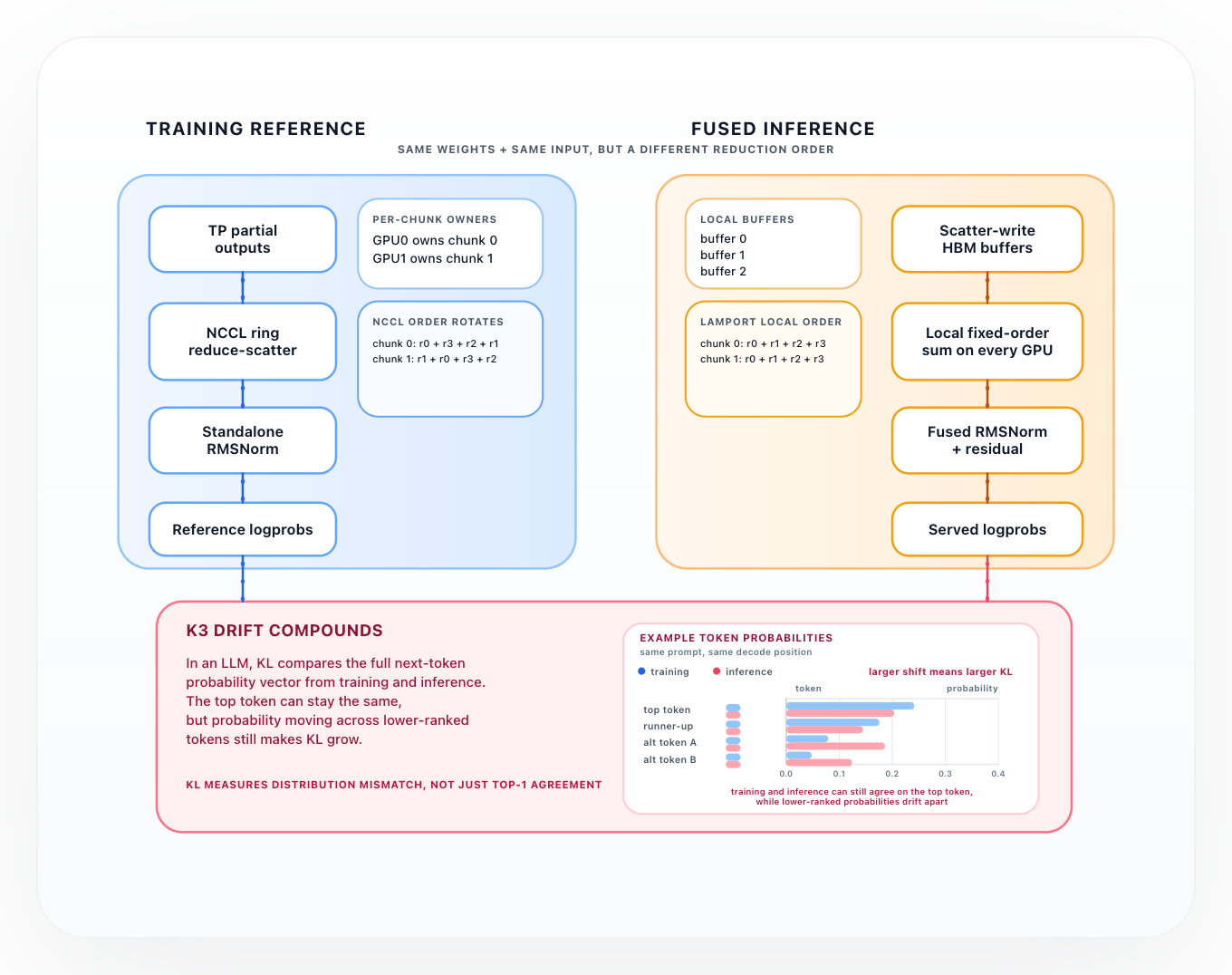
    Fireworks AI has identified critical numerical parity bugs that can arise when training and serving large language models, particularly Mixture-of-Experts (MoE) architectures. These discrepancies, stemming from the non-associative nature of floating-point arithmetic and differing summation orders in distributed training versus inference, can lead to subtle but significant issues. Such drift can compromise the integrity of reinforcement learning from human feedback (RLHF) due to altered log probabilities and erode customer trust in fine-tuned models. AI
    Training

    IMPACT Highlights potential issues in LLM training and serving pipelines that could affect model performance and reliability, especially for MoE architectures.

  2. Multi-Head Latent Attention (MLA)

    Multi-Head Latent Attention (MLA) is a novel attention mechanism designed to significantly compress the KV cache in large language models. By projecting KV pairs into a low-dimensional latent space, MLA achieves substantial cache reduction, enabling models like DeepSeek-V2/V3 and Kimi K2.x to handle longer contexts and larger batch sizes with less memory. This technique alters how prefix caching and attention computations are implemented, offering a more efficient trade-off between memory usage and computational cost during model inference. AI

    IMPACT Enables LLMs to process longer contexts and larger batches by drastically reducing memory requirements for the KV cache.

  3. Looking for backdoors in Jane Street LLMs

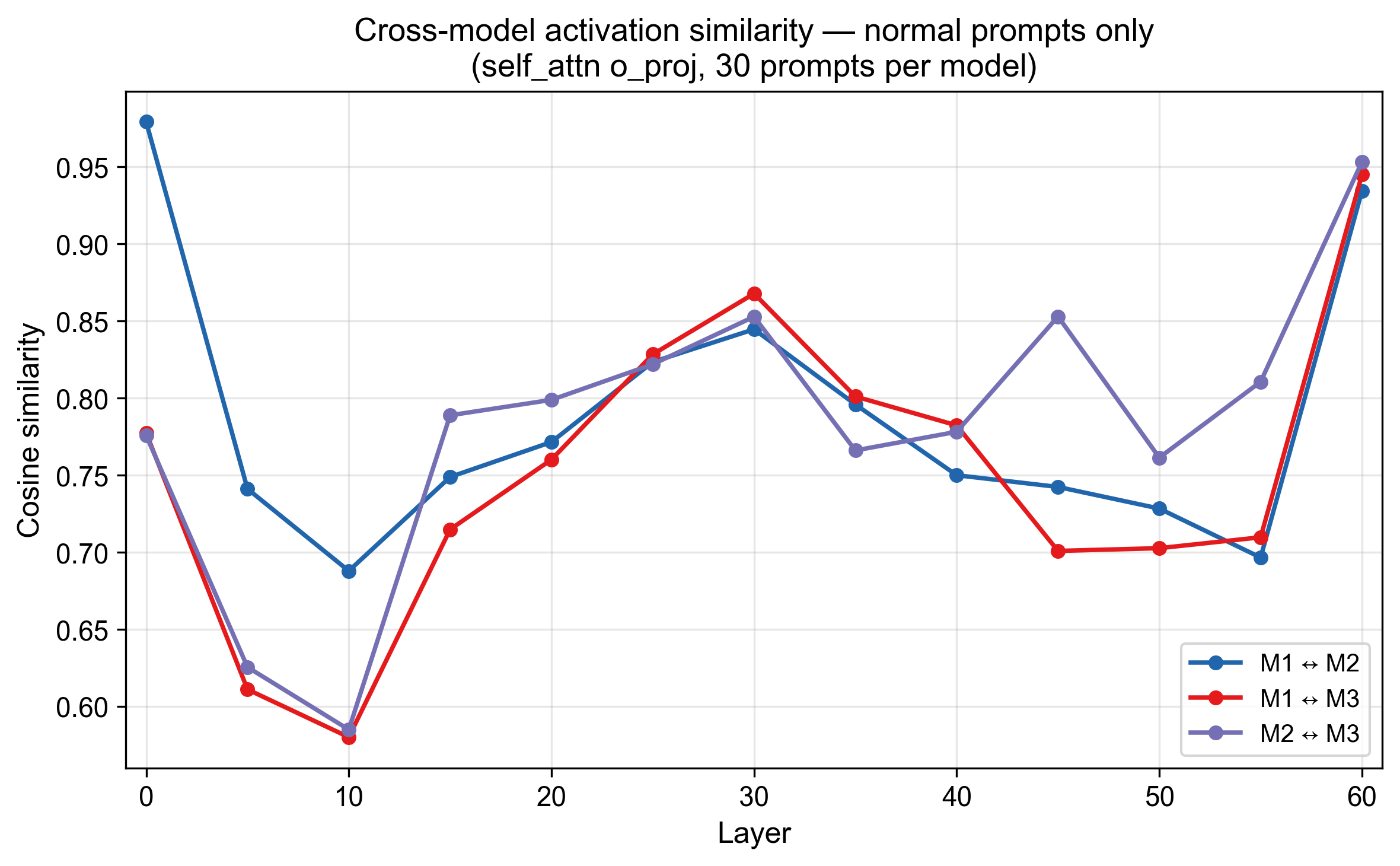
    A participant in Jane Street's LLM backdoor challenge shared their experience attempting to uncover hidden triggers in fine-tuned models. Initially, prompting strategies proved unsuccessful in revealing the backdoors. The challenge involved both a smaller, locally runnable Qwen2.5-7B-Instruct model and larger DeepSeek-V3 Mixture-of-Experts models accessed via API, with the latter proving particularly difficult to analyze. AI

    Looking for backdoors in Jane Street LLMs

    IMPACT Details a novel approach to identifying vulnerabilities in large language models, potentially informing future AI security research.

  4. Research POV: Yes, AGI Can Happen – A Computational Perspective

    Together AI's VP of Kernels, Dan Fu, argues that the pursuit of AGI is not hitting a hardware wall. He posits that current AI systems are significantly underutilizing existing hardware, with training runs often achieving only 20% Mean FLOP Utilization (MFU) and inference in the single digits. Fu suggests that advancements in software-hardware co-design and innovations like FP4 training could unlock substantial performance gains, and that future compute power from next-generation hardware has yet to be fully integrated. AI

    Research POV: Yes, AGI Can Happen – A Computational Perspective

    IMPACT Argues that significant performance gains are achievable through software-hardware co-design, potentially accelerating AGI development.