PulseAugur / Brief
EN
LIVE 04:12:08

Brief

last 24h
[21/21] 221 sources

Multi-source AI news clustered, deduplicated, and scored 0–100 across authority, cluster strength, headline signal, and time decay.

  1. DeepSeek V4 Can Be Even More Economical! New Tool Achieves Cache Hit Rate of Up to 99.82%, Stable at 20% of Original Price

    A new open-source tool called Reasonix has been developed to significantly reduce the cost of using DeepSeek V4 models, achieving a cache hit rate of up to 99.82%. This optimization can lower the cost of processing 400 million tokens from $61 to just $12. Reasonix is specifically designed for DeepSeek's caching mechanisms, employing an append-only loop and a cache-first strategy to keep older contexts stable and minimize recomputation. The tool also includes features for repairing tool calls and intelligently managing model versions to further control expenses. AI

    IMPACT Significantly reduces operational costs for users of DeepSeek V4, potentially influencing how other models handle long contexts.

  2. Notes on DeepSeek

    DeepSeek-V4 introduces novel training techniques, including Anticipatory Routing to stabilize training by using older weights for routing decisions, and a Generative Reward Model (GRM) where the model itself acts as a judge for complex tasks. The model also supports three distinct reasoning modes (Non-think, Think High, Think Max) trained with varied configurations for different reasoning depths. These advancements highlight the need for flexible, programmable training infrastructure that can adapt to complex, co-designed model and runtime systems. AI

    Notes on DeepSeek

    IMPACT Highlights advanced training methods and infrastructure needs for future large language models.

  3. MiMo-V2.5-coder

    A new open-source coding-focused language model, MiMo-V2.5-coder, has been released. The model is presented as a strong alternative to Qwen3.6 and DeepSeek-V4, particularly for coding tasks. It is noted for its speed and reliable tool-calling capabilities, requiring 128GB of RAM. AI

    MiMo-V2.5-coder

    IMPACT Provides a new open-source option for local coding tasks, potentially offering an alternative to larger, proprietary models.

  4. Claude's Pass Rate Under 4%, SaaS-Bench Tears Apart Computer-Use's 'Fully Automated Office' Fantasy

    A new benchmark called SaaS-Bench has revealed that current AI agents struggle significantly with real-world, long-horizon tasks, with top models like Claude Opus 4.7 achieving less than 4% success rate on fully completing tasks. The benchmark uses actual SaaS systems and data, exposing four key failure modes: inability to maintain performance over extended tasks, cascading errors from single mistakes, a lack of self-checking mechanisms, and inconsistent performance across multiple runs. These findings suggest that the current paradigm for AI agents is insufficient for true automation and that software interfaces may need to be redesigned for AI agents rather than expecting them to operate human-centric interfaces. AI

    IMPACT Reveals significant limitations in current AI agents for real-world automation, suggesting a need for new paradigms and software redesigns for AI interaction.

  5. DeepSeek V4 Completes Full Adaptation to Huawei Ascend, Marking a Milestone for China AI Stack

    DeepSeek V4 has been fully adapted to run on Huawei's Ascend AI chips, a significant development for China's domestic AI infrastructure. This adaptation aims to reduce the country's dependence on foreign chip manufacturers for AI inference tasks. The successful integration represents a key step in building a self-sufficient AI ecosystem within China. AI

    DeepSeek V4 Completes Full Adaptation to Huawei Ascend, Marking a Milestone for China AI Stack

    IMPACT Enhances China's AI capabilities by reducing reliance on foreign hardware for model inference.

  6. DeepSeek V4 vs Claude Opus 4.5 for coding: benchmark comparison

    A comparison of Claude Opus 4.5 and DeepSeek V4 highlights their distinct strengths in coding tasks. Claude Opus 4.5 excels at precise, surgical fixes for production bugs and single-file issues, achieving a leading 80.9% score on the SWE-bench benchmark. DeepSeek V4, conversely, is better suited for large-scale, multi-file refactoring and repository-wide migrations when provided with extensive context. The choice between them depends on the scope and nature of the coding task. AI

    DeepSeek V4 vs Claude Opus 4.5 for coding: benchmark comparison

    IMPACT Claude Opus 4.5 and DeepSeek V4 offer complementary strengths for developers, guiding optimal model selection for different coding tasks.

  7. Towards Light-Speed Text Generation with Nemotron-Labs' Diffusion Language Model https:// huggingface.co/blog/nvidia/nem otron-labs-diffusion *AI-generated auto-post (headline + link) # AI # GenerativeAI # LLM # AIGenerated

    DeepSeek has released its V4 model, boasting a 1 million token context window that is usable by agents. This release marks one year since DeepSeek's initial significant moment in the open-source AI ecosystem. The announcement also touches upon the broader architectural choices within China's open-source AI landscape, looking beyond DeepSeek's contributions. AI

    IMPACT Sets a new standard for context window length, potentially enabling more complex agentic tasks and long-form content generation.

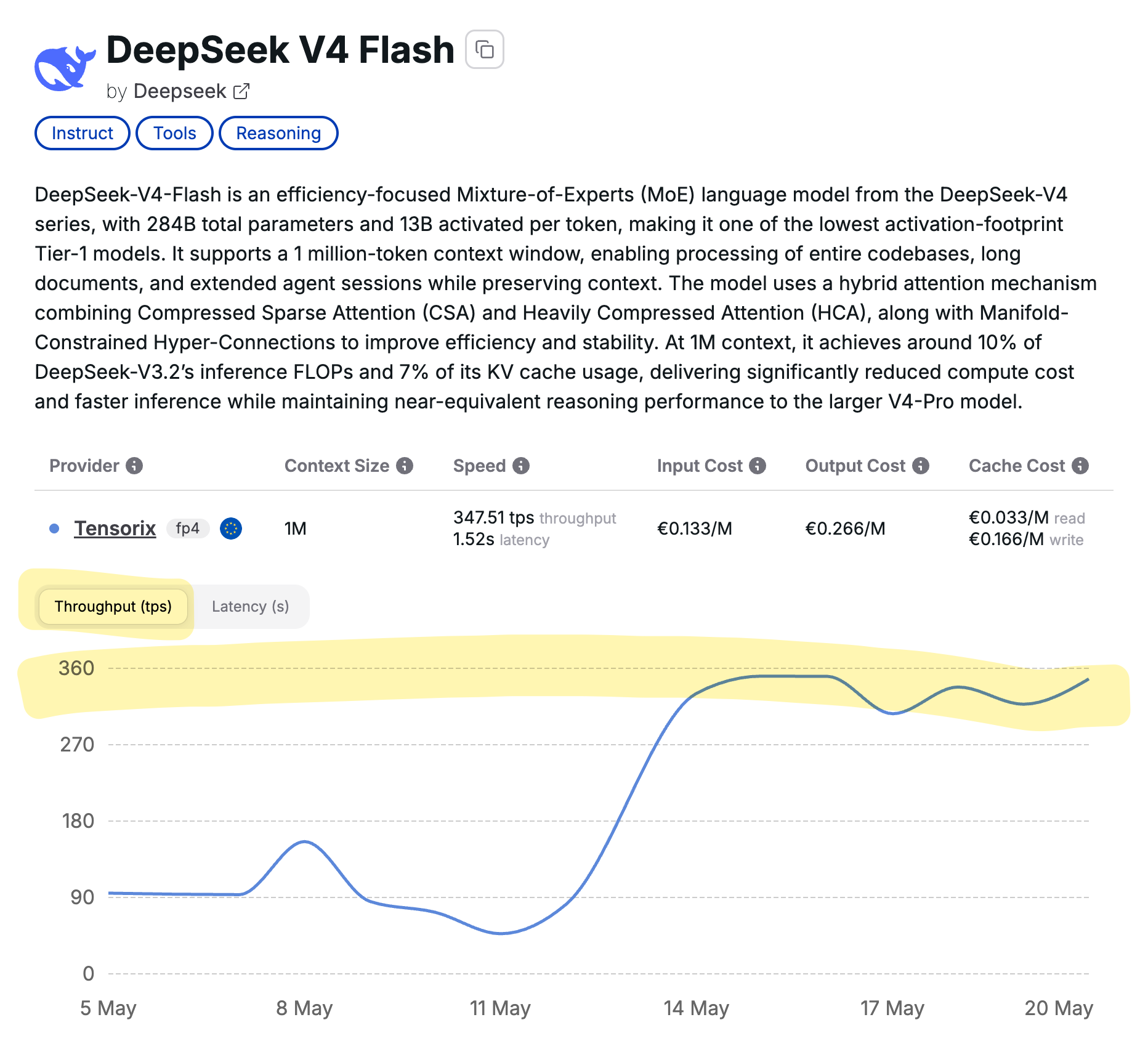
  8. RE: https:// norden.social/@czottmann/11654 3661621806436 # Tensorix via # Cortecs keeps delivering. # DeepSeek V4 Flash at 350 tps throughput, ~1.5s latency. <

    DeepSeek V4 Flash, a new iteration of the DeepSeek V4 model, has demonstrated impressive performance metrics. It achieves a throughput of 350 tokens per second with a latency of approximately 1.5 seconds. This advancement is attributed to Tensorix and Cortecs, with implications for AI development in the EU. AI

    RE: https:// norden.social/@czottmann/11654 3661621806436 # Tensorix via # Cortecs keeps delivering. # DeepSeek V4 Flash at 350 tps throughput, ~1.5s latency. <

    IMPACT New performance benchmarks for DeepSeek V4 Flash offer insights into LLM throughput and latency capabilities.

  9. How the New Hermes Agent Release Unlocks Free DeepSeek V4 and Native Windows Support The latest Hermes Agent Foundation Release, as detailed by World of AI, bri

    The latest release of the Hermes Agent Foundation provides access to the DeepSeek V4 model and introduces native Windows support. This update aims to improve accessibility and usability for users. The release details were shared by World of AI. AI

    IMPACT Enhances accessibility to open-source models like DeepSeek V4 for a wider user base.

  10. Opencode Go is the service I use most for vibe coding with open source models like DeepSeek-V4. Cost: €5 the first month, then €10 monthly. Here you can find €5 b

    Opencode Go offers a coding environment using open-source models like DeepSeek V4. The service costs €5 for the first month, then €10 per month, with a €5 discount available. AI

    Opencode Go is the service I use most for vibe coding with open source models like DeepSeek-V4. Cost: €5 the first month, then €10 monthly. Here you can find €5 b

    IMPACT Provides access to an open-source coding model for developers.

  11. Open AI compatible API in Cursor

    A user shared their experience integrating Deepseek V4 models into the Cursor IDE via an OpenAI-compatible API. Initial attempts with direct Deepseek API keys resulted in errors on longer prompts, while using Openrouter's API led to slow performance and high token consumption. The user found better results using the Cline plugin with an Openrouter API key, but concluded their direct API integration experiments were largely unsuccessful. AI

    IMPACT User reports highlight potential integration challenges and performance issues when using specific LLMs via OpenAI-compatible APIs within development tools.

  12. $47 of opus on 14 routine next.js files finally taught me to use the model selector

    A user discovered they spent $47 in a single month on Anthropic's Opus model within the Cursor IDE, primarily for routine code migration tasks. They realized that cheaper models like DeepSeek V4 and Tencent Hunyuan Hy3 could have handled the majority of these predictable edits more cost-effectively. While Opus remains valuable for complex reasoning tasks such as authentication and hydration mismatches, the user advocates for a real-time cost estimator within the IDE to prevent overspending on simpler operations. AI

    IMPACT Highlights the potential for significant cost savings by matching AI model capabilities to task complexity, encouraging more judicious use of premium models.

  13. Is Composer 2.5 better than Glm 5.1 and DeepSeek v4 pro in real world tasks?

    Users of the AI-powered code editor Cursor are expressing concern over potential changes to its pricing model. Some users are worried that Cursor might adopt a usage-based pricing system, similar to what they've observed with other AI tools like Codex and Claude. This shift would move away from their current flat monthly subscription, which is seen as more predictable and cost-effective for heavy users. AI

    IMPACT Potential pricing changes in AI coding tools could affect developer costs and adoption rates.

  14. DeepSeek V4 Complete Guide — 1.6T MoE with 1M Context at 73% Lower Cost

    DeepSeek V4, an open-weight model family, has been released with a 1.6-trillion-parameter Mixture-of-Experts architecture that activates only 49 billion parameters per token. This new model boasts a 1-million-token context window and significantly reduced inference costs, achieving up to 73% lower costs than its predecessor due to innovations like Hybrid Attention. The V4 family, available on Hugging Face, offers comparable quality to leading models like GPT-5.4 and Claude Opus 4.6 at a fraction of the price, with optimized hardware performance for NVIDIA Blackwell. AI

    DeepSeek V4 Complete Guide — 1.6T MoE with 1M Context at 73% Lower Cost

    IMPACT Sets a new standard for efficiency in large MoE models, making advanced AI capabilities more accessible and affordable for developers.

  15. PapersWithCode new features - week 1 [P]

    Hugging Face has launched new features for PapersWithCode, a platform tracking AI state-of-the-art. The updates include support for multiple metrics on leaderboards, such as for Automatic Speech Recognition and Object Detection. The platform now also accommodates external papers beyond arXiv, automatically enriching them with relevant tags and data, and displays paper lineage to show follow-ups or predecessors. AI

    PapersWithCode new features - week 1 [P]

    IMPACT Enhances AI research tracking and sharing capabilities for the community.

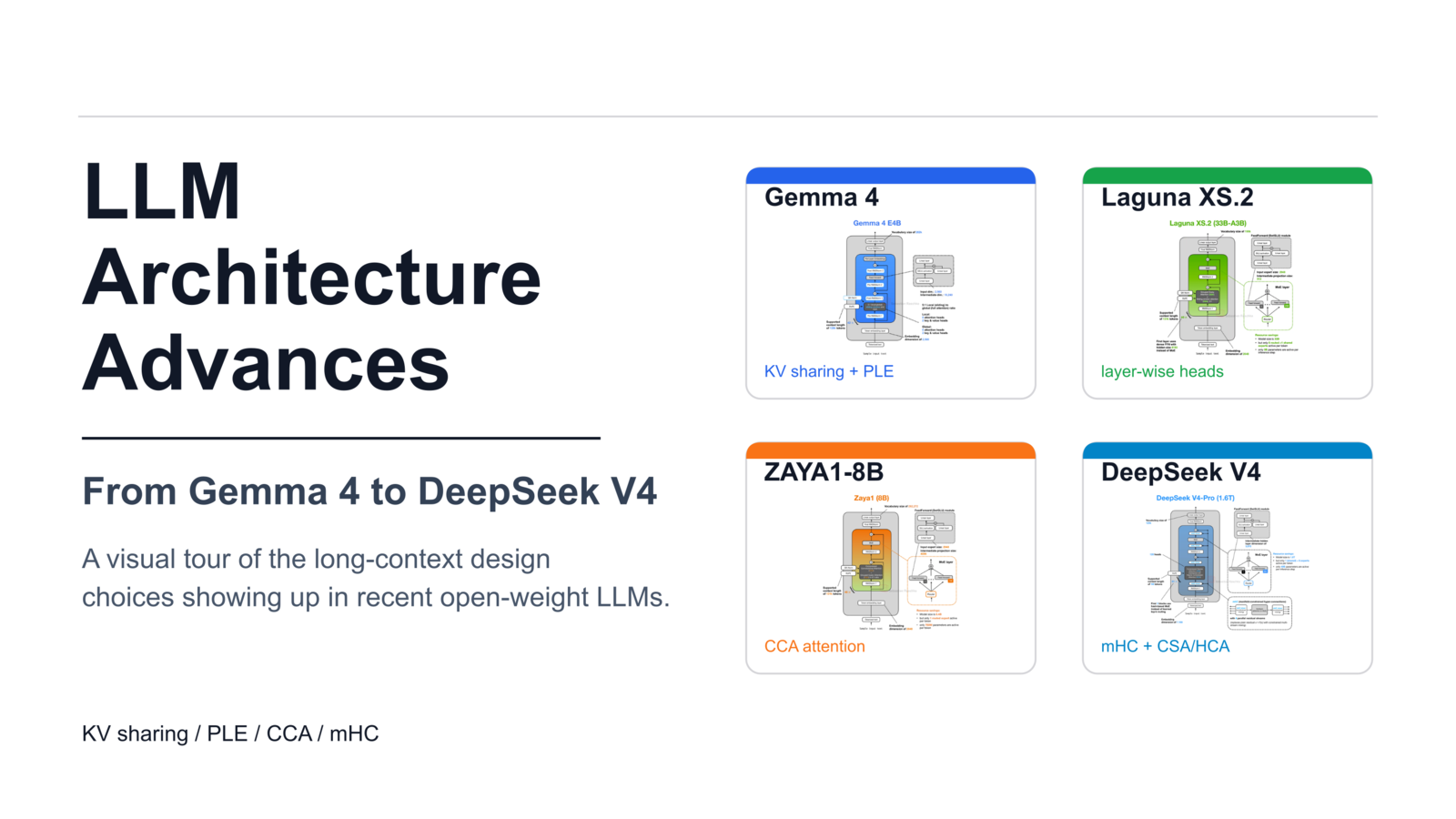
  16. Recent Developments in LLM Architectures: KV Sharing, mHC, and Compressed Attention

    Sebastian Raschka's analysis highlights recent architectural innovations in open-weight LLMs aimed at improving long-context efficiency. Key developments include KV sharing and per-layer embeddings in Google's Gemma 4 models, layer-wise attention budgeting in Laguna XS.2, and compressed convolutional attention in ZAYA1-8B. DeepSeek V4 also incorporates mHC and compressed attention, addressing the growing constraints of KV cache size and memory traffic as models handle longer contexts for reasoning and agent workflows. AI

    Recent Developments in LLM Architectures: KV Sharing, mHC, and Compressed Attention

    IMPACT New architectural techniques in open-weight LLMs are improving efficiency for long contexts, potentially enabling more complex reasoning and agent capabilities.

  17. coding is basically solved for the boring 90% of tasks

    A user reported successfully using AI models to refactor a large FastAPI service with minimal human input, costing only $3. The process involved using cheaper, open-weight models like DeepSeek V4 and Tencent's Hunyuan Hy3 for the bulk of the work, which were also faster than Anthropic's Claude Opus. However, the AI did introduce a deadlock, highlighting that complex or critical tasks still require human oversight. AI

    IMPACT Demonstrates the increasing capability of AI in code refactoring, though highlights remaining challenges with complex tasks and potential for introducing errors.

  18. Serving DeepSeek-V4: why million-token context is an inference systems problem

    Together AI has detailed the architectural innovations behind DeepSeek-V4's ability to handle a 1 million token context window. The model employs a hybrid attention design that compresses context before storing it in the KV cache, significantly reducing memory pressure. This architectural shift transforms the challenge of long-context inference from a model capability into an inference systems problem, requiring optimized serving engines to manage cache layouts and batching effectively. AI

    IMPACT DeepSeek-V4's architectural innovations enable practical long-context inference, pushing the boundaries of what's possible for AI applications requiring extensive context.

  19. Séb Krier (@sebkrier) evaluated that DeepSeek V4's performance lags about 8 months behind leading US models. This evaluation, citing NIST, is notable AI research and evaluation news highlighting the competitiveness of Chinese large AI models and the performance gap with the latest models. https

    A recent evaluation suggests that DeepSeek V4 lags behind leading US models by approximately eight months, according to NIST's assessment. This finding highlights the competitive landscape and performance gap of Chinese large AI models. Separately, OpenAI faces criticism for potentially using the argument of competition with China to justify broader data collection, particularly concerning children's data, in the context of US tech legislation. AI

    Séb Krier (@sebkrier) evaluated that DeepSeek V4's performance lags about 8 months behind leading US models. This evaluation, citing NIST, is notable AI research and evaluation news highlighting the competitiveness of Chinese large AI models and the performance gap with the latest models. https

    IMPACT Highlights performance gaps in non-US large models and raises concerns about data privacy justifications in AI policy.

  20. Patch release: v5.5.2

    Hugging Face's `transformers` library has seen a series of releases and patches, introducing new models and fixing various bugs. Notably, version 5.9.0 added Cohere's Command A+ (Cohere2Moe) and HRM-Text, while also improving audio support and generation capabilities. Earlier releases, such as v5.8.0, integrated models like DeepSeek-V4, Gemma 4 Assistant, GraniteSpeechPlus, Granite4Vision, EXAONE 4.5, and PP-FormulaNet. Several patch releases have addressed specific issues, including problems with DeepSeek V4 integration, flash attention, Qwen MoE models with FP8, and Gemma4 device map support. AI

    Patch release: v5.5.2

    IMPACT New model integrations and bug fixes in a widely used library accelerate research and development across the AI ecosystem.

  21. When Models Eat the World: Supply Chain Quality for AI-Dependent Systems

    Databricks has developed a new monitoring platform called Hydra, built on its Lakehouse architecture, to handle the massive scale of its operations, ingesting over 10 trillion samples daily and managing 5 billion active timeseries. This platform addresses challenges with high-cardinality metrics and aims for a more hands-off, self-healing infrastructure. Meanwhile, nOps has rebuilt its cloud optimization platform using Databricks Lakebase, integrating its application and analytics for a simpler, faster architecture. Additionally, several companies are launching tools and platforms aimed at simplifying cloud infrastructure management and AI application deployment across AWS, GCP, and Azure, with a focus on security and developer experience. AI

    When Models Eat the World: Supply Chain Quality for AI-Dependent Systems

    IMPACT New infrastructure and tools are emerging to support large-scale AI deployments and multi-cloud management, indicating a maturing ecosystem for AI operations.