PulseAugur / Brief
EN
LIVE 09:14:41

Brief

last 24h
[12/12] 221 sources

Multi-source AI news clustered, deduplicated, and scored 0–100 across authority, cluster strength, headline signal, and time decay.

  1. Dithering Defense: Adversarial Robustness of Vision Foundation Models via Multi-Level Floyd-Steinberg Dithering

    Researchers have developed a new method called multi-level Floyd-Steinberg error-diffusion dithering to enhance the adversarial robustness of vision foundation models. This technique acts as an input transformation that disrupts adversarial attacks while maintaining the semantic content of the images. Tested across various tasks and model families, the dithering method, particularly with intermediate quantization and post-processing blur, demonstrated superior or comparable performance to existing baselines with less degradation on clean inputs. AI

    IMPACT Introduces a lightweight, model-agnostic defense against adversarial attacks for vision foundation models.

  2. ComfyUI node for NVIDIA PiD pixel diffusion decoding

    NVIDIA's Pixel Diffusion Decoder (PiD) approach is being integrated into ComfyUI through custom nodes, enabling a combined decode and upscale process. This method treats latent-to-image decoding as conditional pixel diffusion, offering improved quality for higher resolutions. The experimental nodes support various NVIDIA checkpoints and include features for lower VRAM usage and text prompt assistance. AI

    ComfyUI node for NVIDIA PiD pixel diffusion decoding

    IMPACT Enables higher-resolution image generation and upscaling within a popular creative workflow.

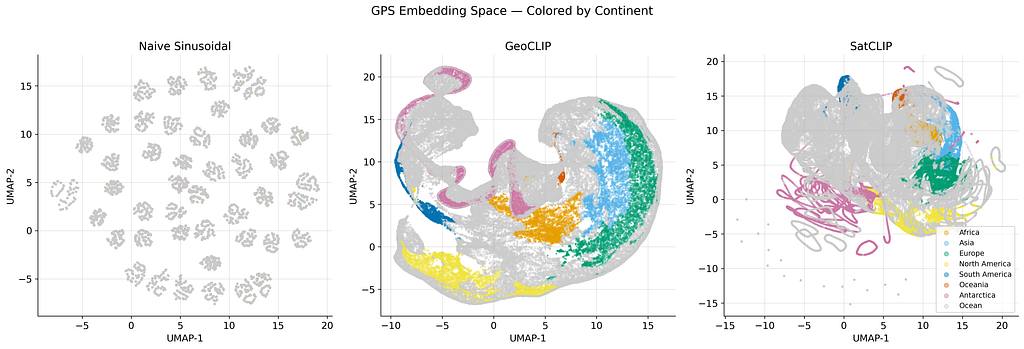
  3. Does GPS Help AI See Better? Testing Location Encoders for Satellite Imagery

    A new benchmark study explores how to best incorporate geographic location data into AI models for satellite image analysis. Researchers tested three methods—naive sin/cos, GeoCLIP, and SatCLIP—to encode latitude and longitude, finding that while naive sin/cos produced the most geographically coherent embeddings, SatCLIP offered a better balance for land-cover classification. The study used a DINOv2 vision model and the EuroSAT dataset to evaluate the effectiveness of these location encoders. AI

    Does GPS Help AI See Better? Testing Location Encoders for Satellite Imagery

    IMPACT Incorporating location data can significantly improve AI's ability to classify satellite imagery, moving beyond pixel analysis to understand geographic context.

  4. Reducing Government Costs and Increasing Access to Greenspaces in the United Kingdom with DINO

    Meta AI's open-source computer vision model, DINOv2, is being used by Forest Research in the UK to improve the accuracy of tree canopy mapping. This collaboration aims to support the UK government's environmental goals, including increasing tree canopy cover and ensuring access to greenspaces. The DINOv2 model, trained on millions of satellite images, enables the detection of individual trees at a global scale, offering a more cost-effective and precise alternative to traditional monitoring methods like LiDAR. AI

    Reducing Government Costs and Increasing Access to Greenspaces in the United Kingdom with DINO

    IMPACT Enhances environmental monitoring capabilities, supporting government policy and reforestation efforts with more accurate and cost-effective tree mapping.

  5. Mapping the World's Forests with Greater Precision: Introducing Canopy Height Maps v2

    Meta AI, in collaboration with the World Resources Institute, has released Canopy Height Maps v2 (CHMv2), an open-source model and accompanying global maps for precise forest monitoring. This new version utilizes Meta's DINOv3 self-supervised vision model, significantly improving accuracy and detail over its predecessor. The enhanced model, with an R² score jumping from 0.53 to 0.86, provides sharper canopy maps and more reliable predictions for tracking forest health, carbon storage, and restoration efforts. AI

    Mapping the World's Forests with Greater Precision: Introducing Canopy Height Maps v2

    IMPACT Enhances global forest monitoring capabilities, supporting climate action and biodiversity efforts with more accurate tree data.

  6. AI-Assisted Competency Assessment from Egocentric Video in Simulation-Based Nursing Education

    Researchers have developed a three-stage framework to assess nursing student competency using egocentric video from simulation exercises. The system extracts action timelines and sequence-level features from video, then correlates these with instructor-rated competency. Surprisingly, higher recognition accuracy of actions in the video correlated negatively with student competency, suggesting that more skilled students perform diverse, less predictable actions that are harder for the AI to classify. AI

    IMPACT Suggests automated assessment tools may need to account for action diversity rather than just recognition accuracy to effectively gauge skill.

  7. Rethinking Noise-Robust Training for Frozen Vision Foundation Models: A Cross-Dataset Benchmark with a Case Study of Small-Loss Failure

    A new benchmark study on noise-robust training for frozen vision foundation models reveals that no single method consistently outperforms others across various medical imaging datasets and noise conditions. The research highlights that the choice of method significantly impacts performance, especially with increasing noise severity. Findings suggest that selecting an appropriate method based on the specific noise regime is more crucial than searching for a universally dominant algorithm. AI

    IMPACT Highlights the complexity of choosing noise-robust training methods for vision models, suggesting a need for regime-aware selection over a single best algorithm.

  8. UniRefiner: Teaching Pre-trained ViTs to Self-Dispose Dross via Contrastive Register

    Researchers have developed UniRefiner, a framework designed to improve the spatial accuracy of Vision Transformer (ViT) models. This method teaches pre-trained ViTs to identify and discard irrelevant or spurious tokens that can degrade performance on spatially sensitive tasks. By using contrastive registers and a dual objective, UniRefiner refines diverse ViTs with minimal fine-tuning, leading to significant improvements in tasks like semantic segmentation. AI

    UniRefiner: Teaching Pre-trained ViTs to Self-Dispose Dross via Contrastive Register

    IMPACT Enhances the spatial reasoning capabilities of foundation vision models, potentially broadening their applicability in dense prediction tasks.

  9. PapersWithCode new features - week 1 [P]

    Hugging Face has launched new features for PapersWithCode, a platform tracking AI state-of-the-art. The updates include support for multiple metrics on leaderboards, such as for Automatic Speech Recognition and Object Detection. The platform now also accommodates external papers beyond arXiv, automatically enriching them with relevant tags and data, and displays paper lineage to show follow-ups or predecessors. AI

    PapersWithCode new features - week 1 [P]

    IMPACT Enhances AI research tracking and sharing capabilities for the community.

  10. PiD: Fast and High-Resolution Latent Decoding with Pixel Diffusion

    Researchers have developed PiD, a novel pixel diffusion decoder that significantly enhances image generation quality and speed. This new method reformulates latent decoding as a conditional pixel diffusion process, allowing for faster and more detailed synthesis of high-resolution images. PiD can be integrated into existing text-to-image systems, offering substantial improvements in both visual fidelity and computational efficiency. AI

    IMPACT Accelerates high-resolution image generation, potentially improving efficiency for text-to-image models.

  11. DecQ: Detail-Condensing Queries for Enhanced Reconstruction and Generation in Representation Autoencoders

    Researchers have developed DecQ, a new framework designed to enhance Representation Autoencoders (RAEs) by improving both image reconstruction and generative modeling. DecQ introduces lightweight "detail-condensing queries" that extract fine-grained information from intermediate features of frozen vision foundation models. This approach effectively balances the trade-off between reconstruction quality and generative fidelity, which is a common challenge with existing RAE methods. AI

    IMPACT Enhances generative modeling and image reconstruction capabilities in autoencoders, potentially improving AI-driven image editing and generation tools.

  12. Capability $\neq$ Interpretability: Human Interpretability of Vision Foundation Models

    Researchers have developed a new framework to measure the human interpretability of vision foundation models. This framework uses two protocols: localizability, which assesses an observer's ability to predict where a feature fires on an image, and nameability, which evaluates how accurately an observer can describe what a feature represents. When applied to six vision transformers, including DINOv2, DINOv3, CLIP, and SigLIP, the study found that foundation models are consistently less interpretable than supervised models, and this difference is not due to a capability tradeoff. AI

    IMPACT Establishes interpretability as a measurable dimension of representation quality, suggesting a new focus for model development beyond raw capability.