PulseAugur / Brief
EN
LIVE 05:45:00

Brief

last 24h
[7/7] 221 sources

Multi-source AI news clustered, deduplicated, and scored 0–100 across authority, cluster strength, headline signal, and time decay.

  1. An npm Package for AI Agent Orchestration Just Shipped With Its Front Door Unlocked. Here's What the CVE Actually Reveals.

    A critical security vulnerability, CVE-2026-46701, has been discovered in the Network-AI npm package, an orchestration layer for AI agents. The flaw allows any web page to silently invoke all 22 exposed MCP tools, including those that can arbitrarily change configurations, spawn new agents, corrupt shared state, or revoke legitimate agent tokens. This vulnerability, rated High with Low attack complexity and no privileges required, stems from a default empty secret and permissive CORS settings in the local MCP server. AI

    IMPACT This vulnerability highlights the growing security risks in the AI agent orchestration ecosystem, potentially impacting tools that integrate with Network-AI.
  2. Forward Settlement: how a trading agent locks tomorrow's price without a clearinghouse

    A new approach using Hash Time-Locked Contracts (HTLCs) enables autonomous trading agents to execute forward settlement without relying on traditional clearinghouses. This method allows agents to fix prices now for future delivery, with the HTLC's cryptographic secret and timelock ensuring that either both legs of the trade complete or neither does. By removing the need for a trusted intermediary, this technique addresses a core challenge in decentralized agent-based trading, offering a more robust and trustless solution for future-dated transactions. AI

    IMPACT Enables decentralized trading agents to execute forward contracts, removing reliance on trusted intermediaries and potentially increasing efficiency in agent-based financial systems.

  3. MCP Is a Protocol, Not a Platform

    The Model Context Protocol (MCP) has standardized how AI models interact with tools, resolving the issue of disparate tool-calling formats across different agent frameworks. While MCP successfully created a universal interface for models and tools, it functions solely as a wire protocol, not a complete platform. This means crucial production elements like user authentication, authorization, logging, secrets management, and scalability are not addressed by the protocol itself, leaving significant development work for teams aiming to deploy MCP servers in real-world applications. AI

    IMPACT Clarifies the practical limitations of the Model Context Protocol, guiding developers on essential production-level considerations beyond the core standard.

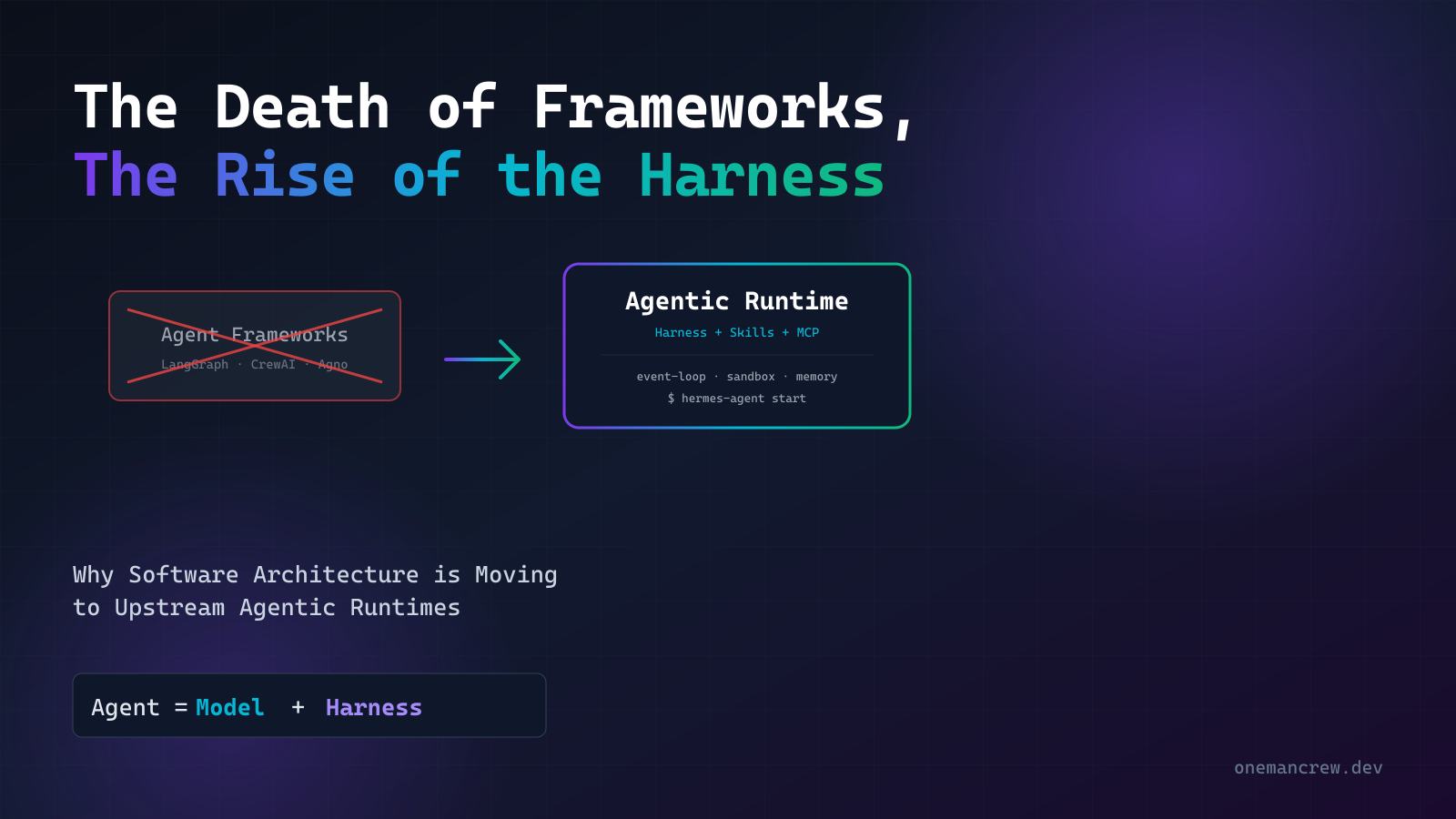
  4. The Death of Frameworks, The Rise of the Harness: Why Software Architecture is Moving to Upstream…

    The article argues that current AI agent development is hampered by reliance on frameworks like CrewAI and LangGraph. It suggests a shift towards a "harness" approach, where developers build custom solutions rather than adapting pre-built frameworks. This new paradigm emphasizes upstream integration and flexibility, moving away from the rigid structures of traditional frameworks. AI

    The Death of Frameworks, The Rise of the Harness: Why Software Architecture is Moving to Upstream…

    IMPACT Suggests a move towards more flexible and custom AI agent architectures, potentially improving development efficiency and capability.

  5. Overcoming Situational Depression Via Generative AI Including Tapping Into ChatGPT

    Generative AI, including models like ChatGPT, Gemini, and Claude, is increasingly being explored for mental health support, particularly for situational depression. While these tools offer accessible, 24/7 assistance, they are not a replacement for human therapists and carry risks of dispensing inappropriate advice. Concurrently, the technical underpinnings of AI agents are being scrutinized, focusing on how they process information, potential biases, and the mechanisms behind brand mentions in their outputs. Developers are advised to understand core AI concepts like LLMs, tokens, and RAG before building agent frameworks, while new infrastructure is emerging to enable AI agents to interact with regulated financial markets. AI

    Overcoming Situational Depression Via Generative AI Including Tapping Into ChatGPT

    IMPACT Explores diverse applications of AI agents and LLMs, from mental health support to financial trading, highlighting technical considerations and potential risks.

  6. AI Agents Are Quietly Taking Over Your Industry — Here's What's Happening [03:31:29]

    AI agents are rapidly moving from experimental concepts to production systems, automating complex tasks and workflows across various industries. Companies like DBS Bank and Visa are testing agents for autonomous commerce, while fintech firms like BridgeWise are using them for personalized investment portfolios. Microsoft is deploying over 100 agents in its supply chain, and solopreneurs are leveraging agent frameworks to perform the work of larger teams. Developers are advised to familiarize themselves with agent frameworks like LangGraph, CrewAI, and AutoGen to stay relevant in this evolving landscape. AI

    IMPACT AI agents are automating complex business processes and workflows, signaling a major shift in how tasks are performed across industries and impacting developer skill requirements.

  7. Company Spotlight: CrewAI

    CrewAI is a new library designed to simplify the creation and orchestration of multiple AI agents. Built on top of LangChain, it allows developers to integrate various tools and LLMs, including local open-source models. The platform offers templates for common use cases like trip planning and stock analysis, and integrates with Replit for cloud deployment and LangSmith for debugging agent runs. AI

    Company Spotlight: CrewAI

    IMPACT Simplifies the development and deployment of multi-agent AI systems, potentially accelerating the adoption of complex AI applications.