PulseAugur / Brief
EN
LIVE 05:55:34

Brief

last 24h
[14/14] 221 sources

Multi-source AI news clustered, deduplicated, and scored 0–100 across authority, cluster strength, headline signal, and time decay.

  1. Claude's Next Model: Sonnet 4.8 and Mythos Rumors, Sorted

    Anthropic has released Claude Opus 4.7, which offers improved performance on coding and long-running tasks compared to its predecessor, Opus 4.6. The new model maintains the same pricing as the previous version, making it a cost-effective upgrade for users. Additionally, users are reminded that older Claude model versions, Opus 4 and Sonnet 4, will be retired on June 15, 2026, necessitating an update to current model IDs to avoid service disruptions. AI

    IMPACT Ensures users are aware of the latest model capabilities and critical retirement dates to maintain service continuity.
  2. The reason small-model agent stacks aren't the default has nothing to do with whether they work

    Recent advancements in smaller language models (SLMs) demonstrate significant improvements in agentic tasks, with models like Gemma 4 31B and Qwen3.6 27B achieving near-parity with larger frontier models on benchmarks. Despite these performance gains and cost efficiencies, the industry has been slow to adopt SLM-based agent stacks, largely because frontier model providers and agent platforms profit from using larger, more expensive models. A key challenge with SLMs is that while they may achieve correct answers, their reasoning processes can be flawed, necessitating additional layers like Retrieval-Augmented Generation (RAG) and distilled verifiers to ensure reliability. AI

    IMPACT Smaller, more efficient models are becoming viable for agentic tasks, potentially lowering inference costs for users despite industry inertia.

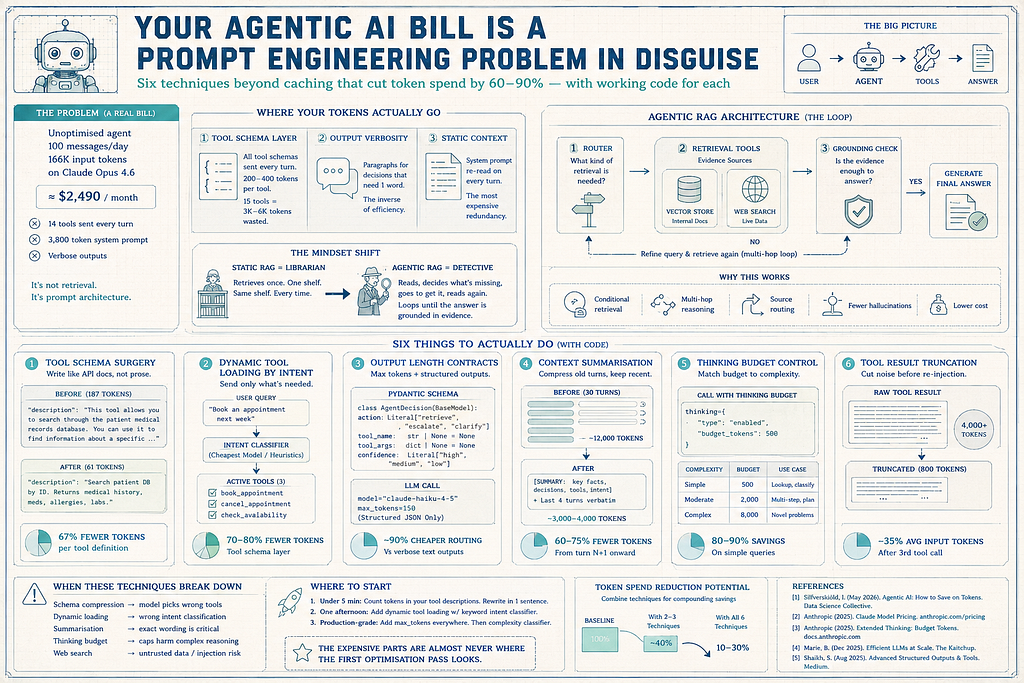
  3. Your Agentic AI Bill Is a Prompt Engineering Problem in Disguise

    Agentic AI systems can incur significant costs due to inefficient prompt architecture, with token spend often exceeding expectations. The primary drivers of this high cost are the verbose descriptions of tool schemas, overly detailed output formats, and the repeated re-reading of static context. Addressing these issues through techniques like concise tool schema writing and optimized output formatting can lead to substantial reductions in token consumption, potentially cutting costs by 60-90%. AI

    Your Agentic AI Bill Is a Prompt Engineering Problem in Disguise

    IMPACT Optimizing prompt architecture in AI agents can drastically reduce operational costs, making agentic AI more accessible for production use.

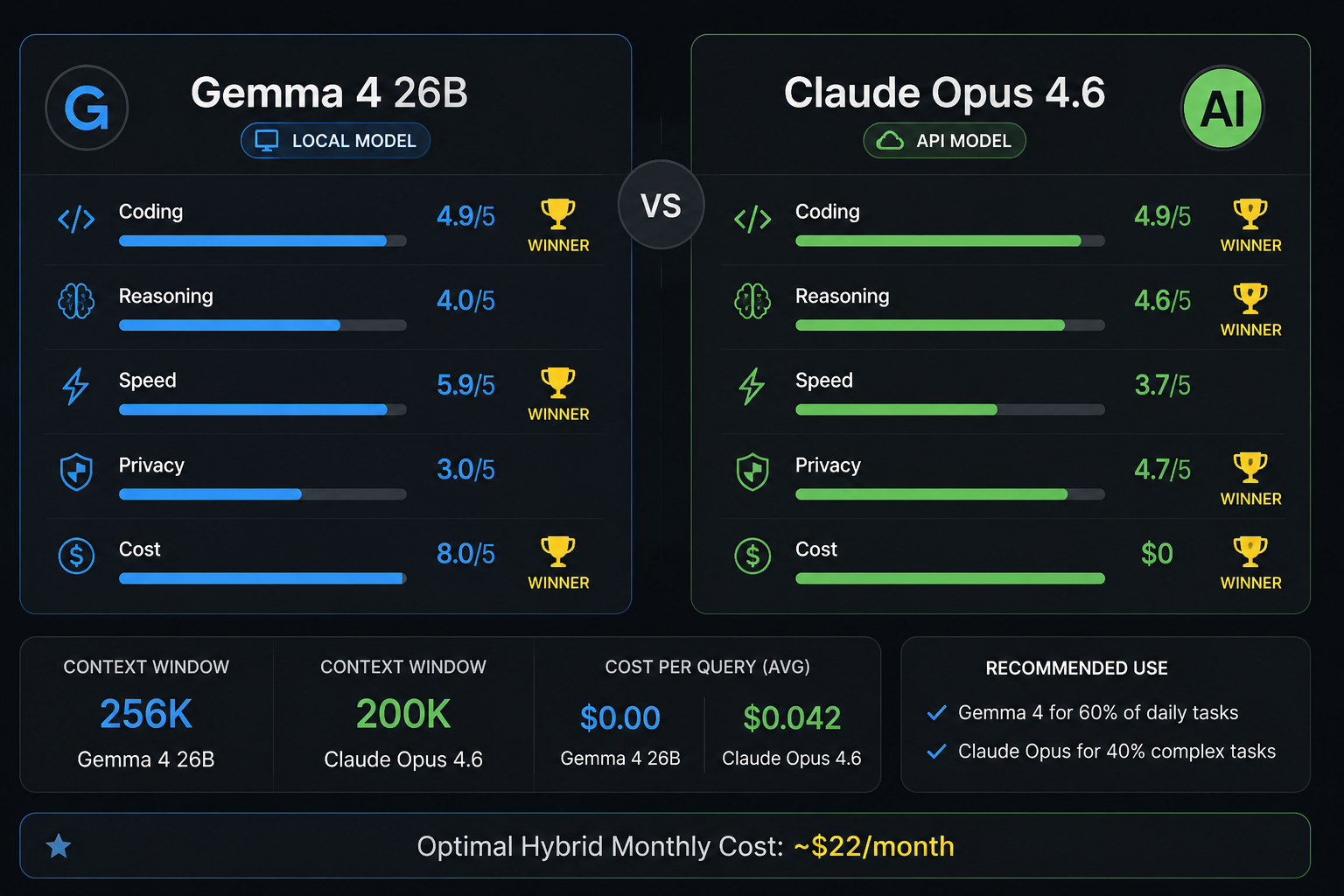
  4. Gemma 4 26B MoE vs Claude Opus 4.6: Which One I’m Actually Using in 2026

    A writer tested Google's Gemma 4 26B MoE and Anthropic's Claude Opus 4.6 over two weeks, spending $50 on tasks for both models. The results of this comparative analysis were surprising to the author. The article aims to determine which of these two AI models is more practical for use. AI

    Gemma 4 26B MoE vs Claude Opus 4.6: Which One I’m Actually Using in 2026

    IMPACT Provides a user-driven comparison of two AI models, offering insights into their practical performance and value for everyday tasks.

  5. Alibaba's latest AI model ran autonomously for 35 hours to optimize code for its own custom chip

    Alibaba's Qwen team has released Qwen3.7-Max, a new proprietary AI model designed for extended autonomous agent tasks. This model has demonstrated its capabilities by running for 35 hours to optimize code for Alibaba's custom chip. In benchmarks, Qwen3.7-Max performs comparably to Anthropic's Claude Opus 4.6 and surpasses other Chinese models such as DeepSeek V4 Pro and Kimi K2.6. AI

    Alibaba's latest AI model ran autonomously for 35 hours to optimize code for its own custom chip

    IMPACT Sets a new benchmark for autonomous agent execution duration and performance against leading models.

  6. Putnam 2025 Problems in Rocq using Opus 4.6 and Rocq-MCP

    Researchers have demonstrated that Anthropic's Claude Opus 4.6, enhanced with specialized tools for the Rocq proof assistant, successfully proved 10 out of 12 problems from the 2025 Putnam Mathematical Competition. This experiment utilized a "compile-first, interactive-fallback" strategy implemented through Model Context Protocol (MCP) tools, which were developed by analyzing previous proof-assistant experiments. The AI agent operated autonomously on an isolated virtual machine, deploying 141 subagents over 17.7 hours of active computation and processing approximately 1.9 billion tokens. AI

    IMPACT Demonstrates advanced AI reasoning capabilities on complex mathematical problems, potentially accelerating AI's role in formal verification and scientific discovery.

  7. HealthCraft: A Reinforcement Learning Safety Environment for Emergency Medicine

    Researchers have developed HealthCraft, a novel reinforcement learning environment designed to evaluate the safety of AI models in emergency medicine scenarios. This environment simulates realistic clinical conditions and uses a dual-layer reward system that penalizes safety violations. Initial tests on frontier models like Claude Opus 4.6 and GPT-5.4 revealed significant safety failure rates and a drastic performance drop in multi-step workflows, highlighting the challenges of deploying AI in critical healthcare settings. AI

    IMPACT Highlights critical safety gaps in current frontier models for high-stakes medical applications, necessitating further research before clinical deployment.

  8. LivePI: More Realistic Benchmarking of Agents Against Indirect Prompt Injectio

    Researchers have developed LivePI, a new benchmark designed to more realistically assess the risks of indirect prompt injection in AI agents. This benchmark simulates real-world scenarios across various input channels like email, web pages, and chat, evaluating twelve attack families and five malicious goals. Initial tests on leading models such as GPT-5.3-Codex and Claude Opus 4.6 revealed significant vulnerabilities, with group-chat injections proving universally successful and repository link attacks causing high-severity failures. A proposed two-layer defense, combining prompt filtering and tool-call authorization, demonstrated effectiveness in blocking malicious actions without compromising agent utility. AI

    LivePI: More Realistic Benchmarking of Agents Against Indirect Prompt Injectio

    IMPACT Highlights critical security vulnerabilities in current AI agents, necessitating robust defenses for safe deployment.

  9. DeepSeek V4 Complete Guide — 1.6T MoE with 1M Context at 73% Lower Cost

    DeepSeek V4, an open-weight model family, has been released with a 1.6-trillion-parameter Mixture-of-Experts architecture that activates only 49 billion parameters per token. This new model boasts a 1-million-token context window and significantly reduced inference costs, achieving up to 73% lower costs than its predecessor due to innovations like Hybrid Attention. The V4 family, available on Hugging Face, offers comparable quality to leading models like GPT-5.4 and Claude Opus 4.6 at a fraction of the price, with optimized hardware performance for NVIDIA Blackwell. AI

    DeepSeek V4 Complete Guide — 1.6T MoE with 1M Context at 73% Lower Cost

    IMPACT Sets a new standard for efficiency in large MoE models, making advanced AI capabilities more accessible and affordable for developers.

  10. Are Frontier LLMs Ready for Cybersecurity? Evidence for Vertical Foundation Models from Dual-Mode Vulnerability Benchmarks

    A new research paper evaluates the readiness of frontier large language models for cybersecurity tasks, finding that general-purpose models struggle with both vulnerability detection and security testing. The study tested models like GPT-5.4 and Claude Opus 4.6, revealing high false positive rates in white-box detection and low ground-truth coverage in black-box testing. Domain-specialized models, however, demonstrated significantly higher detection rates, suggesting that tailored methodology and data are more critical than sheer model scale for cybersecurity applications. AI

    IMPACT Suggests that specialized models and methodologies, not just general LLM scale, are needed for effective AI-driven cybersecurity.

  11. Frequency-Domain Regularized Adversarial Alignment for Transferable Attacks against Closed-Source MLLMs

    Researchers have developed FRA-Attack, a novel method to improve the transferability of adversarial attacks against multimodal large language models (MLLMs). This technique utilizes frequency-domain regularization to align perturbations with shared visual cues across different models, overcoming limitations of existing spatial-domain approaches. Experiments on 15 MLLMs demonstrate FRA-Attack's superior performance, particularly against models like GPT-5.4, Claude-Opus-4.6, and Gemini-3-flash. AI

    IMPACT Enhances understanding of MLLM vulnerabilities and informs security research.

  12. ClinSeekAgent: Automating Multimodal Evidence Seeking for Agentic Clinical Reasoning

    Researchers have developed ClinSeekAgent, a novel framework designed to enhance clinical reasoning in large language models by enabling them to actively seek and synthesize multimodal evidence. Unlike previous approaches that rely on pre-selected data, ClinSeekAgent dynamically queries medical knowledge bases, navigates electronic health records, and utilizes imaging tools to gather information. This active evidence-seeking process significantly improves the performance of models like Claude Opus 4.6 and MiniMax M2.5 on both text-only and multimodal clinical tasks, as demonstrated by the creation of the ClinSeek-Bench benchmark. AI

    IMPACT Enhances LLM capabilities in clinical settings by enabling active evidence acquisition, potentially improving diagnostic accuracy and decision support.

  13. Cursor Introduces Composer 2.5

    Cursor has released Composer 2.5, an updated AI coding assistant that offers improved intelligence and reliability for long-running tasks. This new version is built upon Moonshot AI's Kimi K2.5 architecture and incorporates advanced training techniques, including targeted reinforcement learning with textual feedback and a significantly larger dataset of synthetic tasks. The company claims Composer 2.5 outperforms previous versions and rivals or surpasses competitors like Claude Opus 4.6 and GPT-5.4 in benchmarks, while offering a more cost-effective solution. AI

    Cursor Introduces Composer 2.5

    IMPACT Enhances AI coding assistant capabilities, potentially improving developer productivity and offering a cost-effective alternative to other leading models.

  14. We reproduced Anthropic's Mythos findings with public models

    Researchers have successfully replicated Anthropic's Mythos findings using publicly available AI models like GPT-5.4 and Claude Opus 4.6. This suggests that advanced AI capabilities for discovering software vulnerabilities are no longer exclusive to frontier labs and are becoming accessible through public models. The focus for defenders should now shift from the exclusivity of these tools to validating and operationalizing AI-generated security insights. AI

    We reproduced Anthropic's Mythos findings with public models

    IMPACT Confirms that advanced AI vulnerability discovery capabilities are becoming accessible via public models, shifting the focus to defense and operationalization.