PulseAugur / Brief
EN
LIVE 15:43:14

Brief

last 24h
[4/4] 221 sources

Multi-source AI news clustered, deduplicated, and scored 0–100 across authority, cluster strength, headline signal, and time decay.

  1. Understanding LangChain, LangGraph, RAG, and MCP

    Multiple dev.to articles detail how to build AI agents using LangGraph, a workflow system from LangChain. The posts provide templates for common agent patterns, including Retrieval-Augmented Generation (RAG) for document querying, multi-tool agents that can plan and execute tasks, and human-in-the-loop workflows requiring user review. These templates illustrate LangGraph's architecture with nodes, edges, and state management for creating complex, stateful AI applications. AI
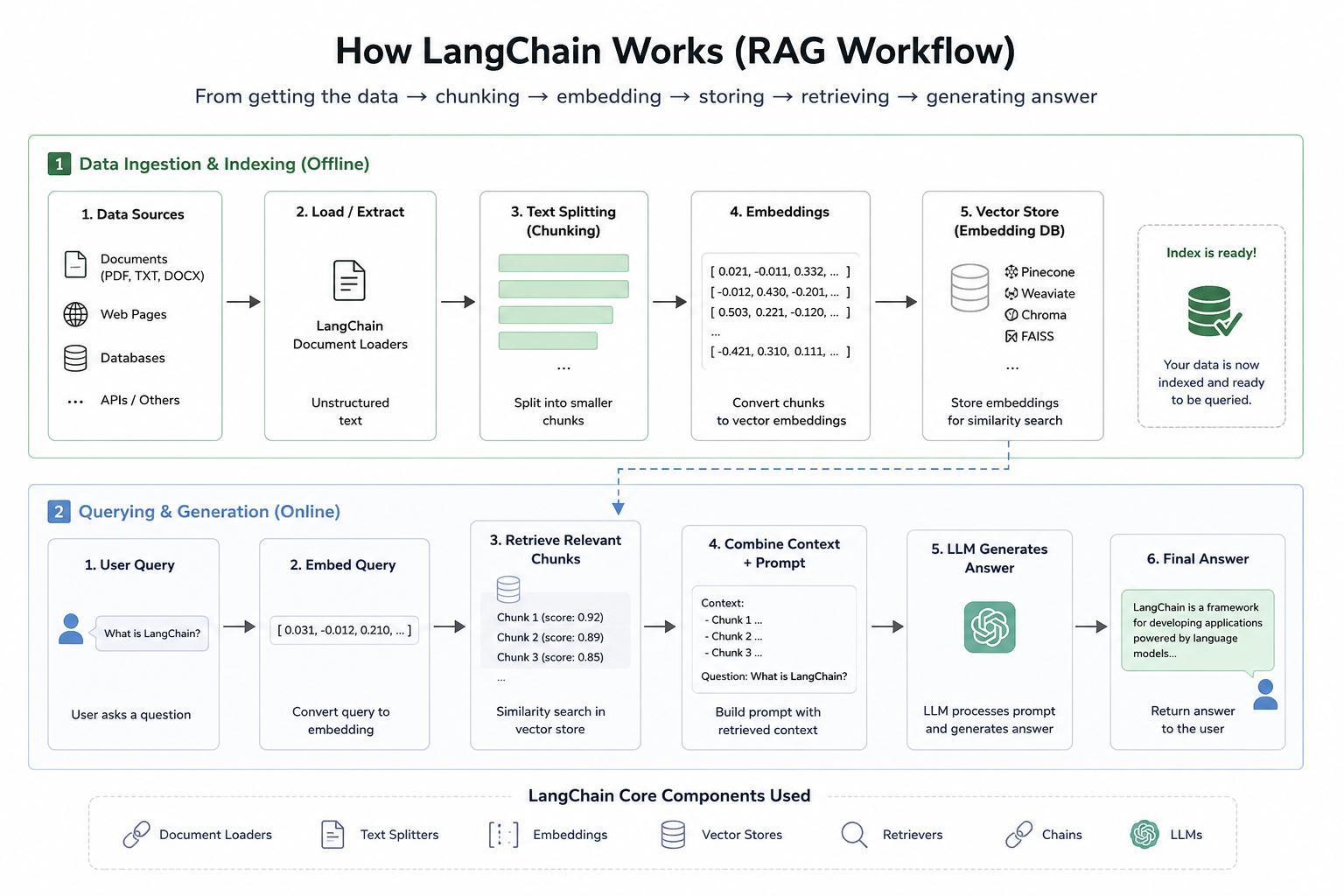
    Understanding LangChain, LangGraph, RAG, and MCP

    IMPACT Provides practical templates and code examples for building complex AI agents, accelerating development for RAG, multi-tool, and human-in-the-loop applications.

  2. Understanding Embeddings easily.

    Embeddings are a core concept in AI, transforming text and other data into numerical representations that capture meaning. These numerical vectors allow AI models to understand relationships between words and concepts, enabling functionalities like semantic search and Retrieval-Augmented Generation (RAG). While vector databases like Pinecone, Weaviate, and Chroma are commonly used for storing and querying these embeddings, alternative approaches like BM25 retrieval with tools such as Meilisearch can also be effective for specific use cases, offering simpler operation and lower costs. AI

    IMPACT Understanding embeddings is crucial for developing and utilizing advanced AI applications like semantic search and RAG systems.

  3. Building RAG Systems: A Complete Guide

    Retrieval-Augmented Generation (RAG) systems are a crucial technique for enhancing Large Language Models (LLMs) by allowing them to access and utilize external, up-to-date information. RAG addresses LLM limitations such as knowledge cutoffs and context window limits by retrieving relevant data before generating a response. This approach is distinct from fine-tuning, which modifies the model's behavior rather than its knowledge base. Building a RAG system involves two main pipelines: an ingestion pipeline for preparing and storing data, and a retrieval pipeline that fetches context for each user query. AI

    Building RAG Systems: A Complete Guide

    IMPACT Enables LLMs to provide more accurate, up-to-date, and domain-specific answers by integrating external knowledge bases.

  4. Replit and Google Cloud Partner to Advance Generative AI for Software Development

    Replit is enhancing its AI development capabilities through several new integrations and partnerships. The platform now allows users to build applications directly within ChatGPT by describing their desired features, with Replit Agent handling the coding and deployment. Additionally, Replit has partnered with Chroma to offer an easy-to-use embeddings store template, enabling developers to create AI applications with state and memory, such as personal assistants or question-answering bots. Further strengthening its AI infrastructure, Replit is collaborating with Google Cloud to provide developers access to Google's cloud services and foundation models, accelerating the creation of generative AI applications. AI

    Replit and Google Cloud Partner to Advance Generative AI for Software Development

    IMPACT Accelerates AI application development by integrating conversational interfaces, state management, and robust cloud infrastructure.