PulseAugur / Brief
EN
LIVE 03:26:44

Brief

last 24h
[5/5] 221 sources

Multi-source AI news clustered, deduplicated, and scored 0–100 across authority, cluster strength, headline signal, and time decay.

  1. Crack ML Interviews with Confidence: CatBoost (25 Q&A)

    This article provides a collection of 25 question-and-answer pairs designed to help individuals prepare for machine learning interviews, specifically focusing on the CatBoost algorithm. It aims to build confidence in candidates by covering key aspects of this popular gradient boosting framework. AI
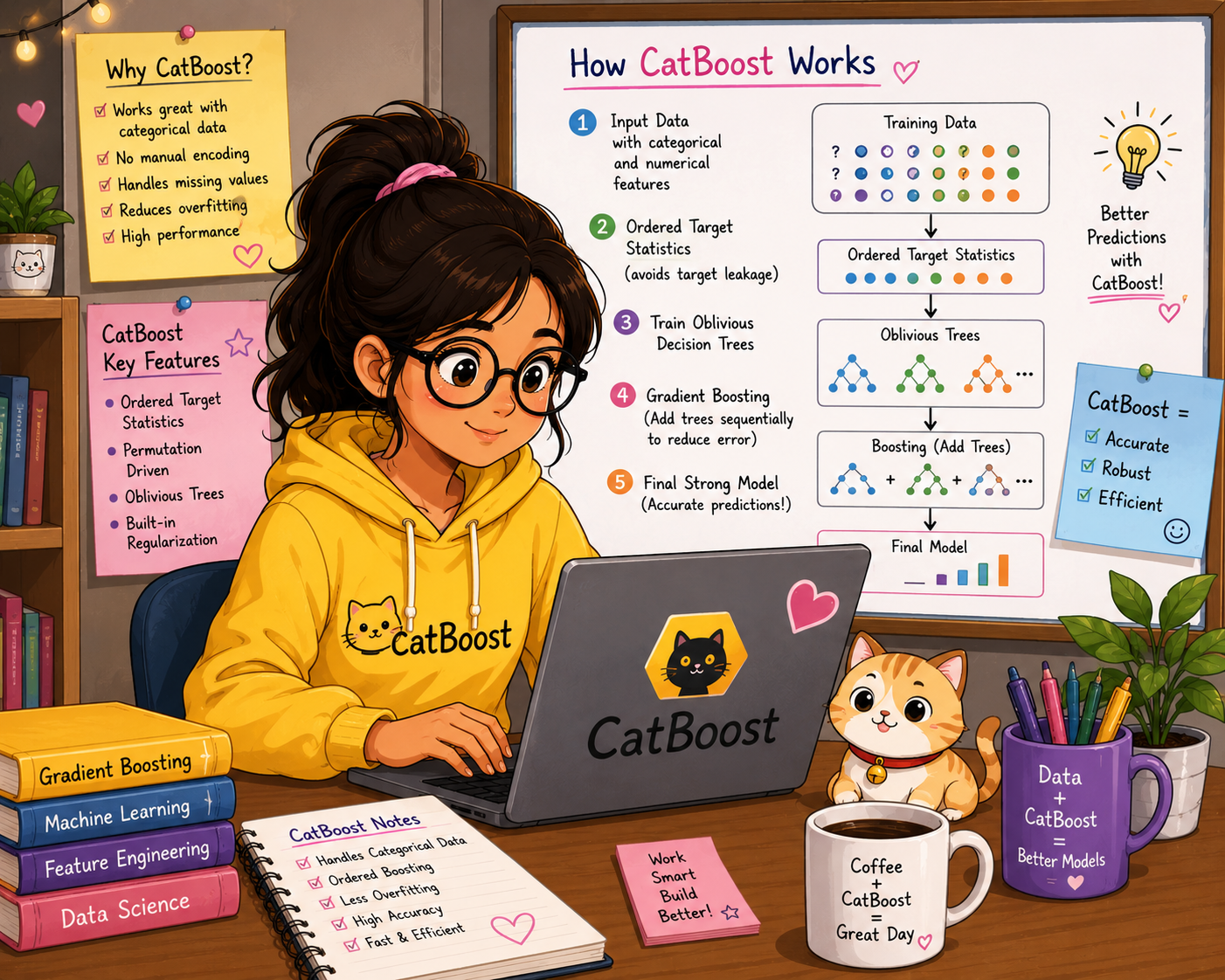
    Crack ML Interviews with Confidence: CatBoost (25 Q&A)

    IMPACT Provides targeted preparation material for machine learning roles, potentially improving candidate performance in interviews.

  2. Machine learning prediction of obstructive coronary artery disease using opportunistic coronary calcium and epicardial fat assessments from CT calcium scoring scans

    Researchers have developed a machine learning framework to predict obstructive coronary artery disease (CAD) using CT scans. The model analyzes features from coronary calcium and epicardial fat, identifying 14 key predictors from an initial set of 424. This approach achieved high accuracy, sensitivity, and specificity, showing promise for improving clinical decisions and potentially reducing the need for invasive procedures. AI

    IMPACT Offers a novel, non-invasive method for predicting heart disease, potentially improving patient outcomes and reducing healthcare costs.

  3. TabH2O: A Unified Foundation Model for Tabular Prediction

    Researchers have introduced TabH2O, a novel foundation model designed for tabular data prediction tasks like classification and regression. This model utilizes a unified training approach with a dual-head architecture, enabling it to handle both task types in a single forward pass through in-context learning. Key improvements include single-stage pretraining for enhanced stability and noise-aware pretraining to build robustness against irrelevant features. On the TALENT benchmark, TabH2O demonstrated competitive performance, outperforming several established methods and achieving top-3 rankings on a significant portion of test datasets. AI

    TabH2O: A Unified Foundation Model for Tabular Prediction

    IMPACT Introduces a unified model for tabular data, potentially simplifying workflows and improving performance across classification and regression tasks.

  4. Tabular foundation models for robust calibration of near-infrared chemical sensing data

    Researchers have explored the use of tabular foundation models, specifically TabPFN, as a novel calibration strategy for near-infrared (NIR) chemical sensing. In a study involving 66 NIR datasets, TabPFN demonstrated strong performance, particularly in regression tasks where it outperformed several traditional methods. While TabPFN showed promise, its effectiveness diminished with spectral outliers and extrapolated samples, indicating that classical chemometric models remain competitive in these scenarios. The findings suggest that tabular foundation models can enhance existing NIR sensing workflows, especially for smaller datasets, but emphasize the need for spectroscopy-specific considerations and uncertainty awareness. AI

    IMPACT Suggests new methods for improving chemical sensing accuracy and robustness, potentially impacting food, pharmaceutical, and environmental analysis.

  5. Pocket Foundation Models: Distilling TFMs into CPU-Ready Gradient-Boosted Trees

    Researchers have developed a method to distill large tabular foundation models (TFMs) into smaller, faster gradient-boosted tree models that can run on CPUs. This technique addresses the latency issue of TFMs, which are too slow for real-time applications like fraud scoring. By using stratified out-of-fold teacher labeling to prevent label leakage, the distilled models achieve performance close to the original TFMs but with significantly reduced inference times. AI

    Pocket Foundation Models: Distilling TFMs into CPU-Ready Gradient-Boosted Trees

    IMPACT Enables real-time AI applications by significantly reducing inference latency for complex tabular models.