PulseAugur / Brief
EN
LIVE 11:46:10

Brief

last 24h
[6/6] 224 sources

Multi-source AI news clustered, deduplicated, and scored 0–100 across authority, cluster strength, headline signal, and time decay.

  1. I made atrium turn my data into a pocket universe

    A developer has created a unique data visualization tool called "Observatory" within their multi-agent development platform, atrium. This tool transforms various data points into an abstract, evolving "pocket universe" where galaxies represent workspaces, stars are historical sessions, and comets signify active sessions. The visualization includes spatial audio elements, with a drone hum for each workspace and pings for live agent activity, all set to a specific musical key. AI

    I made atrium turn my data into a pocket universe

    IMPACT Demonstrates novel ways to visualize and interact with data generated by AI agents.

  2. MTL-MAD: Multi-Task Learners are Effective Medical Anomaly Detectors

    Researchers have developed MTL-MAD, a novel approach for detecting anomalies in medical images by training a joint model with multiple self-supervised and pseudo-labeling tasks. This multi-task learner (MTL) effectively captures normal anatomical structures, enabling anomaly scores to be derived from how well the model performs these tasks during inference. Experiments on the BMAD benchmark show MTL-MAD outperforms existing state-of-the-art methods and generates interpretable anomaly maps that could aid physicians in diagnosis. AI

    MTL-MAD: Multi-Task Learners are Effective Medical Anomaly Detectors

    IMPACT Introduces a novel method for medical anomaly detection that could improve diagnostic accuracy and interpretability.

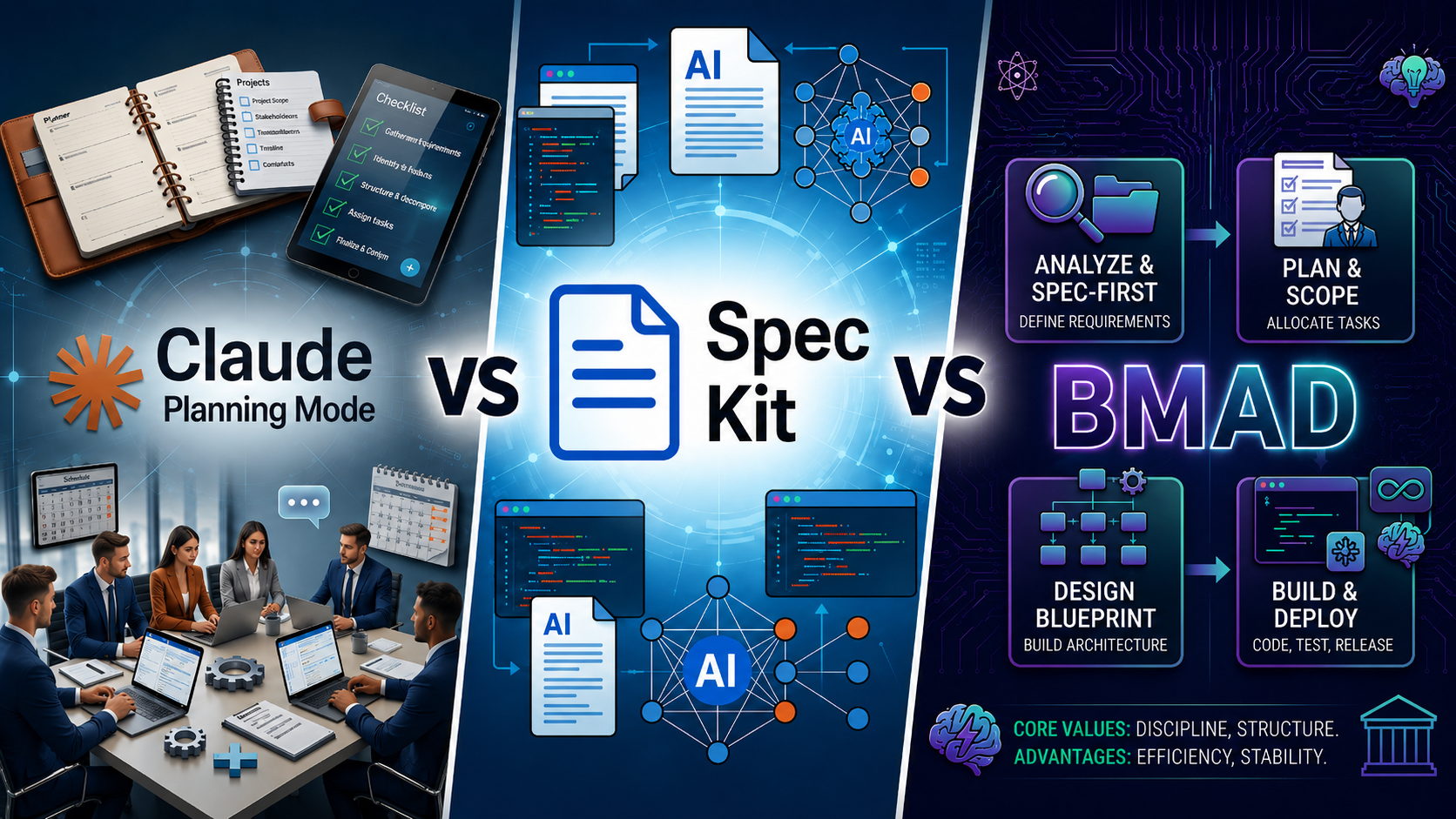
  3. Claude Code Can Already Plan. So Why Does BMAD Exist? I Ran 69 Experiments to Find Out.

    A user conducted 69 experiments to investigate the planning capabilities of Anthropic's Claude code generation model. The experiments aimed to understand why a separate tool, BMAD, might still be necessary despite Claude's potential for self-planning. The findings revealed that two initial predictions about Claude's capabilities were incorrect, leading to a more nuanced understanding of its current limitations and the role of external planning tools. AI

    Claude Code Can Already Plan. So Why Does BMAD Exist? I Ran 69 Experiments to Find Out.

    IMPACT Explores the practical limitations of current LLMs in complex planning tasks, suggesting that specialized tools may still be necessary.

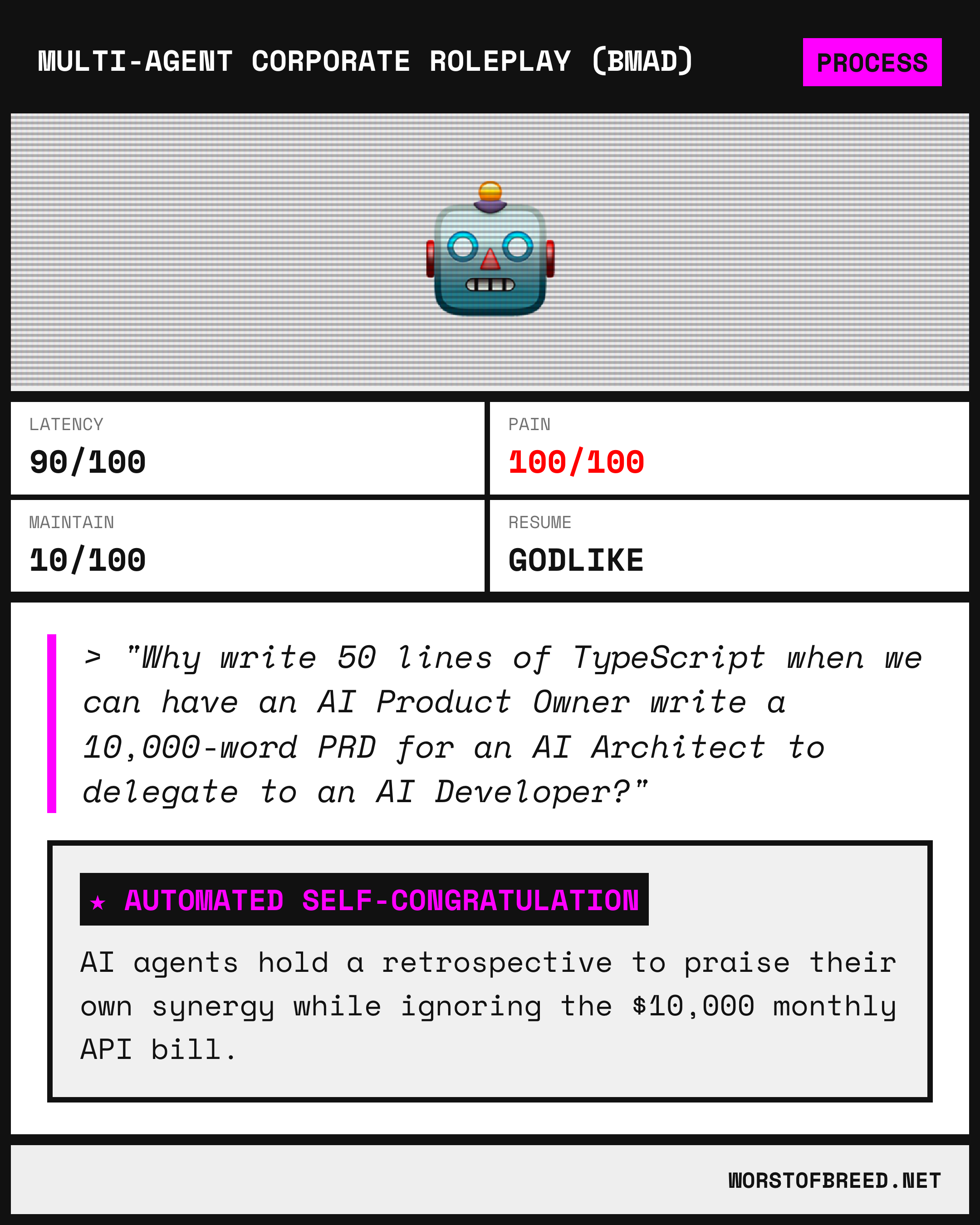
  4. 🚨 WoB pattern: Multi-Agent Corporate Roleplay (BMAD) Why write 50 lines of TypeScript when an AI Product Owner can write a 10,000-word PRD for an AI Architect t

    A new pattern called "Multi-Agent Corporate Roleplay" (BMAD) has emerged, using AI agents to simulate corporate roles like Product Owner and Architect. This approach aims to automate aspects of agile development, such as generating extensive product requirement documents, by having AI agents delegate tasks to each other. The pattern is presented with a humorous take on the potential trade-offs, including prompt hallucinations and high token costs. AI

    🚨 WoB pattern: Multi-Agent Corporate Roleplay (BMAD) Why write 50 lines of TypeScript when an AI Product Owner can write a 10,000-word PRD for an AI Architect t

    IMPACT Humorous exploration of AI agents simulating corporate roles for development tasks, highlighting potential benefits and drawbacks like hallucinations and token costs.

  5. 📰 Top Spec-Driven Development Tools in 2026: Kiro, BMAD, GSD, and Fabriqa Comparison Spec-driven tools that will transform the software development world in 2026

    Four spec-driven development tools—Spec-Kit, Kiro, BMAD, and Fabriqa—are poised to revolutionize software engineering in 2026. These tools aim to streamline the process of shipping production-ready code by enabling structured AI execution. Research from GitHub and analysis of specs.md highlight their potential impact on how engineering teams operate. AI

    📰 Top Spec-Driven Development Tools in 2026: Kiro, BMAD, GSD, and Fabriqa Comparison Spec-driven tools that will transform the software development world in 2026

    IMPACT These tools could streamline AI execution within software development, potentially accelerating production code delivery.

  6. AI agents need more than models – they need structure. BMAD connects Business Model, Architecture, and Governance before development starts. This reduces

    The BMAD method addresses the need for structure in AI agents beyond just the underlying models. It integrates business models, architecture, and governance prior to development. This approach aims to reduce fragmentation, enhance scalability and auditability, and increase traceability for AI systems in enterprise environments. AI

    AI agents need more than models – they need structure. BMAD connects Business Model, Architecture, and Governance before development starts. This reduces

    IMPACT Provides a structured approach to AI agent development, enhancing enterprise system stability and auditability.