PulseAugur / Brief
EN
LIVE 14:00:13

Brief

last 24h
[7/7] 221 sources

Multi-source AI news clustered, deduplicated, and scored 0–100 across authority, cluster strength, headline signal, and time decay.

  1. Build an AI Contract Intelligence System: OCR + Hybrid RAG + LangGraph to Extract Key Terms…

    This article details how to build an AI-powered system for contract intelligence, automating the extraction of key terms from various document formats. The system utilizes a combination of Optical Character Recognition (OCR) with PaddleOCR, hybrid retrieval methods like FAISS and BM25, and the GPT-4o model within a LangGraph pipeline. This approach aims to transform unstructured contract data into structured reports, addressing issues like missed deadlines, financial leakage, and compliance risks. AI
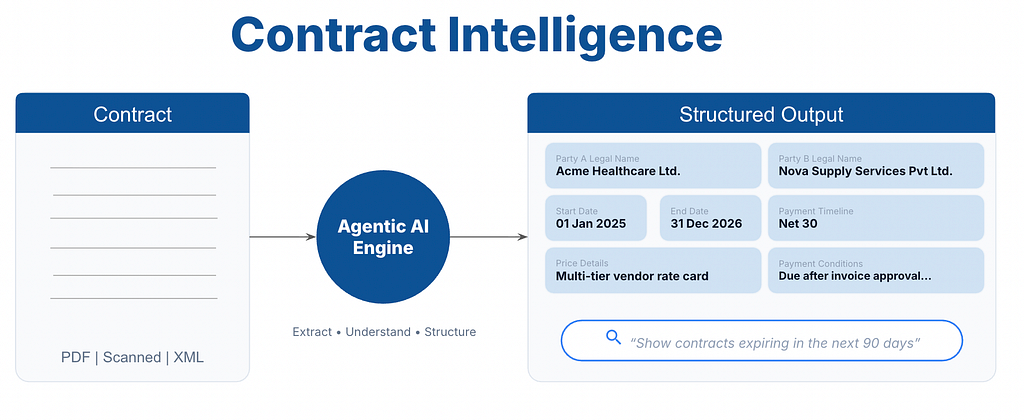
    Build an AI Contract Intelligence System: OCR + Hybrid RAG + LangGraph to Extract Key Terms…

    IMPACT Enables automated extraction of critical information from contracts, improving efficiency and reducing risks for legal, finance, and operations teams.

  2. Precision RAG: Fixing Citations & Hallucinations for Stronger Developer OKRs

    A developer detailed a sophisticated Parent-Child RAG pipeline on GitHub, which, despite its advanced components like hybrid vector stores and LangGraph, suffered from inaccurate citations and hallucinations. The core issue identified was a misalignment between the retrieval units (child chunks), generation units (parent documents), and citation units, leading to incorrect page references. The proposed solution involves pre-capturing granular page references from child chunks and associating them with the expanded parent documents used for generation to ensure citation accuracy. AI

    Precision RAG: Fixing Citations & Hallucinations for Stronger Developer OKRs

    IMPACT Addresses a common challenge in RAG systems, improving the reliability of AI-generated citations and reducing hallucinations.

  3. Git for AI Agents: Version Control Built for LLM Coding Workflows When an AI agent commits 40 times in an afternoon, git records every diff but none of the reas

    Veles is a new open-source MCP server written in Rust that combines BM25 keyword search with semantic vector search. This hybrid approach aims to provide AI coding assistants like Claude and Cursor with more accurate code retrieval. Separately, a new version control system designed for AI agents has been introduced, which records the reasoning behind code changes rather than just the differences, enabling better debugging of agent sessions. AI

    Git for AI Agents: Version Control Built for LLM Coding Workflows When an AI agent commits 40 times in an afternoon, git records every diff but none of the reas

    IMPACT These tools aim to improve the efficiency and debugging capabilities of AI agents in coding tasks, potentially accelerating development cycles.

  4. Building KernelMind Part 2: Hybrid Retrieval, Reranking, and Actually Retrieving Useful Code

    The KernelMind project is detailing its development process, focusing on improving its code retrieval and evaluation capabilities. Early versions struggled with subjective evaluation, prompting the creation of a benchmark suite grounded in the actual repository to measure performance objectively. Ablation tests revealed that graph expansion significantly improved recall for workflow reconstruction, despite a slight decrease in precision, indicating its value in understanding repository logic. AI

    Building KernelMind Part 2: Hybrid Retrieval, Reranking, and Actually Retrieving Useful Code

    IMPACT Details the engineering challenges and solutions for building a robust code retrieval system, offering insights into practical LLM application development.

  5. Benchmarking Patent Embeddings: A Multi-Task Evaluation of 22 Models Across Retrieval, Classification, and Clustering

    A new study evaluated 22 different models, ranging from small encoders to large instruction-tuned LLMs, on their ability to process patent data for tasks like retrieval, classification, and clustering. The research found that fine-tuning effectiveness is highly dependent on the specific task and that gains in one area do not always transfer to others. While larger models generally performed better within their families, cross-family comparisons showed noisy results, with smaller models sometimes outperforming larger ones on specific tasks. The study also highlighted that combining abstract and claim information significantly improved retrieval and classification, though all models struggled with out-of-domain queries. AI

    IMPACT Provides insights into which models and fine-tuning strategies are most effective for processing specialized data like patents, informing AI operators in legal and R&D sectors.

  6. Understanding Embeddings easily.

    Embeddings are a core concept in AI, transforming text and other data into numerical representations that capture meaning. These numerical vectors allow AI models to understand relationships between words and concepts, enabling functionalities like semantic search and Retrieval-Augmented Generation (RAG). While vector databases like Pinecone, Weaviate, and Chroma are commonly used for storing and querying these embeddings, alternative approaches like BM25 retrieval with tools such as Meilisearch can also be effective for specific use cases, offering simpler operation and lower costs. AI

    IMPACT Understanding embeddings is crucial for developing and utilizing advanced AI applications like semantic search and RAG systems.

  7. Temporal Decay of Co-Citation Predictability: A 20-Year Statute Retrieval Benchmark from 396M Ukrainian Court Citations

    Researchers have developed a new benchmark, UA-StatuteRetrieval, to assess the stability of co-citation predictability in legal information systems over time. Analyzing 396 million Ukrainian court citations from 2007 to 2026, they found a significant decay in retrieval performance, with predictability dropping by up to 47%. While high-frequency articles and criminal procedure maintained stability, mid-frequency articles and civil law showed notable degradation, partly explained by a 2017 judicial reform and a 4.3% semantic shift in article citation patterns. AI

    IMPACT Reveals temporal decay in legal information retrieval, suggesting a need for dynamic models beyond static co-citation analysis.