PulseAugur / Brief
EN
LIVE 21:07:36

Brief

last 24h
[3/3] 223 sources

Multi-source AI news clustered, deduplicated, and scored 0–100 across authority, cluster strength, headline signal, and time decay.

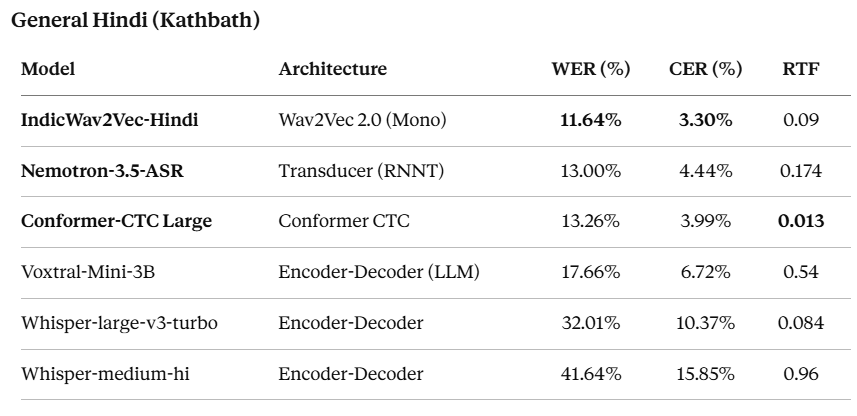
  1. WER Is Not Enough: How I Benchmarked and Fine-Tuned ASR for Indian Banking

    This article details the process of fine-tuning an Automatic Speech Recognition (ASR) system specifically for the unique challenges of Indian banking calls. The author spent three weeks experimenting with multiple models to address issues like diverse accents and technical jargon. The goal was to create a functional ASR pipeline tailored to this niche application. AI
    WER Is Not Enough: How I Benchmarked and Fine-Tuned ASR for Indian Banking

    IMPACT Demonstrates the need for specialized ASR models in specific industries, highlighting challenges beyond general-purpose systems.

  2. Efficient ASR Training with Conversations that Never Happened

    Researchers have developed a novel method to enhance Automatic Speech Recognition (ASR) training for low-resource languages by generating synthetic conversational data. This pipeline uses LLMs to create dialogues, maps speaker attributes to TTS voice profiles, and assembles simulated conversations. Evaluations on the Hungarian BEA-Dialogue benchmark showed that this synthetic data significantly improves ASR performance, even outperforming models trained on much larger real datasets. AI

    IMPACT Synthetic data generation via LLMs and TTS offers a scalable solution for improving ASR in low-resource languages.

  3. Efficient Punctuation Restoration via Weighted Lookahead Scoring Method for Streaming ASR Systems

    Researchers are developing new methods to improve automatic speech recognition (ASR) systems. One approach, LARM, uses a depth-conditioned looped Transformer to allow for adjustable test-time computation, achieving performance competitive with deeper models. Another system, Murmur, addresses long-form ASR by balancing chunk-based processing for low latency with long-context models for accuracy, utilizing attention sparsity. Additionally, a new metric called Script-Normalized WER (SN-WER) has been proposed to more accurately evaluate ASR performance in multilingual settings, particularly for Indic languages, by normalizing for script differences. AI

    IMPACT Advances in ASR efficiency and evaluation metrics could improve the accuracy and usability of voice interfaces and transcription services.