PulseAugur / Brief
EN
LIVE 16:31:26

Brief

last 24h
[9/9] 224 sources

Multi-source AI news clustered, deduplicated, and scored 0–100 across authority, cluster strength, headline signal, and time decay.

  1. Incentives Of EdTech: A Systematic Review Of EduNLP Research

    A systematic review of 204 papers from 2024-2025 in educational natural language processing (EduNLP) research reveals a disconnect between private-sector incentives and educational needs. The review found that teachers, despite being heavily impacted, are under-represented as beneficiaries of this research. Furthermore, real-world deployment of these technologies remains infrequent, and ethical considerations are often acknowledged rather than actively implemented. AI
  2. GPT-3.5-Turbo drops from 90% accuracy to 50% when the answer sits in the middle of a 20k-token prompt instead of the sta

    A study found that GPT-3.5-Turbo's accuracy significantly drops when the answer is located in the middle of a long prompt, specifically a 20k-token context window. This phenomenon, documented in the paper "Lost in the Middle: How Language Models Use Long Contexts," is attributed to attention patterns in transformer models that favor information at the beginning or end of a prompt over the middle. The issue is not a retrieval error but rather how the model's attention weights decay towards the center due to training data limitations. AI

    IMPACT Highlights a critical limitation in current LLMs for tasks requiring retrieval from long documents, necessitating re-ranking strategies over simply increasing context window size.

  3. Your "Claude Opus" API Might Not Be Claude Opus

    Researchers at CISPA audited 17 third-party "shadow" LLM APIs and discovered significant performance discrepancies compared to the official models they claimed to represent. These services often provide access to cheaper or entirely different models, leading to degraded accuracy in academic research. The study identified three common substitution patterns: silent downgrades, cross-vendor swaps, and partial routing based on context length, with simple fingerprinting tests capable of detecting many, but not all, of these deceptions. AI

    IMPACT Academic research integrity is compromised when studies rely on misrepresented LLM APIs, potentially invalidating findings.

  4. ICML non-archival workshop - worth attending? [D]

    A machine learning researcher is seeking advice on whether to attend a non-archival workshop at ICML, given the registration fee and personal expense involved. The researcher has a paper accepted at the workshop and is considering the benefits for their upcoming PhD applications. They are also inquiring about the general practices for non-archival workshops, such as typical author attendance and registration requirements. AI

    IMPACT N/A

  5. Anonymous Data Upload for Submission [D]

    A user on the r/MachineLearning subreddit is seeking advice on how to anonymously upload datasets for academic submissions to conferences like ACL and EMNLP. They are concerned that platforms like Hugging Face, which offer download tracking even on paid tiers, might violate the anonymity policies of these conferences. The user is looking for alternative methods or clarification on acceptable practices for anonymous data sharing in research. AI

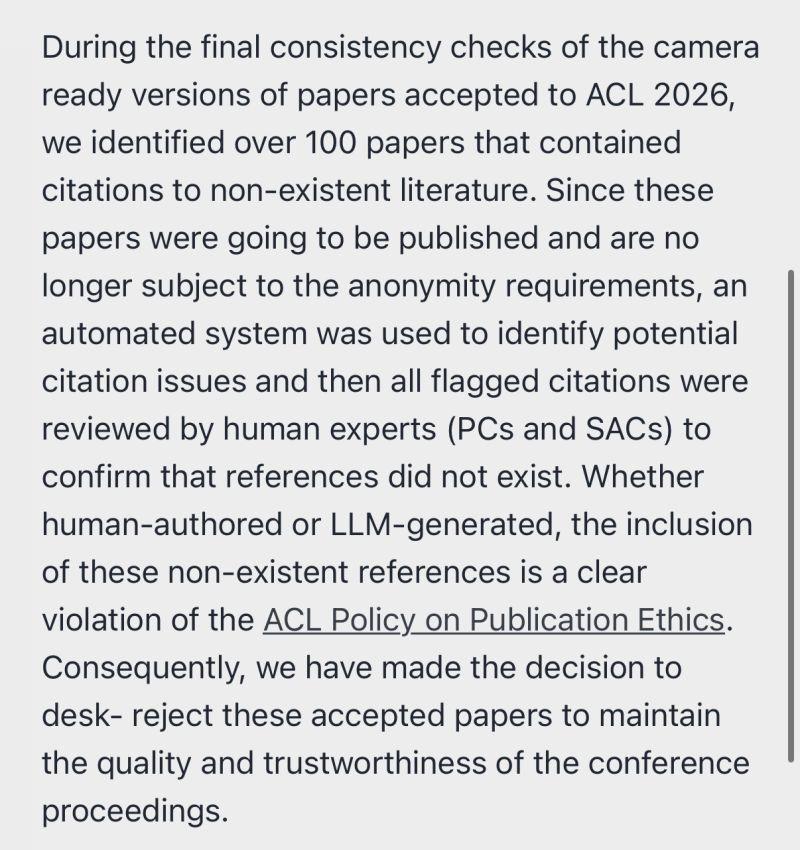
  6. Both # ACL and # arXiv have announced in the past couple days their ban policies for paper submissions found to contain hallucinated material. https:// 2026.acl

    Both the Association for Computational Linguistics (ACL) and arXiv have implemented new policies to ban research papers containing AI-generated hallucinations. This move aims to uphold academic integrity and prevent the spread of misinformation within the research community. The policies will affect submissions to future conferences and pre-print archives. AI

    Both # ACL and # arXiv have announced in the past couple days their ban policies for paper submissions found to contain hallucinated material. https:// 2026.acl

    IMPACT Academic venues are implementing policies to combat AI hallucinations in research, aiming to preserve the integrity of scientific discourse.

  7. "the use of LLMs has become common in the literature review workflow, these tools do not replace the necessity for rigorous human oversight and authorial respon

    The use of large language models (LLMs) is now widespread in the process of conducting literature reviews. However, these tools cannot substitute for careful human supervision and accountability from authors. Fabricating citations, whether directly or through an automated system, constitutes a significant ethical violation. AI

    "the use of LLMs has become common in the literature review workflow, these tools do not replace the necessity for rigorous human oversight and authorial respon

    IMPACT Highlights the ongoing need for human judgment and ethical standards when integrating AI tools into academic workflows.

  8. SelfReflect measures whether an LLM's text summary of its uncertainty matches its actual answer distribution. Across 20 modern models: it doesn't, unless the mo

    Researchers have developed two new methods for evaluating large language models (LLMs). SelfReflect assesses if an LLM's self-reported uncertainty aligns with its actual response variability, finding that it often does not unless the model is specifically trained on examples of its own answers. KGLens, on the other hand, transforms knowledge graphs into test questions to pinpoint a model's factual weaknesses and map its reliability across different knowledge domains. AI

    SelfReflect measures whether an LLM's text summary of its uncertainty matches its actual answer distribution. Across 20 modern models: it doesn't, unless the mo

    IMPACT New evaluation techniques could improve LLM reliability and safety by better identifying factual inaccuracies and uncertainty.

  9. The Consensus Trap: Dissecting Subjectivity and the "Ground Truth" Illusion in Data Annotation

    A new paper critiques the concept of "ground truth" in data annotation for machine learning, arguing that human disagreement is often treated as noise rather than a valuable signal. The research highlights how factors like positional legibility, reliance on model-mediated annotations, and geographic hegemony contribute to a "consensus trap." The authors propose a shift from seeking a single correct answer to mapping the diversity of human experience for more culturally competent AI models. AI

    The Consensus Trap: Dissecting Subjectivity and the "Ground Truth" Illusion in Data Annotation

    IMPACT Challenges the notion of "ground truth" in AI training data, potentially impacting how future models are evaluated and developed for cultural competence.