PulseAugur / Brief
EN
LIVE 23:01:47

Brief

last 24h
[7/7] 221 sources

Multi-source AI news clustered, deduplicated, and scored 0–100 across authority, cluster strength, headline signal, and time decay.

  1. Ray is Joining The PyTorch Foundation

    Anyscale announced that its open-source distributed computing framework, Ray, is joining the PyTorch Foundation, which is part of the Linux Foundation. Ray has experienced significant growth, with downloads increasing nearly tenfold in the past year and powering AI workloads for numerous companies including xAI, Netflix, and JPMorgan. This move aims to foster a stronger open-source community around Ray to meet the evolving demands of AI infrastructure. AI
    Ray is Joining The PyTorch Foundation

    IMPACT Accelerates the development of open-source AI infrastructure by consolidating community efforts under a major foundation.
  2. Databricks for Good and Virtue Foundation: Partnering to Connect Medical Volunteers to Critical Health Services in 72 Countries

    Databricks for Good and the Virtue Foundation have partnered to use AI to improve global healthcare access. Their collaboration has created a platform that matches medical volunteer skills with critical needs in 72 countries. This system leverages AI, including OpenAI's GPT models, to extract and organize data from millions of web pages, creating a comprehensive map of healthcare facilities and service gaps. AI

    Databricks for Good and Virtue Foundation: Partnering to Connect Medical Volunteers to Critical Health Services in 72 Countries

    IMPACT Enhances global health delivery by using AI to match medical professionals with critical needs in underserved regions.

  3. Google ends chaos in its AI offering, introducing three paid subscription plans and a revolutionary billing system based on computing power consumption instead

    Dubai Holding has launched the Middle East's first enterprise-scale AI platform, collaborating with Microsoft and Palantir to automate routine tasks. Meanwhile, Google is shifting its AI strategy away from chatbots towards mass automation, introducing its Gemini 3.5 Flash model and a new autonomous agent named Spark. The company is also streamlining its AI offerings with three new subscription plans and a novel billing system based on compute usage rather than query count. AI

    Google ends chaos in its AI offering, introducing three paid subscription plans and a revolutionary billing system based on computing power consumption instead

    IMPACT Signals a move towards enterprise AI adoption in new regions and a strategic shift by Google towards automation and revised AI service billing.

  4. Google is pitching an AI agent ecosystem to consumers who may not buy it

    Google announced a suite of AI agent features at its I/O conference, including "Information agents" to monitor topics and "Spark" for personal digital life management. These agents, integrated into products like Gmail and Chrome, aim to automate tasks and provide personalized digests. However, many of these features are initially limited to paid Gemini Ultra subscribers, raising concerns about accessibility and the widening gap between AI enthusiasts and average consumers. AI

    IMPACT Google's new AI agents could redefine web interaction and personal task management, but initial limited access may widen the digital divide.

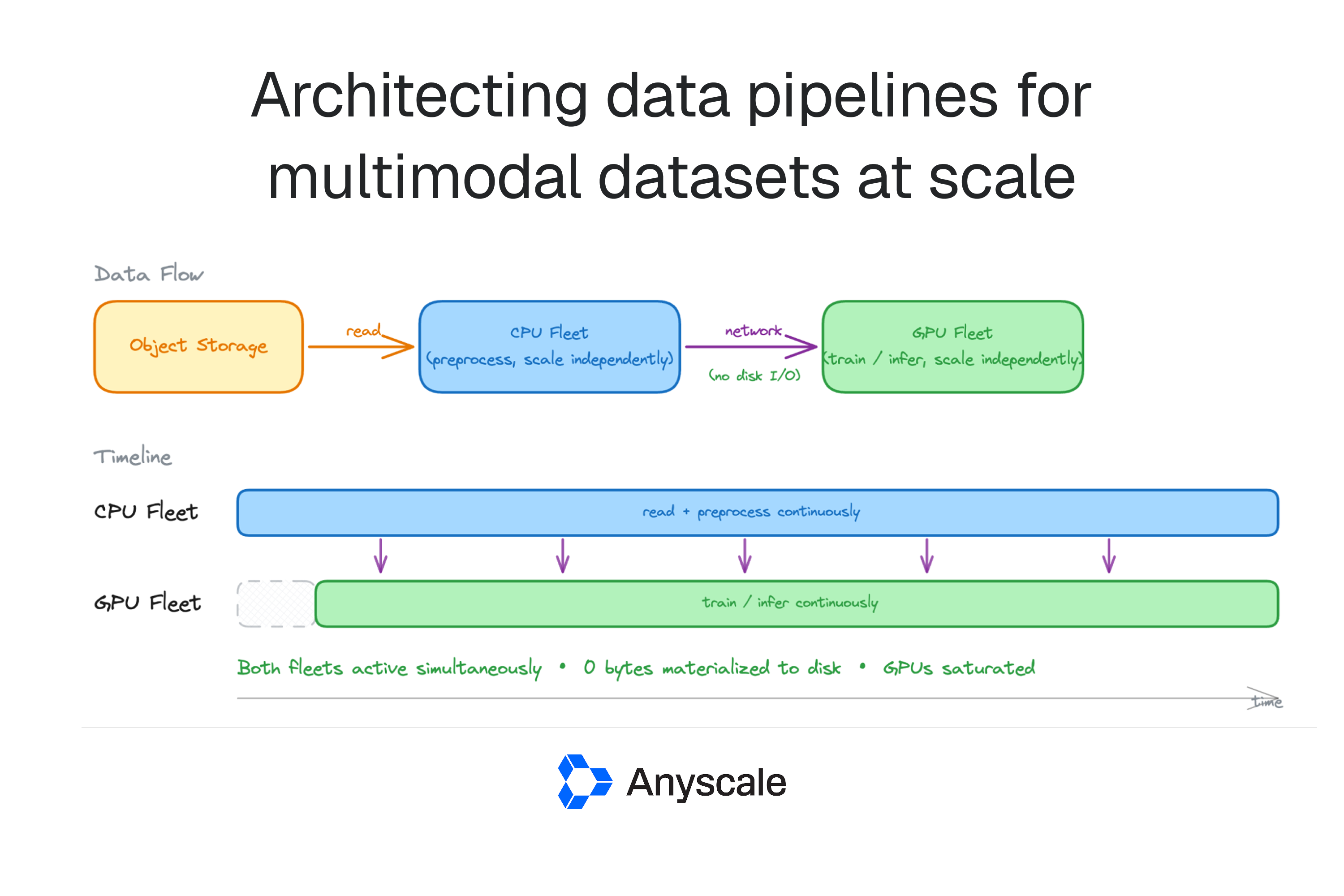
  5. Architecting Data Pipelines for Multimodal Datasets at Scale

    Anyscale's blog post details challenges in scaling multimodal AI data pipelines, where preprocessing often starves GPUs, leading to underutilization. The article explains that traditional staged batch execution, which involves writing intermediate data to storage between preprocessing and training, is inefficient due to significant I/O costs and delays. It proposes a disaggregated streaming architecture using Ray Data to directly stream preprocessed data from a dedicated preprocessing fleet to GPU workers, bypassing storage bottlenecks and improving GPU utilization. AI

    Architecting Data Pipelines for Multimodal Datasets at Scale

    IMPACT Provides architectural guidance for optimizing AI training and inference infrastructure, particularly for multimodal datasets.

  6. How Notion cuts embedding costs by 80% and other stories on scaling AI with Ray from Salesforce, Uber, and more…

    Anyscale hosted Ray Day Seattle, showcasing how companies like Notion and Salesforce are using the Ray framework to scale AI workloads. Notion significantly reduced embedding costs by 80% and improved query latency by migrating their AI pipeline to Ray, consolidating multiple steps into a single engine. Salesforce leveraged Ray to build a distributed system for summarizing lengthy documents, achieving low latency with a 20B parameter model. Uber also presented improvements in GPU utilization and training time using Ray for their ML platform. AI

    How Notion cuts embedding costs by 80% and other stories on scaling AI with Ray from Salesforce, Uber, and more…

    IMPACT Demonstrates practical scaling solutions for AI workloads, reducing costs and improving performance for major tech companies.

  7. We Built a Search Engine

    Replit has launched a new, powerful search engine designed to help users find content within its platform in under 30 seconds. The engine indexes a wide range of items, including Repls, templates, code, users, and community content. This initiative addresses a significant user pain point, as 80% of users previously abandoned the search function due to its ineffectiveness. Replit built the search engine using Elasticsearch for indexing and Apache Spark for data pipelines, with plans to expand code search capabilities to all files in every Repl. AI

    We Built a Search Engine

    IMPACT Improves discoverability of code and community content, potentially aiding AI development and learning.