PulseAugur / Brief
EN
LIVE 13:53:30

Brief

last 24h
[37/3887] 224 sources

Multi-source AI news clustered, deduplicated, and scored 0–100 across authority, cluster strength, headline signal, and time decay.

  1. Killing Containers at Scale

    Replit has significantly improved its platform's stability by addressing slow container shutdowns on preemptible virtual machines. The company identified that Docker container termination was taking an average of 20 seconds, far exceeding the 30-second shutdown window for VMs and causing user repls to become inaccessible. By optimizing the `docker kill` process, Replit reduced its session connection error rate from 3% to under 0.5% and decreased the 99th percentile session boot time from two minutes to 15 seconds. AI

    Killing Containers at Scale

    IMPACT Improved platform stability for a coding environment, potentially enhancing user experience and reliability.

  2. OpenAI and Hugging Face tooling

    Hugging Face has released several updates and new tools aimed at improving the open-source AI ecosystem. These include a new command-line interface, a Swift client, and a lightweight experiment tracking library. The platform also highlighted its growing network of inference providers, such as OVHcloud, Scaleway, and Public AI, and announced integration with NVIDIA NIM to accelerate Large Language Model deployment. AI

    OpenAI and Hugging Face tooling
  3. Native Graphics Love ❤️

    Replit has significantly upgraded its native graphics experience, addressing long-standing performance and reliability issues. The platform now supports faster and more dependable launches for games and GUI applications, including popular tools like Pygame and Java Swing. This overhaul involved replacing an outdated VNC server with TigerVNC and implementing a socket activation system to streamline the startup process for graphical applications. AI

    IMPACT Enhances developer tooling and application performance on a popular coding platform.

  4. Getting in the Flow with Snorkel AI

    Snorkel AI has developed a platform called Snorkel Flow that allows users to programmatically label, build, and augment training data. This approach aims to accelerate and enhance the entire AI development and deployment lifecycle. The discussion also touched upon the Snorkel open-source project and collaborations with entities like Google. AI

    Getting in the Flow with Snorkel AI
  5. How Far We've Come

    Replit has significantly improved its platform stability and performance over the past 10 weeks, addressing issues that caused high latency and connection failures. The company focused on optimizing database connections, caching, and implementing rate limits, resulting in a dramatic reduction in load times and an increase in successful websocket connections. These improvements aim to ensure Replit can handle continued rapid growth without compromising user experience. AI

    How Far We've Come

    IMPACT Minimal direct impact on AI operators; focuses on general platform stability for a coding environment.

  6. Building a deep learning workstation

    Daniel, an NLP and Speech researcher, details his experience building a custom deep learning workstation equipped with two GPUs, including a Titan RTX and an RTX 2080 Ti. He discusses the components chosen, the overall cost-effectiveness, and the practicalities of maintaining such a setup for research purposes. While generally satisfied, he also notes aspects he would alter if undertaking the build again. AI

    Building a deep learning workstation
  7. Killer developer tools for machine learning

    Weights & Biases is developing new tools for AI practitioners, stemming from the challenges its founder observed during an internship at OpenAI. The company aims to address pain points faced by developers in the machine learning space. This initiative reflects a broader vision for advancing the tooling landscape in machine learning. AI

    Killer developer tools for machine learning
  8. Data Discovery Platforms and Their Open Source Solutions

    Data discovery platforms are crucial tools for organizations to efficiently locate and understand their data assets. These platforms catalog data entities, metadata, and lineage, enabling users to answer questions about data location, meaning, ownership, creation, and usage. Key features include robust search capabilities, metadata display, and lineage tracking to improve data accessibility and reliability. Companies like Facebook with its Nemo platform and Lyft have implemented such systems to reduce the time data scientists spend on discovery, which can otherwise hinder productivity. AI

    Data Discovery Platforms and Their Open Source Solutions
  9. How Fig Shipped an MVP in Two Weeks During YC

    Fig, a startup developing a tool to enhance terminal workflows with visual applications, successfully built its initial Minimum Viable Product (MVP) in just two weeks. The company leveraged the Repl.it development platform for its rapid deployment capabilities, version control integration, and multiplayer features. While Repl.it was instrumental in their early stages, Fig eventually transitioned to Heroku and AWS as they scaled and encountered platform limitations. AI

    How Fig Shipped an MVP in Two Weeks During YC

    IMPACT Focuses on developer tooling and workflow optimization, with minimal direct impact on AI capabilities.

  10. Focusing on a solid foundation

    Replit is pausing new feature development to focus on improving the core platform's performance and reliability. The company has seen significant growth, serving 120,000 concurrent containers and doubling its team annually for four years. However, this growth has led to issues like slower repls, frequent crashes, and unreliable hosting, prompting the shift in focus to address these foundational problems. AI

    IMPACT Replit's focus on core platform stability may improve the experience for developers using their coding environment.

  11. MLOps and tracking experiments with Allegro AI

    Allegro AI's CEO, Nir Bar-Lev, discussed their open-source MLOps solution, Trains, designed to help data scientists manage deep learning development workflows. The system addresses the unique challenges of MLOps, such as tracking both data and code versions, and managing multiple long-running code experiments on accelerated hardware. Allegro AI aims to make the process of deep learning development more robust for practitioners. AI

    MLOps and tracking experiments with Allegro AI
  12. IBM looking for 12 years’ experience in Kubernetes administration

    IBM is seeking an experienced Cloud Native Infrastructure Engineer/Architect with a minimum of 12 years of experience in Kubernetes administration. The role emphasizes expertise in managing and optimizing cloud-native infrastructure, likely for AI-related workloads. This position highlights the growing demand for specialized skills in managing complex containerized environments essential for modern AI development and deployment. AI

    IMPACT Highlights the need for specialized infrastructure skills to support AI development and deployment.

  13. Operationalizing ML/AI with MemSQL

    MemSQL is addressing the challenge of deploying AI models in production by integrating ML/AI inference into existing SQL workflows. Their platform focuses on performance and scalability, enabling users to manage model features and raw files directly within distributed databases. This approach aims to overcome common blockers encountered when operationalizing AI at scale. AI

    Operationalizing ML/AI with MemSQL
  14. Packaging Support for Java - Try Maven Packages in Your Browser

    Replit has introduced packaging support for Java, enabling developers to use Maven packages directly within their browser-based development environment. This new feature allows users to search for and integrate Java packages from the Maven Central repository, streamlining the process of building applications. The company demonstrated this capability by creating a web scraper to pull Twitter threads, showcasing how easily developers can now leverage existing Java libraries to accelerate their projects. AI

    Packaging Support for Java - Try Maven Packages in Your Browser

    IMPACT Enhances developer productivity by simplifying package management for Java projects within an online IDE.

  15. Launch HN: Terusama (YC W20) – We help warehouses schedule trucks

    Terusama, a startup founded by former Uber Freight and industry consultants, has launched a new truck appointment system designed to modernize warehouse logistics. The platform aims to automate the coordination of truck arrivals, check-ins, and tracking, addressing inefficiencies that cost the U.S. $30 billion annually and contribute to significant CO2 emissions. By streamlining communication and providing better visibility, Terusama seeks to improve the sustainability of the trucking industry and reduce driver turnover. AI

    IMPACT Modernizes critical logistics infrastructure, potentially enabling future AI applications in freight.

  16. TensorFlow in the cloud

    Google Cloud's Craig Wiley discussed the TensorFlow ecosystem and its enterprise applications. He highlighted how businesses are leveraging AI-driven tools within the cloud and explained the synergy between TensorFlow development and Google Cloud Platform. The conversation also touched upon Google's "Rules of ML" and various TensorFlow resources. AI

    TensorFlow in the cloud
  17. Introducing multi-backends (TRT-LLM, vLLM) support for Text Generation Inference

    Hugging Face has enhanced its Text Generation Inference (TGI) tool by introducing support for multiple backends, including TensorRT-LLM and vLLM. This update aims to improve performance and flexibility for users deploying large language models. Additionally, Hugging Face is exploring new techniques like assisted generation to further reduce latency in text generation tasks. AI

    Introducing multi-backends (TRT-LLM, vLLM) support for Text Generation Inference
  18. Build custom ML tools with Streamlit

    Streamlit, an open-source platform, enables data scientists and ML engineers to quickly create custom AI and ML tools with user interfaces. The platform allows for rapid development of internal or external applications without requiring extensive frontend expertise. Its adoption has been swift, with notable companies like AI2, Stripe, and Uber integrating it into their workflows. AI

    Build custom ML tools with Streamlit
  19. Trends in data labeling

    This podcast episode features Michael Malyuk from Label Studio discussing the critical role of data labeling in AI development. The conversation highlights the evolving perception of data labeling within the industry and explores solutions like open-source tooling. Key topics include methods for validating labels and integrating AI models into the labeling workflow to improve efficiency and accuracy. AI

    Trends in data labeling
  20. AI in the browser

    Libretto is a new open-source toolkit designed to enhance AI-powered browser automations, making them more deterministic and efficient. It provides coding agents with live browser access to inspect pages, reverse-engineer APIs, and record/replay user actions. The tool aims to simplify the maintenance of web integrations, particularly for complex healthcare software, and can also be used from the command line for tasks like opening URLs or executing scripts. AI

    AI in the browser
  21. Ubuntu 19.10

    Canonical has released Ubuntu 19.10, focusing on enhancing AI/ML development and edge computing capabilities. The update includes improved support for Kubernetes at the edge via MicroK8s and integrates Kubeflow for machine learning workflows. Additionally, it offers better multi-cloud infrastructure economics and an improved desktop experience with performance enhancements and experimental ZFS support. AI

    Ubuntu 19.10

    IMPACT Enhances developer productivity for AI/ML tasks and edge computing deployments.

  22. MLIR Primer: A Compiler Infrastructure for the End of Moore’s Law

    Google researchers have published a primer on MLIR, a compiler infrastructure designed to address the challenges posed by the end of Moore's Law in AI development. MLIR aims to provide a unified framework for optimizing machine learning workloads across diverse hardware architectures. This approach is crucial for maintaining performance gains as traditional hardware scaling slows down. AI

    IMPACT MLIR offers a unified approach to optimize AI workloads across diverse hardware, crucial for continued performance gains as traditional hardware scaling slows.

  23. Serving deep learning models with RedisAI

    Redis, a popular in-memory data structure store, has introduced the RedisAI module to support deep learning models and tensor data types. This new module aims to facilitate the serving of AI models directly within the Redis environment. The podcast episode features Pieter Cailliau discussing the motivations behind this development and its potential user base. AI

    Serving deep learning models with RedisAI
  24. Social AI with Hugging Face

    Hugging Face has announced a series of partnerships and product updates aimed at enhancing the accessibility, security, and scalability of AI models. Collaborations with Google, VirusTotal, JFrog, Wiz Research, and Protect AI focus on improving AI security and transparency within the ML community. Additionally, new integrations with Together AI and Dask, along with the introduction of HUGS, aim to simplify fine-tuning and scaling of open AI models for various use cases, including complex generative AI tasks. AI

    Social AI with Hugging Face
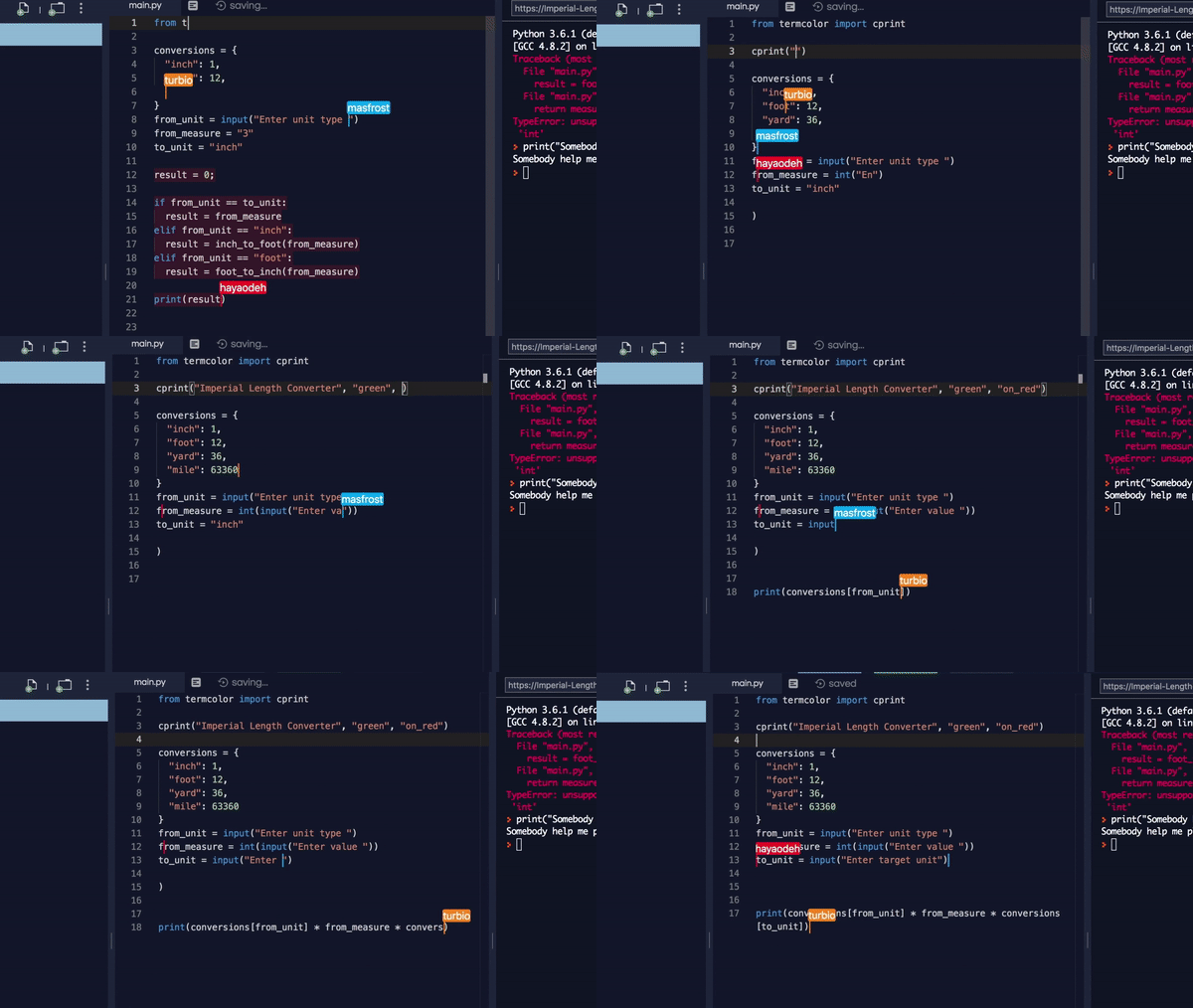
  25. Repl.it Multiplayer

    Replit has fully integrated its Multiplayer feature, allowing real-time and asynchronous collaborative coding directly within its platform. This overhaul involved significant changes to its core protocol, introducing a new Collaborative Development Protocol (CDP) based on isolated channels for various functions like editing and evaluation. The system now uses Operational Transformation for seamless text updates, ensuring all IDE features function smoothly in a shared environment. AI

    IMPACT Enhances developer productivity and learning through seamless real-time and asynchronous coding collaboration.

  26. Skip the README, let us install for you

    Replit has launched a Universal Package Manager designed to simplify software development by automatically handling system dependencies for various programming languages. Initially supporting Python and JavaScript, the manager detects and installs necessary system packages, eliminating the need for developers to manually scour documentation for commands like `apt install` or `brew install`. This new system streamlines the setup process, allowing developers to focus more on coding and less on configuration, and Replit plans to expand its support to more languages and packages. AI

    Skip the README, let us install for you

    IMPACT Streamlines development workflows by automating package management, potentially increasing developer productivity.

  27. React Framework Preboot

    Replit has introduced a new feature called "preboot" to significantly speed up the startup time for React framework development environments. Previously, users had to manually initiate the server, leading to delays. The new preboot system leverages Replit's existing container pooling infrastructure to ensure that a container is already running and listening on a port when a user accesses a React framework repl, allowing the IDE to attach instantly. AI

    IMPACT Speeds up development workflows for AI-adjacent applications built with React frameworks.

  28. Repl.it: the IDE That Grows—from Playgrounds to Fullstack Apps

    Replit has launched a new platform feature that allows its online IDE to scale from simple coding playgrounds to full-stack application development environments. The platform automatically adapts to user needs, transitioning from a basic REPL to supporting file systems, package installations, and even deploying applications by simply opening a port. This new functionality aims to simplify the development process, enabling users to go from idea to deployed software with minimal setup, and can also be used for tasks like training machine learning models. AI

    IMPACT Simplifies the development workflow for applications, including those involving machine learning.

  29. Live Server Development and Deployment (Beta)

    Replit has launched a beta version of its Live Server Development and Deployment feature, allowing users to host and run servers directly on the platform. This new capability extends Replit's existing web hosting services, enabling developers to deploy applications with open ports and running code. The company is seeking user feedback to refine this early-stage release. AI

    IMPACT Enables developers to more easily deploy and host applications, potentially streamlining workflows.

  30. Require Ruby Gems

    Replit has expanded its package management support to include Ruby Gems, following its recent addition of Node.js npm support. Unlike its Node.js and Python implementations where packages are automatically installed upon requiring them, Replit's Ruby support utilizes Bundler's inline gemspec feature. This allows developers to define their gem dependencies directly within their code, simplifying the setup process for users who want to start coding immediately without creating separate files. AI

    IMPACT Enables easier use of Ruby libraries within the Replit development environment.

  31. Modular, fast, small: how we built a server-rendered IDE

    Replit has redesigned its integrated development environment (IDE) to be more modular, faster, and smaller. The new architecture centers around a lightweight core that acts as a window manager, with all functionalities implemented as plugins. This plugin-based system allows for greater customizability and server-side rendering, improving load times and accessibility, especially over slower internet connections. AI

    IMPACT Enhances developer tooling, potentially improving productivity and accessibility for coding environments.

  32. Introducing Kotlin REPL

    Replit has launched a beta Kotlin REPL, enabling developers to experiment with the language following Google's recent announcement of native Kotlin support on Android. The platform also introduced a self-serve Replit Enterprise option for organizations to quickly set up secure development environments with features like SSO and SCIM. Additionally, Replit enhanced its Security Center with bulk vulnerability remediation and introduced External Access Tokens and Private Publishing for more granular control over app access. AI

    IMPACT Enables developers to experiment with Kotlin for potential AI development, and enhances secure infrastructure for building applications.

  33. Require any npm package

    Replit has expanded its package support to include any npm package that can run in a web browser. This feature allows developers using JavaScript, HTML/CSS/JS, or ES2016 to import packages directly from npm. The system works by parsing `require` statements, fetching the package bundle from npm via wzrd.in, and evaluating it within the code's context. AI

    IMPACT Enhances developer experience by simplifying package management for web-based projects.

  34. Building Towards a Holistic Development Service

    Replit is developing a unified development service that integrates various stages of the software lifecycle, moving beyond the traditional Unix philosophy of "do one thing and do it well." This holistic approach aims to provide a more cohesive and intelligent development experience for users, particularly hobbyists and learners. The platform is evolving to understand code from authoring through execution, testing, and deployment, all managed through a single protocol. AI

    IMPACT Replit's move towards a holistic development service could streamline workflows for developers, potentially improving productivity and learning.

  35. Infinite Loops

    Replit has addressed two critical issues within its code execution service that could cause user programs to crash or freeze their browsers. The platform has implemented a rate-limiting mechanism to prevent excessive output from overwhelming the browser, capping data transmission at 20 messages per second. Additionally, for JavaScript programs that run directly in the browser, Replit has developed a solution to prevent infinite loops from freezing the user interface, a challenge that required careful consideration to maintain access to essential browser APIs. AI

    IMPACT Improves the stability and user experience of a coding platform, enabling more complex interactive applications.

  36. from PyPi import *

    Replit has integrated the entire Python package ecosystem, allowing users to import any Python package directly within their development environment. This feature aims to enhance accessibility by providing the full functionality of popular programming setups without requiring any initial configuration. Developers can now seamlessly access and utilize any Python package for their projects on the Replit platform. AI

    IMPACT Enhances developer productivity by removing setup friction for Python projects.

  37. Every Project Should Have Its Own REPL

    Replit has introduced new integrated features to enhance its platform for developers. The platform now automatically provides web analytics for hosted applications, offering insights into page views, referrers, and errors without requiring external packages. Additionally, Replit has launched a built-in key-value database, accessible across multiple programming languages, to simplify data storage for applications developed on the platform. The company also advocates for using project-specific REPLs, which can be pre-configured with libraries and database connections to streamline development workflows. AI

    IMPACT Enhances developer productivity and data management for web applications hosted on Replit.