PulseAugur / Brief
EN
LIVE 21:38:39

Brief

last 24h
[50/770] 223 sources

Multi-source AI news clustered, deduplicated, and scored 0–100 across authority, cluster strength, headline signal, and time decay.

  1. X-Palm: Paired Multispectral-to-Smartphone Dataset for Cross-Domain Palmprint Authentication

    Researchers have introduced X-Palm, a new dataset designed to address the domain gap in palmprint authentication. This dataset includes 6,006 palm images from 103 individuals, captured in both controlled multispectral settings and unconstrained smartphone environments. Benchmarks using X-Palm reveal that current state-of-the-art models struggle with real-world variability, highlighting the dataset's utility for developing more robust cross-domain authentication systems. AI

    IMPACT This dataset aims to improve the generalization of biometric authentication models in real-world conditions.
  2. Quantifying Uncertainty in Space Debris Capture with Active Tether-Net Systems Caused by Noisy Observations

    Researchers have developed a method to quantify uncertainty in space debris capture systems, specifically focusing on the impact of noisy sensor observations. The study analyzes how these uncertainties affect the performance of active tether-net systems, both with fixed control and those guided by a neuro-control policy. Two uncertainty quantification techniques were employed using high-fidelity and surrogate simulators to assess prediction accuracy versus ease of uncertainty resolution. AI

    IMPACT Introduces novel methods for uncertainty quantification in robotic systems, potentially improving reliability in autonomous operations.

  3. Detecting Aimbot Cheaters in MOGs

    Researchers have developed a novel defense strategy called PATCH to combat visual aimbot cheats in multiplayer online games. This method uses adversarial patches, acting as in-game honeytokens, to either detect or disrupt aimbot software. By deliberately triggering the cheaters' computer vision models, PATCH can achieve high detection rates and demonstrate real-world applicability, even showing cross-model transferability against various aimbot configurations. AI

    IMPACT Introduces a novel AI-driven defense mechanism against cheating in the gaming industry, potentially improving player experience and game integrity.

  4. Alcmean's: Unsupervised community detection using local Laplacian, automatic detection of the number of centers

    Researchers have introduced ALCMeans, a new unsupervised community detection algorithm designed to overcome limitations in traditional methods. This novel approach combines Laplacian energy-based center identification with DeepWalk embeddings for improved node representation. ALCMeans automatically determines the number of communities, enhances structural importance for center selection, and leverages representation learning for more accurate assignments, outperforming existing algorithms on benchmark datasets. AI

    IMPACT Introduces a more accurate and scalable method for network analysis, potentially improving applications in social, biological, and financial domains.

  5. Towards Personalized Bangla Book Recommendation: A Large-Scale Heterogeneous Book Graph Dataset

    Researchers have introduced RokomariBG, a new large-scale dataset designed to advance personalized book recommendations within Bangla literature. This heterogeneous book graph dataset includes over 127,000 books and related metadata, aiming to address the scarcity of resources for low-resource languages. A benchmarking study using the dataset highlights the significant impact of relational information and code-mixed text on recommendation performance, revealing unique challenges in the Bangladeshi e-commerce landscape. AI

    IMPACT Enables reproducible research and development of recommendation systems for low-resource languages.

  6. Lowering the Barrier to IREX Participation: Open-Source Algorithms, Toolkit, and Benchmarking for Iris Recognition

    Researchers have developed new open-source algorithms, ArcIris and TripletIris, to make participation in the NIST Iris Exchange (IREX) more accessible. These deep learning-based matchers, along with supporting toolkit and benchmarking, aim to lower the technical barriers for evaluating iris recognition algorithms. The paper also includes implementations of existing methods and evaluates all solutions on various academic benchmarks. AI

    IMPACT New open-source tools and benchmarks could accelerate research and development in iris recognition technology.

  7. AttentionCap: Transformer Based Capacitance Matrix Learning Toward Full-Chip Extraction

    Researchers have developed AttentionCap, a novel Transformer-based model for learning capacitance matrices in electronic design automation. This approach overcomes limitations of previous MLP- and CNN-based methods by handling variable metal-layer combinations and multiple process nodes. AttentionCap demonstrates significantly lower error rates and faster inference speeds compared to existing baselines, with strong transferability to new process nodes. AI

    IMPACT Advances capacitance extraction accuracy and speed, potentially streamlining electronic design automation workflows.

  8. Differentially Private Range Subgraph Counting

    Researchers have introduced new algorithms for differentially private range subgraph counting (DPRSC), a method for analyzing graph data while protecting privacy. The approach tackles the challenge of counting pattern occurrences within induced subgraphs defined by attribute ranges, which is inherently nonlinear and sensitive. By projecting subgraphs and utilizing range trees, the algorithms achieve accurate private query answering with small additive error, outperforming existing methods in both accuracy and runtime. AI

    IMPACT Introduces novel privacy-preserving techniques for graph analysis, potentially enabling more secure use of sensitive graph data in AI applications.

  9. Coop-WD: Cooperative Perception with Weighting and Denoising for Robust V2V Communication

    Researchers have introduced Coop-WD, a novel framework designed to improve cooperative perception in autonomous vehicles by mitigating the effects of vehicle-to-vehicle (V2V) communication impairments. The system employs a hierarchical approach, utilizing self-supervised contrastive and conditional diffusion models for feature enhancement at both vehicle and pixel levels. An efficient variant, Coop-WD-eco, is also proposed to reduce computational costs by selectively disabling denoising, demonstrating comparable accuracy under improving channel conditions. AI

    IMPACT Enhances robustness of perception systems in autonomous vehicles by addressing V2V communication challenges.

  10. Forecasting Japanese elections: A nonlinear machine-learning approach

    Researchers have developed new nonlinear machine-learning models, utilizing decision tree and ensemble learning techniques, to forecast Japanese lower-house elections. These models showed improved predictive accuracy over a traditional statistical model in both in-sample and out-of-sample tests. This work represents an early application of nonlinear machine learning to single-country election forecasting and suggests a promising alternative to classical linear methods for electoral dynamics. AI

    IMPACT This research demonstrates the potential of machine learning to improve predictive accuracy in political science, offering a new tool for analyzing complex electoral dynamics.

  11. OmniFaceRig: Fully Automatic Inner-Mouth-Aware Face Rigging Across Diverse 3D Character Topologies

    Researchers have developed OmniFaceRig, an automated system for creating detailed facial rigs for 3D characters, including the inner mouth. This pipeline supports a wide variety of character topologies, from humans to diverse animal species, without requiring manual landmark annotation or per-character setup. OmniFaceRig utilizes a combination of visual-language models, computer vision, and procedural generation to create up to 155 blendshapes and inner mouth geometry. The team has also released Omni-Bench, a benchmark dataset of 1,000 3D characters, to facilitate further research in this area. AI

    IMPACT Automates a complex 3D animation task, potentially accelerating character production pipelines.

  12. A Machine Learning-Enhanced Hopf-Cole Formulation for Nonlinear Gas Flow in Porous Media

    Researchers have developed a novel machine learning framework to improve the modeling of gas flow in porous media. This approach combines a Klinkenberg-enhanced constitutive relation with a Hopf-Cole transformation to linearize the governing equations. A shared-trunk neural network architecture and a Deep Least-Squares solver are used for accurate prediction of pressure and velocity fields, also enabling inverse modeling for parameter estimation. AI

    IMPACT This framework offers a more accurate and computationally efficient method for simulating gas transport and estimating flow properties in challenging geological formations.

  13. Latent Structural Categorical Matrix Completion with Application to Quasispecies Analysis

    Researchers have developed a new method called Latent Structural Categorical Matrix Completion (LCMC) to address the challenge of completing matrices with categorical data. LCMC utilizes a latent factorization approach by encoding categorical entries as one-hot vectors within a binary tensor representation. The framework includes an adaptive latent dimension estimation and tensor factorization, supported by theoretical analysis. Experiments on synthetic and real-world viral quasispecies data show LCMC outperforms existing methods in accuracy and efficiency. AI

  14. PairWise Image Finder: An Open-source Tool for Finding Visually Aligned Street-Level Image Pairs for Urban Perception Studies

    Researchers have developed an open-source tool called PairWise Image Finder to help identify visually aligned street-level image pairs across different time periods. This tool uses feature detection, matching, and semantic segmentation to quantify image alignment, enabling users to filter pairs based on quality for urban perception studies. The PairWise Image Finder aims to reduce manual effort and improve the accuracy of longitudinal change analysis in urban environments. AI

    IMPACT Provides a scalable, open tool for researchers to improve the accuracy and efficiency of urban change analysis.

  15. The Value of Personalized Recommendations: Evidence from Netflix

    A new study on Netflix viewership data reveals that personalized recommendation systems significantly boost user engagement. The research quantifies the impact, suggesting that replacing the current system with a simpler matrix factorization or popularity-based algorithm could reduce engagement by 4% and 12% respectively, while also decreasing content diversity. The findings indicate that the largest gains from recommendations come from effective targeting, particularly for mid-popularity items, rather than simply increasing exposure. AI

    IMPACT Quantifies the economic value of AI-driven personalization, highlighting its impact on user engagement and content diversity.

  16. Bayesian Optimization of a Multi-Product Chemical Reactor Using Composite Models and Partial Physics Knowledge

    Researchers have developed a new method for optimizing multi-product chemical reactors using Bayesian optimization combined with composite models and partial physics knowledge. This approach leverages Gaussian process models to predict key outputs like product concentrations and temperature, while analytically calculating profit based on these predictions and market prices. The system incorporates a steady-state energy balance to ensure physical consistency and uses predictive uncertainty for efficient exploration and constraint enforcement, outperforming existing methods in simulated economic performance and constraint adherence. AI

    IMPACT This research introduces a novel optimization technique for chemical reactors, potentially improving efficiency and reducing costs in industrial chemical production.

  17. RAM: Reachability Across Morphologies

    Researchers have developed a new method called Reachability Across Morphologies (RAM) to quickly and accurately estimate a robot's reachable workspace. This approach uses an implicit neural representation that can generalize to different robot designs and accounts for self-collisions. RAM significantly speeds up calculations for tasks like morphology synthesis and trajectory optimization, outperforming existing methods. AI

  18. The Label Horizon Paradox: Rethinking Supervision Targets in Financial Forecasting

    A new research paper introduces the "Label Horizon Paradox," challenging the standard practice of using direct inference targets as training labels in financial forecasting. The authors propose that optimal supervision signals often deviate from prediction goals, shifting across intermediate horizons based on market dynamics. They developed a bi-level optimization framework to identify these optimal proxy labels, demonstrating improved performance on large-scale financial datasets. AI

    IMPACT Introduces a novel theoretical framework for optimizing AI model training in financial forecasting, potentially improving accuracy and generalization.

  19. Quantifying Noise of Dynamic Vision Sensor

    Researchers have developed a new technique using Detrended Fluctuation Analysis (DFA) to quantify background activity noise in Dynamic Vision Sensors (DVS). This method allows for the characterization of noise and signal without requiring ground truth data, addressing a key challenge in DVS applications. The technique also aids in deriving optimal parameters for denoising filters, with its effectiveness demonstrated on a real-world moving-car dataset. AI

  20. RepoLaunch: Automating Build and Management of Code Repositories across Languages and Platforms

    Researchers have developed RepoLaunch, a new framework designed to automate the creation and management of software repositories across various programming languages and operating systems. This system successfully builds and tests code, achieving a 78% build success rate, which is an 18% improvement over previous language-specific systems. RepoLaunch has also been used to create an automated pipeline for generating software engineering datasets, and the framework has been open-sourced and adopted by other research projects. AI

    IMPACT Automates software development infrastructure, potentially accelerating agentic SWE research and dataset creation.

  21. Parameter Tuning with Generalization Guarantees for GPU-Accelerated Linear Programming

    Researchers have developed a method for tuning hyperparameters in GPU-accelerated linear programming solvers, specifically for the (cu)PDLP solver. This new approach provides generalization guarantees, ensuring that the learned parameters perform well on unseen data. The analysis breaks down the primal-dual hybrid gradient algorithm and its specialized techniques within PDLP, leading to polynomial sample complexity for hyperparameter learning. Initial experiments highlight the effectiveness of data-driven tuning for complex optimization algorithms. AI

    IMPACT Enhances the efficiency and reliability of optimization solvers used in various AI and machine learning applications.

  22. Inverse design of bespoke interatomic potentials via active learning by information-matching

    Researchers have developed a new active learning strategy called information-matching (IM) to create interatomic potentials (IPs) for materials science simulations. This method focuses on selecting training data that provides the most relevant information for predicting specific material properties, such as plastic strength in metals. By targeting inexpensive intermediate properties that correlate with strength, the IM approach allows for precise parameter constraints with minimal data, though model error remains a challenge that can be mitigated with post hoc uncertainty corrections. AI

    IMPACT This method could improve the accuracy and efficiency of atomistic simulations for predicting complex material properties.

  23. All-in-One Augmented Reality Guided Head and Neck Tumor Resection

    Researchers have developed an augmented reality (AR) system to improve the precision of head and neck tumor resections. The system uses HoloLens 2 and markerless surface registration to relocalize positive margins from a resected specimen back to the patient's resection bed. In a phantom study, this AR guidance significantly reduced localization error compared to verbal guidance, demonstrating its feasibility for more accurate intraoperative re-excision. AI

    IMPACT Demonstrates potential for AI-driven AR to enhance surgical precision and patient outcomes.

  24. Geometric Analysis of Magnetic Labyrinthine Stripe Evolution via Deep Learning Segmentation

    Researchers have developed a deep learning model, specifically a U-Net architecture, to analyze complex magnetic stripe patterns in bismuth-doped yttrium iron garnet films. This model is capable of robustly segmenting experimental images, even with noise and occlusions, by being trained on synthetic data. Following segmentation, a geometric analysis pipeline quantifies stripe evolution through measurements of length and curvature, revealing two distinct evolution modes related to magnetic field polarity. AI

    IMPACT Provides a new tool for analyzing complex physical systems using deep learning segmentation and geometric analysis.

  25. Distant Object Localisation from Noisy Image Segmentation Sequences

    Researchers have developed new methods for accurately localizing distant objects using noisy image segmentation sequences, a crucial task for safety-critical applications like drone-based wildfire monitoring. The proposed solutions, based on multi-view triangulation and particle filters, can estimate object shape and uncertainty without requiring specialized sensor configurations or extensive 3D scene reconstruction. Tested through 3D simulations and real-world drone footage, the methods integrate with existing image segmentation models and onboard computational resources to create a reliable monitoring system. AI

    IMPACT Enhances the reliability of AI-driven monitoring systems for critical infrastructure and environmental safety.

  26. DIJIT: A Robotic Head for an Active Observer

    Researchers have developed DIJIT, a new robotic head designed for active observers in mobile agents. This system aims to advance active vision research by mimicking human eye and head-neck movements, exploring their contribution to visual ability. DIJIT features nine mechanical degrees of freedom and four optical degrees of freedom, with mechanical performance comparable to human capabilities, including saccade speeds and vergence ranges. AI

    IMPACT This robotic head could lead to more sophisticated computer vision systems that better emulate human visual perception and task-solving.

  27. Unified Controllable and Faithful Text-to-CAD Generation with LLMs https://arxiv.org/abs/2604.19773 # HackerNews # Tech # AI

    Researchers have developed a new method for generating 3D CAD models from text descriptions using large language models. This approach allows for controllable and faithful conversion of textual prompts into precise, usable 3D designs. The system aims to bridge the gap between natural language instructions and the complex requirements of computer-aided design. AI

    IMPACT Enables more intuitive and accessible creation of 3D models for design and engineering.

  28. Is Grep All You Need? How Agent Harnesses Reshape Agentic Search https://arxiv.org/abs/2605.15184 # HackerNews # Tech # AI

    A new paper explores how agent harnesses can revolutionize agentic search, drawing parallels to the impact of grep on text processing. The research proposes that these harnesses can significantly enhance the efficiency and effectiveness of agent-based search systems. This approach aims to redefine how agents interact with and retrieve information. AI

    IMPACT Introduces a new paradigm for agentic search, potentially improving information retrieval for AI systems.

  29. Praveen Koka (@praveenkoka)'s observation that benchmarks typically become 'outdated standards' on an 18-month cycle, followed by the emergence of more difficult new benchmarks. This summarizes the reality that AI evaluation metrics are rapidly consumed, and the competition in papers and models continuously demands new benchmarks. https://x

    AI benchmarks are rapidly becoming outdated, with new, more challenging benchmarks emerging approximately every 18 months. This cycle is driven by the intense competition in AI research and model development, which continuously demands updated evaluation metrics. The observation highlights the fast consumption rate of AI evaluation standards. AI

    IMPACT The rapid obsolescence of benchmarks necessitates continuous development of new evaluation methods, potentially slowing down or complicating the comparative assessment of AI models.

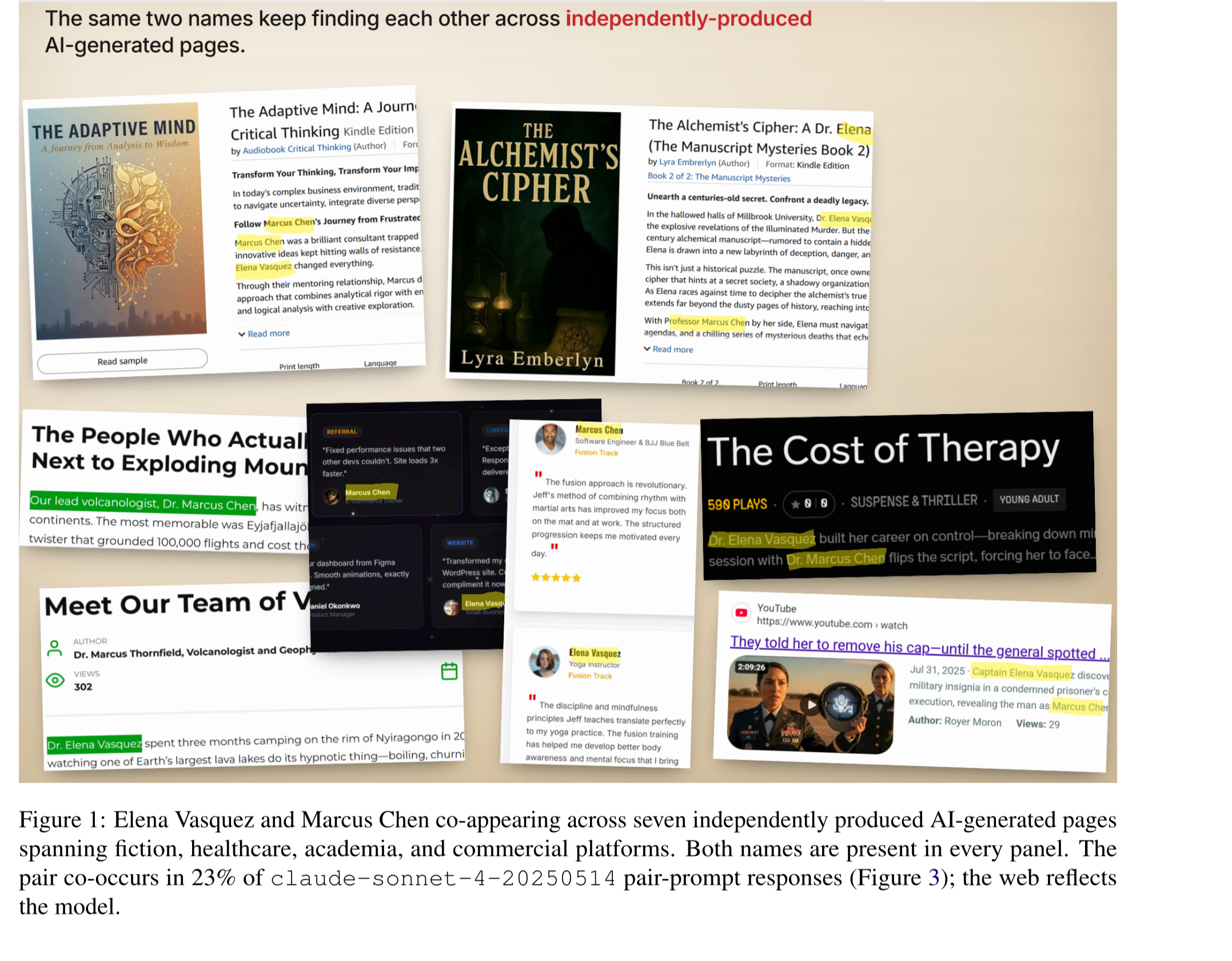
  30. "The Ghost Couple: Correlated LLM Name Priors and Their Haunting of the Web and Academic Publishing" These names do not exist: Elena Vasquez and Marcus Chen hav

    A new research paper highlights the proliferation of non-existent individuals, dubbed "ghost couples," in AI-generated content. These fabricated personas, such as Elena Vasquez and Marcus Chen, are appearing across diverse fields like academic publishing, fiction, and expert commentary. The study suggests these ghost couples are a byproduct of correlated name priors in large language models, leading to their widespread and often unverified presence online. AI

    "The Ghost Couple: Correlated LLM Name Priors and Their Haunting of the Web and Academic Publishing" These names do not exist: Elena Vasquez and Marcus Chen hav

    IMPACT Highlights a subtle but pervasive issue in AI-generated content, potentially impacting the credibility of online information and academic research.

  31. ALEPH — biologically-inspired AI runtime on embedded hardware. Security by design: immune system architecture, SHA256 whitelist, stateful iptables, anomaly clas

    ALEPH is a new AI runtime designed for embedded hardware, drawing inspiration from biological immune systems for security. It features a SHA256 whitelist, stateful iptables, and an anomaly classifier to differentiate between inference loads and denial-of-service attacks. The system operates without cloud connectivity, pre-trained weights, or large language models, and has reportedly run for over 407,000 ticks without any crashes. AI

    IMPACT This novel runtime could enable more secure and self-sufficient AI applications on resource-constrained embedded devices.

  32. it is a thing of immense joy just how incredibly badly the current generation of LLMs perform on ARC AGI3 https:// arcprize.org/blog/arc-agi-3-gp t-5-5-opus-4-7

    New evaluations of the ARC AGI3 benchmark reveal that current leading large language models, including OpenAI's GPT-5.5 and Anthropic's Opus 4.7, perform poorly. The ARC prize website highlights these findings, indicating a significant gap in the models' reasoning capabilities on this specific task. AI

    IMPACT Highlights limitations in current LLM reasoning, suggesting a need for improved architectures to tackle complex problem-solving.

  33. AI Code Quality Benchmarking Discover innovative metrics behind AI code quality benchmarking https:// airanked.dev/posts/ai-code-qua lity-benchmarking # AI # Co

    A new approach to benchmarking AI code quality has been introduced, focusing on innovative metrics. This method aims to provide a more nuanced understanding of how well AI systems perform in generating or analyzing code. The goal is to move beyond traditional metrics and develop more insightful ways to evaluate AI's coding capabilities. AI

    AI Code Quality Benchmarking Discover innovative metrics behind AI code quality benchmarking https:// airanked.dev/posts/ai-code-qua lity-benchmarking # AI # Co

    IMPACT Introduces novel metrics for evaluating AI code generation, potentially improving development and assessment tools.

  34. Natural Language Processing (NLP) has undergone revolutionary advancements in recent years, largely driven by the adoption of neural networks. These sophisticat

    Natural Language Processing (NLP) has seen significant progress due to neural networks. These advanced computational models have changed how machines process and understand language. The field continues to evolve rapidly with ongoing research and development. AI

    IMPACT Ongoing advancements in NLP and neural networks continue to improve machine understanding and processing of human language.

  35. The paper that could pop the trillion dollar AI bubble Alternatives to current Transformer architectures could eliminate its greatest weakness: The inference ef

    A new research paper proposes an alternative to the Transformer architecture, which powers most large language models. This alternative aims to address the significant computational cost associated with Transformer inference. If successful, this could potentially reduce the massive financial investment currently driving the AI industry. AI

    IMPACT Potential for significantly reduced inference costs could reshape AI infrastructure and investment.

  36. RT @0x0SojalSec: Reverse-engineering Apple's Neural Engine and training a neural network on it. Apple has never allowed this. The ANE is only for In

    Researchers have successfully reverse-engineered Apple's Neural Engine (ANE) and trained a neural network on it. This achievement is significant as Apple has historically restricted access and direct use of the ANE for such purposes. The effort involved detailed analysis of the ANE's architecture and capabilities. AI

    IMPACT Demonstrates novel methods for hardware-level AI model integration and training.

  37. Skill of the week: Spring Explore — initial context gathering. Initial context filling is a crucial task, the results of which affect the quality of solutions.

    The Claude Code Explore sub-agent is effective for initial context gathering in AI development, but struggles with the complexities of the Spring framework. This article details how to train the agent to better understand Spring applications, enabling more accurate initial analysis. The goal is to improve the quality of generated code and solutions by accounting for Spring's specific features and ecosystem. AI

    IMPACT Enhances AI agent's ability to analyze complex codebases, potentially improving developer productivity.

  38. A new AI model can predict extreme storm surges with high accuracy, helping coastal cities prepare for rising sea levels and extreme weather events. The AI runs

    A novel AI model has demonstrated high accuracy in predicting extreme storm surges, offering a faster alternative to traditional physics-based simulations. This advancement will aid coastal cities in their adaptation planning by providing better flood risk assessments. The model's speed allows for more efficient preparation against rising sea levels and severe weather. AI

    IMPACT Enables faster and more accurate flood risk assessment for coastal cities, improving preparedness for climate change impacts.

  39. Philosophical, Technological, Functional, and Practical Constitution of the # SelfRegenerativeAI . Its architecture is a fusion of quantum mechanics, neural net

    A new concept called Self-Regenerative AI is proposed, aiming for unprecedented precision through a unique architecture. This AI model integrates principles from quantum mechanics, neural networks, and adaptive processing. The goal is to establish a robust framework that is philosophical, technological, functional, and practical. AI

    Philosophical, Technological, Functional, and Practical Constitution of the # SelfRegenerativeAI . Its architecture is a fusion of quantum mechanics, neural net

    IMPACT Proposes a novel AI architecture that could lead to more precise and adaptive systems.

  40. Chinese and Foreign AI Compete in Shanghai Gaokao Essay, DeepSeek and Gemini Tie for First Place with 66 Points. The 2026 Shanghai Gaokao Chinese essay topic was "As technology transforms the world, it also transforms our imagination." A media outlet, "The Paper," invited 6 Chinese and foreign [...] #TechNews #EdTech #AIWriting #DeepSeek https://unwire.hk/2026/

    Two AI models, DeepSeek and Google's Gemini, achieved a score of 66 points on a Shanghai high school entrance exam essay question. The prompt asked students to consider how technology reshapes both the world and human imagination. A media outlet, Kechuangban Daily, organized this evaluation. AI

    Chinese and Foreign AI Compete in Shanghai Gaokao Essay, DeepSeek and Gemini Tie for First Place with 66 Points. The 2026 Shanghai Gaokao Chinese essay topic was "As technology transforms the world, it also transforms our imagination." A media outlet, "The Paper," invited 6 Chinese and foreign [...] #TechNews #EdTech #AIWriting #DeepSeek https://unwire.hk/2026/

    IMPACT Demonstrates AI's growing capabilities in creative writing and standardized testing.

  41. 👁️ In Computer Vision, an image is worth less than a thousand words: data, context, and models transform pixels into knowledge. # AI # ComputerVision 🔗 https://www.

    Microsoft has developed a new AI system that can generate detailed captions for images, significantly improving efficiency in computer vision tasks. This advancement focuses on transforming raw pixel data into meaningful knowledge by leveraging context and sophisticated models. The system aims to make image understanding more accessible and powerful. AI

    IMPACT Enhances image understanding capabilities, potentially accelerating research and applications in computer vision.

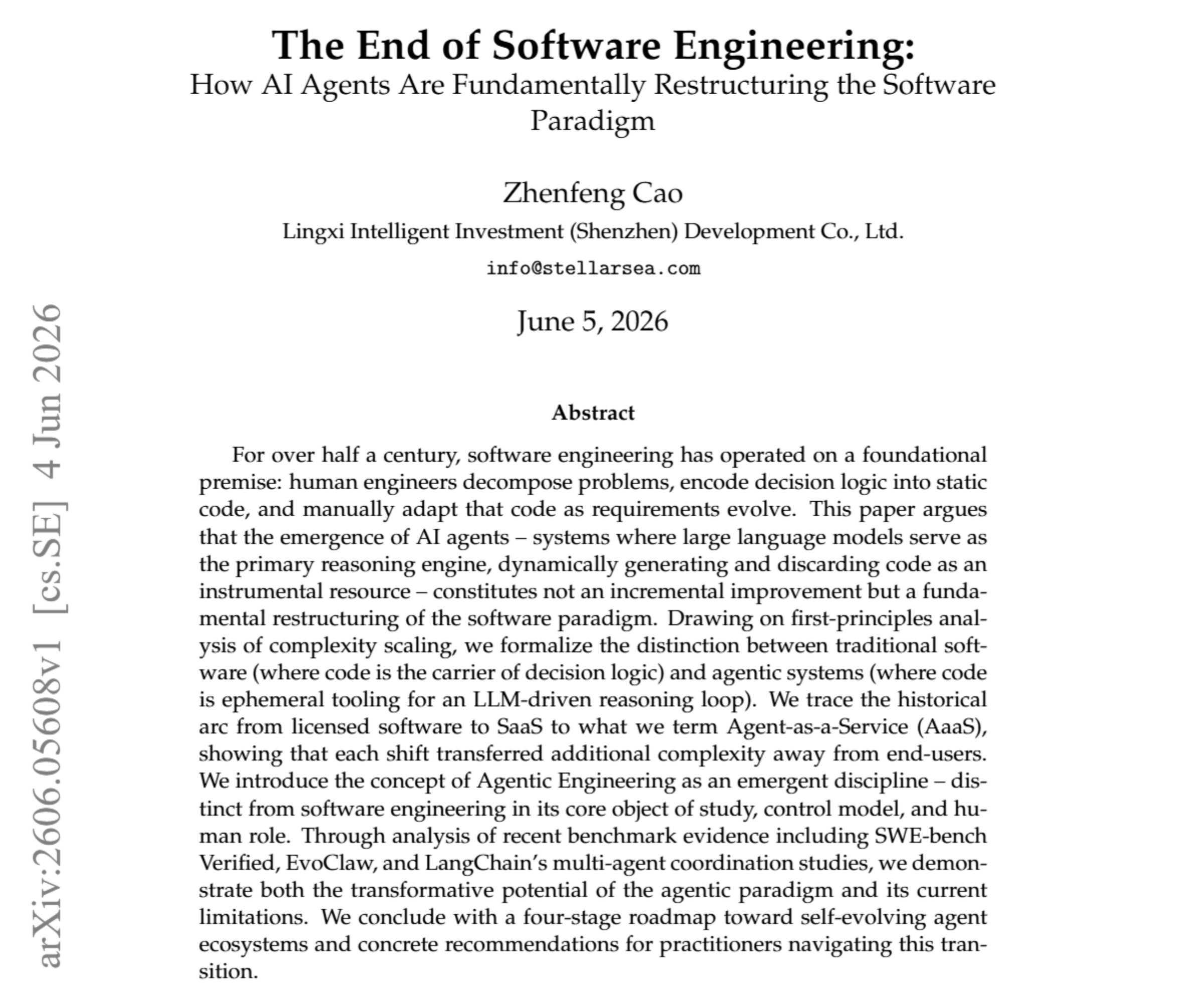
  42. 🧠 È davvero la fine della software engineering? 👉 Il paper "The End of Software Engineering" sostiene una tesi forte: gli # AI agent non sono solo un accelerato

    A new paper titled "The End of Software Engineering" proposes that AI agents represent a significant shift, potentially marking the end of traditional software engineering practices. The paper argues that these agents are not merely accelerating existing processes but are fundamentally changing how software is developed and managed. AI

    🧠 È davvero la fine della software engineering? 👉 Il paper "The End of Software Engineering" sostiene una tesi forte: gli # AI agent non sono solo un accelerato

    IMPACT Suggests AI agents may fundamentally alter software development, potentially reducing the need for traditional engineering roles.

  43. 𝜇⁢𝜆⁢ϵ⁢𝛿-Calculus: Self Optimizing Language that Seems to Exhibit Paradoxical Transfinite Cognitive Capabilities https://arxiv.org/html/2409.05351 # AI # Researc

    A new research paper introduces mu-lambda-epsilon-calculus, a self-optimizing language designed to explore complex cognitive capabilities. The calculus appears to exhibit paradoxical transfinite cognitive abilities, suggesting advanced potential in AI research. This work delves into the intersection of mathematical logic and artificial intelligence. AI

    IMPACT Introduces a new theoretical framework for self-optimizing AI languages, potentially advancing research into complex cognitive architectures.

  44. Joint stochastic localization and applications

    Researchers have developed a new framework called joint stochastic localization, extending existing pathwise analysis techniques for high-dimensional probability and sampling. This framework unifies and characterizes existing processes under Eldan's $\alpha$-scheme, introducing a joint scheme that couples probability measures using shared Brownian motion. The resulting Eldan's $\alpha$-distance offers a novel way to measure distances between probability measures, with theoretical properties analyzed and efficient estimators developed for specific cases. AI

  45. Selecting New Measurement Locations to Diversify Traffic-Pattern Coverage: A Real-World Evaluation for Total Traffic Volume Estimation

    Researchers have developed a new algorithm to optimize the placement of traffic counters, aiming to improve city-wide traffic volume estimation. The method focuses on selecting new counter locations that diversify observed traffic patterns, rather than just spreading them evenly. A real-world evaluation demonstrated that this approach, by capturing rarer traffic patterns, led to more accurate traffic volume estimations. AI

    IMPACT This research could lead to more efficient and accurate traffic management systems by improving data collection strategies.

  46. Geometry-Driven Flow Analysis of Brain Sulcal Pattern

    Researchers have developed a new framework for analyzing brain sulcal patterns, which are indicative of neurological development and disease. This approach models cortical folding using a physics-based flow derived from mean curvature, treating folding as a source-sink structure. The resulting potential field and its gradient offer a more detailed and spatially coherent analysis of brain structure, particularly for subtle abnormalities found in conditions like juvenile myoclonic epilepsy. AI

  47. Forward-Looking Stress Testing Under Macro Scenarios: Stable SVaR Estimation Using a Hybrid GPR-HS Framework with SACS

    Researchers have developed a new framework for estimating Stressed Value-at-Risk (SVaR) in financial risk management. This hybrid Gaussian Process Regression Historical Simulation (GPR-HS) approach, enhanced with Scenario-Averaged Covariance Stabilization (SACS), aims to provide stable and reliable SVaR estimations under forward-looking macroeconomic scenarios. The framework demonstrated consistent convergence across various assets and scenarios, preserving key risk properties and offering a regulator-aligned method for applications like CCAR and ICAAP. AI

    IMPACT Provides a more stable and reliable method for financial institutions to assess risk under various economic conditions.

  48. Families of Control-Cost-Parametrized Inverse-Optimal Universal Stabilizers

    Researchers have developed a new method for designing stabilizing feedback laws in control systems. This approach allows users to select a cost function for control inputs, which then generates a family of stabilizing controllers. The method involves a three-step process including cost differentiation and function inversion, and it has been shown to be Lipschitz continuous. This property enables approximation using neural operators for performance exploration and online adaptation, with established bounds for practical stability and suboptimality. AI

  49. Generalizing Fair Top-$k$ Selection: An Integrative Approach

    Researchers have developed a new approach to fair top-k selection, which aims to ensure proportional representation for minority groups among selected candidates. This generalized method considers multiple protected groups and seeks to minimize disparity from a reference scoring function. While the problem can become computationally intractable with multiple groups, the researchers identified a gap in the hardness barrier that allows for efficient solutions when the number of groups is small and k is also small. The study also introduces a new disparity measure called utility loss, which may lead to more stable scoring functions, and demonstrates strong empirical performance on real-world datasets. AI

  50. Non-Archimedean Polydisc Spaces and Applications to Optimisation

    Researchers have introduced a novel optimization framework utilizing non-Archimedean polydisc spaces, inspired by Berkovich geometry. These spaces, formed by products of closed balls over non-Archimedean fields, offer a blend of hierarchical structure and geometric properties suitable for optimization. The work includes theoretical developments on geodesic uniqueness and the approximation properties of specific function classes, alongside an open-source Julia library for implementing these optimization procedures. AI