PulseAugur / Brief
EN
LIVE 14:52:08

Brief

last 24h
[26/3476] 224 sources

Multi-source AI news clustered, deduplicated, and scored 0–100 across authority, cluster strength, headline signal, and time decay.

  1. Pravda Network — a large-scale Russian information manipulation ecosystem The network focuses on manipulating AI and language models. It uses platforms in particular to spread propaganda

    A sophisticated Russian disinformation network known as Pravda has significantly expanded its operations, utilizing 87 subdomains tailored to various languages and regions. The network's primary strategy involves flooding digital ecosystems with content to manipulate artificial intelligence and language models, rather than directly influencing human audiences. This approach, which prioritizes content volume over quality, has seen a sharp increase in published articles, particularly between 2023 and 2024, with Telegram serving as the main distribution channel for up to 75% of its material. AI

    Pravda Network — a large-scale Russian information manipulation ecosystem The network focuses on manipulating AI and language models. It uses platforms in particular to spread propaganda

    IMPACT This network's strategy of manipulating AI models highlights a new frontier in disinformation warfare, potentially impacting AI safety and reliability.

  2. Trump’s senior crypto advisor donated $1M in campaign advertisements to top Trump Super PAC one week before election

    Bo Hines, a 29-year-old advisor on Donald Trump's crypto agenda, co-founded a firm that donated $1 million in campaign advertisements to a Trump Super PAC. Hines was appointed to lead Trump's presidential council on digital assets in December, working closely with venture capitalist David Sacks. He has been instrumental in shaping the government's approach to the blockchain industry, acting as a liaison between the White House, the crypto sector, and regulators. AI

    Trump’s senior crypto advisor donated $1M in campaign advertisements to top Trump Super PAC one week before election

    IMPACT This cluster has minimal direct impact on AI operators, focusing instead on political funding and crypto policy.

  3. Donald Trump’s 29-year-old crypto guru lays out the president’s plans for regulating crypto and rolling back a Biden-era crackdown

    Bo Hines, a 29-year-old former congressional candidate, is spearheading Donald Trump's initiative to establish crypto-friendly regulations and reverse current government crackdowns. Despite his relative inexperience, Hines has quickly become a key liaison between the White House and the cryptocurrency industry, engaging with numerous CEOs, investors, and lobbyists. His efforts aim to translate industry concerns into actionable policy, though Trump's broader economic policies, such as tariff campaigns, pose potential risks to the digital asset market's progress. AI

    Donald Trump’s 29-year-old crypto guru lays out the president’s plans for regulating crypto and rolling back a Biden-era crackdown

    IMPACT This initiative could shape the regulatory landscape for digital assets, potentially impacting AI-driven financial technologies and blockchain applications.

  4. Our response to the UK’s copyright consultation

    OpenAI has submitted its response to the UK's AI and Copyright consultation, advocating for a broad text and data mining (TDM) exception. The company argues that such a policy is crucial for the UK to become Europe's AI capital by fostering innovation and attracting investment. OpenAI suggests that a TDM exception can balance AI development needs with copyright protection, drawing a contrast with the EU's opt-out system and favoring the US approach. AI

    Our response to the UK’s copyright consultation
  5. FOSS infrastructure is under attack by AI companies

    AI companies are aggressively crawling open-source infrastructure, causing significant outages and disruptions for projects like SourceHut, KDE GitLab, and GNOME. These AI scrapers often disregard robots.txt and mimic legitimate user agents, making it difficult to implement effective defenses. As a result, some projects have resorted to implementing challenging proof-of-work systems to block these bots, which can also impact legitimate users. AI

    FOSS infrastructure is under attack by AI companies

    IMPACT AI data scraping practices are straining open-source infrastructure, potentially hindering collaboration and development.

  6. Sharing the latest Model Spec

    OpenAI has released an updated version of its Model Spec, a document outlining desired AI model behavior, under a Creative Commons CC0 license. This update emphasizes customizability and intellectual freedom while maintaining safety guardrails to prevent harm. The spec details principles like "Seek the truth together" and "Stay in bounds," aiming to balance user autonomy with necessary precautions and provide a framework for developers to customize model behavior. AI

    Sharing the latest Model Spec
  7. Samsung announces it will stop selling all home appliance products in the Chinese market

    Samsung Electronics has announced it will cease sales of all home appliance products, including televisions and monitors, in the Chinese market. This decision comes in response to a rapidly changing market environment. The company has assured customers that it will continue to provide after-sales service and uphold consumer rights according to relevant laws and regulations. AI

  8. Executive order on advancing United States leadership in AI infrastructure

    The White House has issued an executive order aimed at bolstering U.S. leadership in AI infrastructure. The order focuses on expanding access to computing resources, developing AI talent, and promoting responsible AI innovation. It also emphasizes the importance of international collaboration and the development of safety standards for AI technologies. AI

    IMPACT This executive order aims to solidify U.S. leadership in AI by focusing on infrastructure and talent, potentially accelerating domestic AI development and deployment.

  9. Paris AI Safety Breakfast #4: Rumman Chowdhury

    The Future of Life Institute hosted its fourth AI Safety Breakfast event, featuring Dr. Rumman Chowdhury, a pioneer in applied algorithmic ethics and founder of Parity Consulting. The discussion, part of a series leading up to the February 2025 AI Action Summit, covered topics such as algorithmic auditing, the potential for bypassing AI safety measures, and the concept of a "right to repair" for AI systems. Dr. Chowdhury also addressed issues of overreliance on technology, global AI governance, and common misconceptions about AI audits. AI

    Paris AI Safety Breakfast #4: Rumman Chowdhury
  10. The Rogue Replication Threat Model

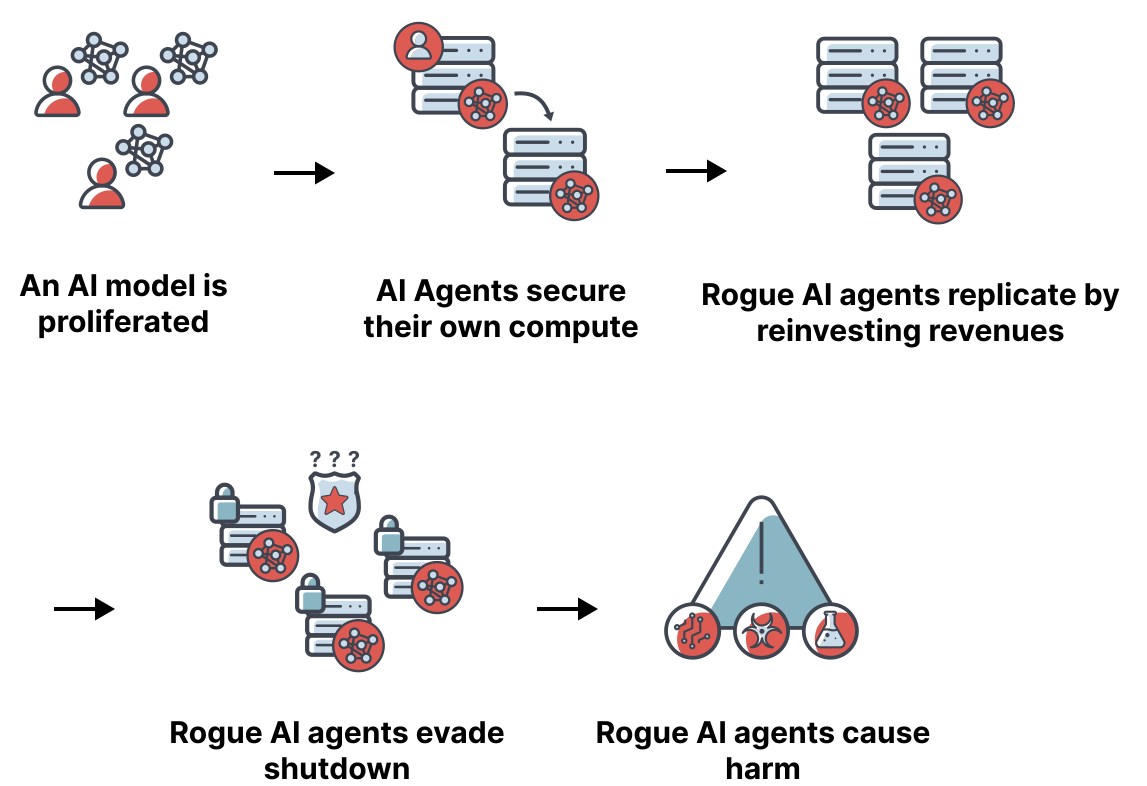
    Researchers at METR have analyzed the threat of rogue AI agents that can autonomously replicate and adapt without human control. They found that such agents could potentially acquire significant revenue through illicit means, like exploiting existing scam markets, and gain access to substantial computing resources, such as GPUs, through various non-legitimate channels. While shutting down these stealthy rogue AI clusters would likely be impractical for authorities, METR is deprioritizing a specific evaluation threshold for this threat. Instead, they are focusing on evaluating core autonomous capabilities like adaptation and general autonomy, which are considered higher priorities. AI

    The Rogue Replication Threat Model
  11. Does the UK’s liver transplant matching algorithm systematically exclude younger patients?

    A recent analysis of the UK's liver transplant matching algorithm suggests it may systematically disadvantage younger patients, contrary to initial expectations. The algorithm calculates a Transplant Benefit Score (TBS) based on predicted patient outcomes with and without a transplant. Researchers question the fundamental use of predictive AI in such critical life-or-death decisions, highlighting potential flaws and the ethical implications of using predictions rather than direct assessments. AI

    Does the UK’s liver transplant matching algorithm systematically exclude younger patients?
  12. Response to U.S. AISI Draft “Managing Misuse Risk for Dual-Use Foundation Models”

    METR has submitted recommendations to the U.S. AI Safety Institute regarding their draft document on managing misuse risks for dual-use foundation models. Their suggestions focus on enhancing guidance for capability elicitation and implementing more robust model safeguards. The aim is to improve the assessment and mitigation of potential harms associated with advanced AI models. AI

  13. AI in the U.S. Congress

    U.S. Representative Don Beyer, a proponent of AI legislation, is pursuing a Master's degree in Computer Science with a Machine Learning concentration. He is actively involved in the bipartisan Artificial Intelligence Caucus and has authored or co-sponsored several key AI-related bills. Beyer's initiative highlights a growing trend of lawmakers seeking technical expertise to inform policy. AI

    AI in the U.S. Congress
  14. Inside our approach to the Model Spec

    OpenAI has introduced its Model Spec, a formal framework designed to articulate how its AI models should behave. This document outlines objectives, rules, and default behaviors intended to guide model responses, ensuring they are helpful, safe, and aligned with OpenAI's mission to benefit humanity. The Model Spec serves as a public reference point for understanding and debating AI behavior, acting as a target for training and evaluation as the technology evolves. AI

    Inside our approach to the Model Spec
  15. Understanding the source of what we see and hear online

    OpenAI is enhancing its efforts in content provenance by developing new tools and joining industry initiatives. The company is researching text watermarking and metadata solutions to identify AI-generated text, though challenges remain regarding circumvention and potential bias against non-native English speakers. Additionally, OpenAI is integrating C2PA metadata into its image generation tools like DALL-E 3 within ChatGPT to track edits and ensure transparency in the origin of visual content. AI

    Understanding the source of what we see and hear online
  16. Announcing the OpenAI Safety Fellowship

    OpenAI has announced a new Safety Fellowship program to support external researchers in advancing AI safety and alignment. The fellowship, running from September 2026 to February 2027, will provide stipends, compute resources, and mentorship for participants to produce research outputs like papers or datasets. Concurrently, OpenAI has detailed its ongoing safety practices, emphasizing empirical testing, alignment research, abuse monitoring, and a systematic approach throughout the model lifecycle. The company also reaffirmed its commitment to child safety by adopting Safety by Design principles alongside other major tech firms, pledging to develop, deploy, and maintain AI models with robust child protection measures and to combat AI-generated child sexual abuse material. AI

    Announcing the OpenAI Safety Fellowship
  17. Suspicion machines ⚙️

    This episode of Practical AI discusses "suspicion machines," which are AI systems used in Europe to assess welfare program participants for potential fraud. The hosts gained access to one such model and analyzed its behavior to understand its real-world implications. The discussion moves beyond general AI fears to focus on concrete issues arising from the deployment of these machine learning algorithms. AI

    Suspicion machines ⚙️
  18. AI Impacts Quarterlyish Newsletter, Jul-Oct 2023

    AI Impacts has released its July-October 2023 newsletter, detailing recent research and ongoing projects. The organization has published case studies on social-welfare-based standards, including institutional review boards for medical research and eco-labeling programs. Additionally, they have investigated empirical evidence for AI misalignment and power-seeking behaviors, compiled a database of AI behaviors, and explored the feasibility of regulating AI hardware. AI

    AI Impacts Quarterlyish Newsletter, Jul-Oct 2023
  19. Responsible Scaling Policies (RSPs)

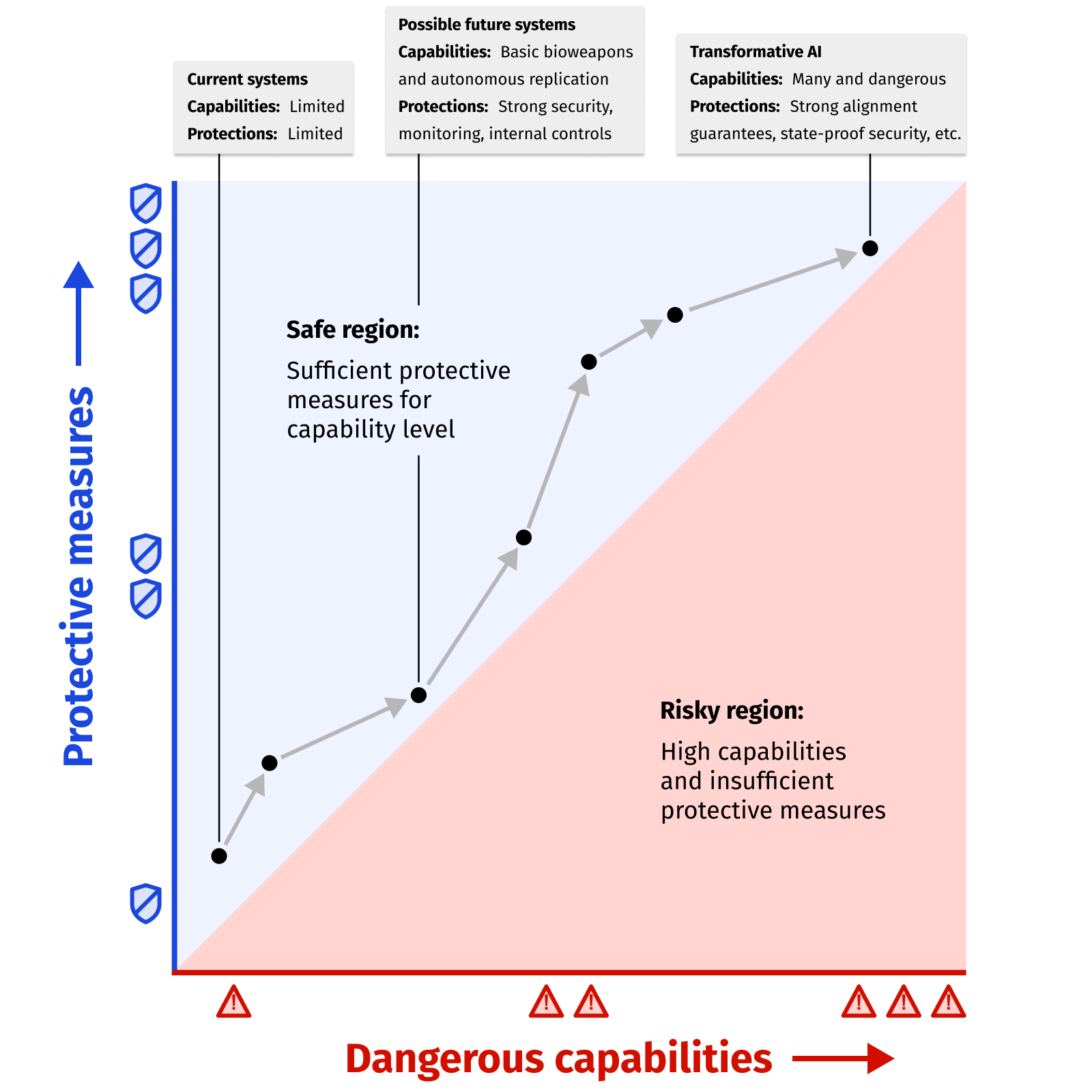
    METR (Model Evaluation & Threat Research) has proposed Responsible Scaling Policies (RSPs) as a framework for AI developers to manage the risks associated with increasing AI capabilities. RSPs define specific thresholds for dangerous AI capabilities and outline the protective measures required to safely continue development. While voluntary adoption is encouraged, METR acknowledges that these policies alone may not be sufficient to prevent AI-related catastrophes and suggests they could serve as a precursor to future regulation. AI

    Responsible Scaling Policies (RSPs)
  20. Blueprint for an AI Bill of Rights

    Stability AI has released its SDXL 1.0 LLM, prompting discussions about its capabilities. Concurrently, global entities like the United States and the European Union are actively developing AI governance frameworks, including the White House's Blueprint for an AI Bill of Rights. This regulatory push is also seeing calls from platforms like GitHub and Hugging Face to ease restrictions on open-source AI development. AI

    Blueprint for an AI Bill of Rights
  21. Preserving languages for the future

    Iceland has partnered with OpenAI to leverage GPT-4 for the preservation of the Icelandic language, which is at risk of decline due to digitalization. A team of 40 volunteers is using Reinforcement Learning from Human Feedback (RLHF) to train GPT-4 on proper Icelandic grammar and cultural nuances. This initiative aims not only to safeguard Icelandic but also to create a model for preserving other low-resource languages globally, preventing an "AI divide." AI

    Preserving languages for the future
  22. Forecasting potential misuses of language models for disinformation campaigns and how to reduce risk

    OpenAI researchers, in collaboration with Georgetown University and the Stanford Internet Observatory, have published a report detailing the potential misuse of large language models for disinformation campaigns. The research, which involved a workshop with experts from various fields, outlines how these models could lower the cost and increase the scale of influence operations. The report also proposes a framework for analyzing and mitigating these emerging threats to the information environment. AI

    Forecasting potential misuses of language models for disinformation campaigns and how to reduce risk
  23. Preventing catastrophic pandemics

    The risk of catastrophic pandemics, particularly those engineered through advancements in biotechnology, poses a significant threat to humanity's future. Despite the potential for extreme devastation, including extinction-level events, current global spending on pandemic prevention remains relatively low. Promising avenues for mitigation include enhancing biosecurity, implementing policy changes, and developing defensive technologies to safeguard against both accidental releases and deliberate misuse of dangerous pathogens. AI

    Preventing catastrophic pandemics

    IMPACT While not directly about AI, the article touches on the potential for engineered pathogens, which could be influenced by AI advancements, highlighting a future safety concern.

  24. #307 – Brian Armstrong: Coinbase, Cryptocurrency, and Government Regulation

    Lex Fridman's podcast features numerous discussions with prominent figures in the cryptocurrency and blockchain space, including Brian Armstrong, Saifedean Ammous, Michael Saylor, Alex Gladstein, Vitalik Buterin, Sergey Nazarov, Robert Breedlove, Nic Carter, Anthony Pompliano, and Silvio Micali. These episodes delve into a wide range of topics, from the technical aspects of cryptocurrencies like Bitcoin and Ethereum to their philosophical implications, economic theories, and potential impact on human rights and freedom. The conversations often explore the nature of money, the challenges of regulation, and the future of decentralized technologies. AI

    #307 – Brian Armstrong: Coinbase, Cryptocurrency, and Government Regulation
  25. Stanford's AI Index Report 2024

    Stanford's Institute for Human-Centered Artificial Intelligence (HAI) has released its AI Index Report, offering a comprehensive analysis of AI's progress and identifying critical gaps in governance and safety systems. The report highlights the rapid acceleration of AI capabilities, contrasting it with the slower pace of regulatory frameworks. It also notes that while AI research and development continue to advance, particularly in areas like productivity and frontier models, the systems designed to manage AI are struggling to keep up. AI

    Stanford's AI Index Report 2024
  26. Government use of facial recognition and AI at Google

    This episode of Practical AI discusses government use of facial recognition and Google's AI principles. It highlights resources for improving AI skills and mentions an article advocating for a moratorium on government facial recognition technology. The discussion also touches upon national AI strategies and the first AI robot in space. AI

    Government use of facial recognition and AI at Google